'Leap' solar tech uses heat-wasting energy to power 130% yield
New “spin-flip” emitter harvests energy previously lost as wasteful heat, yields 130%
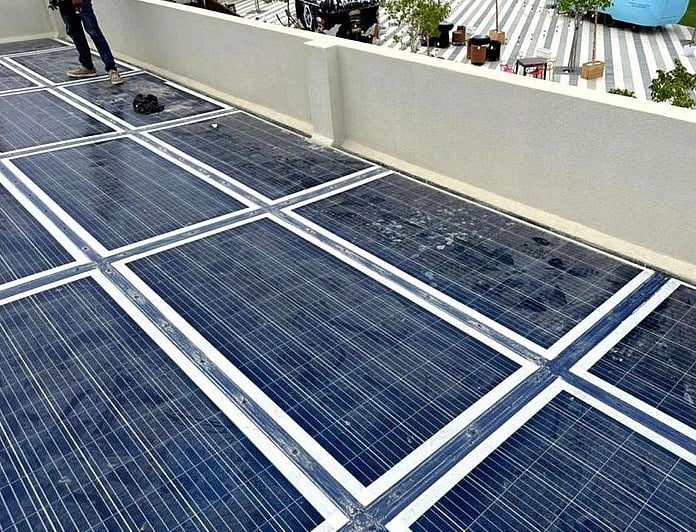
In a stunning leap that shatters decades of scientific “impossibility,” researchers have achieved what was for long dubbed an "unthinkable" solar technology.
A new “spin-flip” emitter material harvests energy previously lost as wasteful heat, pushing quantum yields to a mind-blowing 130%.
The breakthrough could revolutionise renewable energy, slashing costs and supercharging the global shift away from fossil fuels.
What we know so far:
What is this new solar technology breakthrough all about?
Researchers at Kyushu University in Japan, working with Johannes Gutenberg University Mainz in Germany, have developed a molybdenum-based “spin-flip” emitter material that captures extra energy normally lost as heat in solar cells.
By using singlet fission (a process where one high-energy photon generates two lower-energy excitons), the system achieves a quantum yield of about 130% — meaning more excitons are produced than photons absorbed.
This is the first practical demonstration of harvesting singlet-fission-amplified excitons with a near-infrared emissive metal complex in solution.
How does singlet fission and the 'spin-flip' emitter work?
Traditional solar cells lose energy from high-energy photons (e.g., blue light) as heat because one photon typically creates only one exciton.
Singlet fission splits that photon’s energy into two triplet excitons.
That means, until now, standard solar cells capture only about one exciton per photon of light, with higher-energy photons like blue light simply dissipating as heat.
Conventional panels top out at around 20-25% real-world efficiency due to this fundamental limit.
The challenge has been efficiently capturing those extra triplets without wasting them.
The new molybdenum-based “spin-flip” emitter selectively harvests these triplet excitons by changing electron spin states, pairing effectively with tetracene-based materials to reach ~130% quantum yield.
By using singlet fission — a “dream” process where one high-energy photon splits into two lower-energy excitons — the new molybdenum-based spin-flip emitter flips electron spins to capture that extra energy.
The result: More excitons generated than photons absorbed, breaking the 100% quantum yield barrier for the first time in a practical setup.
Who led the research and where was it published?
The work was led by Associate Professor Yoichi Sasaki at Kyushu University’s Faculty of Engineering, with collaborators including researchers from Germany.
It was published in the Journal of the American Chemical Society on March 25, 2026 (DOI: 10.1021/jacs.5c20500), titled “Exploring Spin-State Selective Harvesting Pathways from Singlet Fission Dimers to a Near-Infrared-Emissive Spin-Flip Emitter."
The discovery builds on years of singlet fission research but finally delivers a stable, near-infrared emissive harvester that works in solution with tetracene-based materials.
Lead researcher Yoichi Sasaki called it one of two key strategies to smash efficiency walls, alongside up-conversion of infrared light, as per Science Daily.
What does this mean for solar energy efficiency and real-world impact?
Conventional single-junction solar cells are limited by the Shockley-Queisser limit (~33% theoretical maximum), with real-world panels often at 20-25% due to heat loss.
SHOCKLEY-QUEISSER LIMIT: Solar power has long been hailed as key to combating climate change, yet efficiency ceilings have slowed widespread adoption. The Shockley-Queisser limit for single-junction cells hovered around 33% theoretically — until now.
This demonstrates a key strategy (alongside infrared up-conversion) to exceed 100% quantum yield in exciton harvesting, potentially leading to much higher-efficiency panels.
It could reduce land use, lower costs, decrease reliance on rare materials, and accelerate the shift from fossil fuels.
Are there any skeptical views or limitations?
Experts note this is peer-reviewed proof of concept, not yet a commercial product.
That means it remains at the lab scale (solution-based) for now. Scalability and integration into actual devices are the next hurdles.
While it shatters the “one-photon, one-exciton” ceiling in a controlled setup, translating it to stable, large-scale solar panels will require further engineering.
Still, it’s widely seen as a major step forward in overcoming long-standing efficiency barriers, and the implications are enormous, say experts.
It arrives at a critical moment as nations race to meet net-zero targets amid rising energy demands.
While still lab-scale, the technology paves the way for commercial panels that could make solar cheaper than ever — potentially ending energy scarcity debates.
Skeptics note that scalability hurdles remain, this isn’t hype: it’s peer-reviewed proof that renewables just got a massive upgrade.
The planet’s clean energy future just accelerated dramatically.
Sign up for the Daily Briefing
Get the latest news and updates straight to your inbox
Network Links
GN StoreDownload our app
© Al Nisr Publishing LLC 2026. All rights reserved.