Ford Territory self-charging hybrid SUV has made its global debut in the Philippines with a starting price of Php1,399,000 ($24,000) for the Trend trim.
Ford's $40K EV revolution: 5 affordable 'game-changers' on target
Deloitte study warns 52% of shoppers balk at EVs over $40,000 sticker price
Last updated:
3 MIN READ
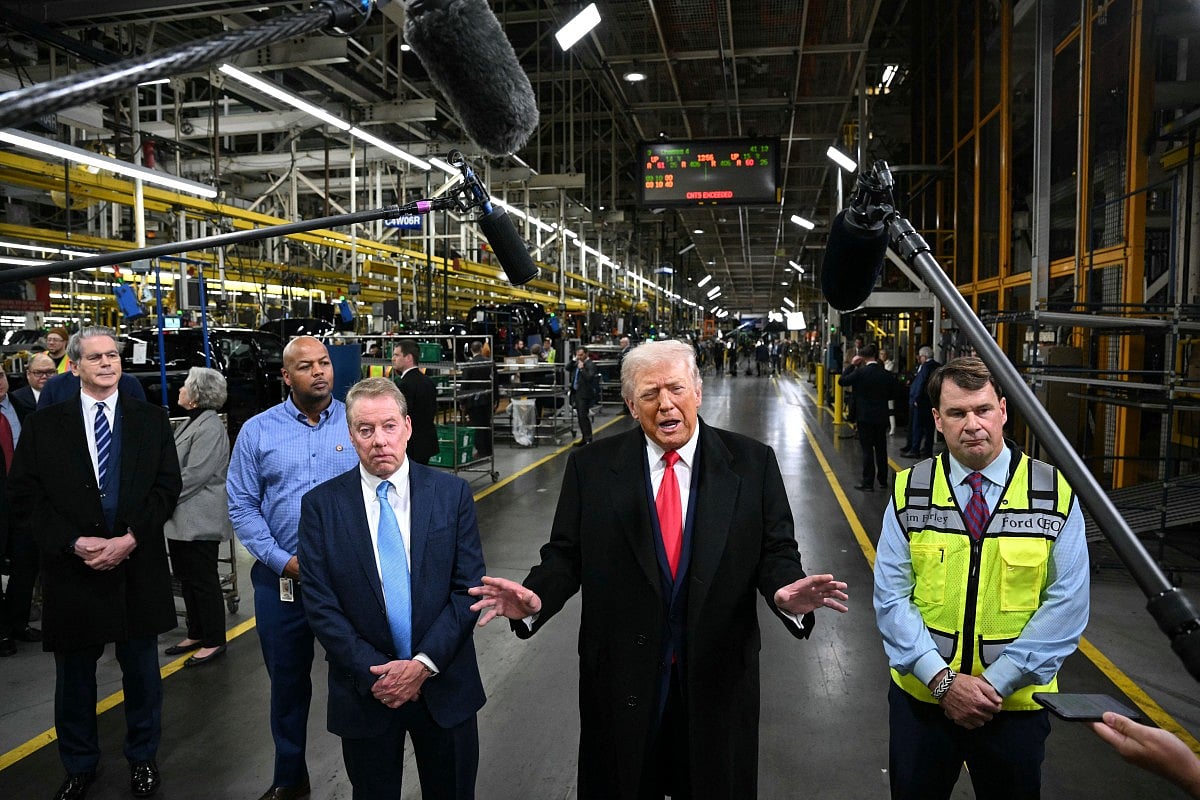
US President Donald Trump speaks alongside Ford executive chairman Bill Ford (3rd L), Ford CEO Jim farley, Treasury Secretary Scott Bessent (L) and plant manager Corey Williams as he tours Ford Motor Company's River Rouge complex in Dearborn, Michigan, on January 13, 2026.
AFP
Ford is ditching gas-guzzler glory for wallet-friendly wheels, plotting five new rides under $40,000 — including a mid-size electric pickup — to roll out into US showrooms by decade's end.
Gone are the days of trucks-only dominance.
Ford is reportedly investing roughly $5 billion in this strategy, including the BlueOval Battery Park in Michigan to secure its battery supply chain.
At the National Automobile Dealers Association (NADA) Show, Ford Blue and Model e President Andrew Frick spilled the electrified tea: expect fresh-name cars, trucks, SUVs, vans, and multi-energy marvels, as per Automotive News.
Lead-off star: 2027 Ford EV pickup
Kicking off the lineup is a mid-size electric pickup on Ford's shiny Universal EV Platform (UEV), teased by CEO Jim Farley as "one of Ford's most audacious projects."
Priced around $30,000, it boasts RAV 4-beating space, Model Y-crushing ownership costs, and China-beating innovation swagger.
Prototype sneak peeks already have gearheads buzzing.
Farley compared its significance to the Apollo or Gemini missions.
Key product details
Target price: The starting price is approximately $30,000. This is to compete with low-cost international rivals.
Performance: The targeted 0–60 mph acceleration is "as fast as a Mustang EcoBoost" (under 5 seconds).
Dimensions: It is expected to be sized closer to the Ford Maverick. However, it will offer interior passenger space comparable to a Toyota RAV4.
Utility: The design includes a front trunk (frunk) and a secure, lockable bed.
Timeline: Production is set to begin at the Louisville Assembly Plant in 2026. Customer deliveries are planned to start in 2027.
Universal EV (UEV) Platform
Ford's UEV platform represents a complete shift in manufacturing reminiscent of Tesla's strategy and focuses on cost-efficiency and simplification.
It pivots to a massvie structural redesign using large aluminum unicastings, consolidating 146 parts into just two, similar to Tesla’s "gigacasting" approach.
It also drives part reduction: The platform uses 20% fewer parts and 25% fewer fasteners than traditional vehicles.
It also utilises advanced wiring: the wiring harness is over 4,000 feet shorter and 22 pounds lighter than Ford's first-generation electric SUV the F-150 Lightning.
Battery tech
This is the most important component of the UEV platform, featuring lithium iron phosphate (LFP) prismatic batteries. These are cobalt- and nickel-free, which lowers costs and improve durability.
The battery pack serves as a structural floor, lowering the centre of gravity.
An "assembly tree" method — building three sections in parallel — could make assembly 40% faster than current processes at the Louisville plant.
Mystery quartet
Traditional 4-door sedan: Ford's first non-SUV/truck/van since the Fusion bowed out in 2020 (Mustang aside).
Trucks, SUVs, vans: Electrified vibes likely — hybrids or full EVs yet to be decided. All leverage the UEV's flexibility for "trucks, cars, and everything in between," as per Ford's blueprint.
Big-picture push: This affordability blitz anchors Ford's Ford+ plan, repopulating idled US plants amid EV price wars.
Frick's vow: Fill US plants with affordable new models.
It's a direct shot at Tesla, Toyota, and global rivals, betting hybrids and cheap EVs lure budget buyers.
Industry backdrop
The 2025 Deloitte Global Automotive Consumer Study warns 52% of shoppers balk at EVs over $40,000 sticker shock. This validates Ford's pivot.
It flags hybrids as the "sweet spot" for mass adoption, with 68% of US buyers eyeing electrified options under $45,000.
Ford's gamble aligns with affordability, volume and survival in a market where EV sales dipped 12% YoY amid subsidy flux, as per a Deloitte report in 2025.
Ford isn't just building cars — it's rebuilding the American road.
It's too early to say whether the $30,000 EV truck would steal Tacoma's thunder.
The $30,000 target price's inclusion of potential federal tax credits is unknown.
Sign up for the Daily Briefing
Get the latest news and updates straight to your inbox
Network Links
GN StoreAbout Gulf NewsTerms & ConditionsReach by GNSitemapContact usPrivacy PolicyGN FocusHave your sayWork with usAdvertise with usGulf News epaperPrinting Services
Download our app
© Al Nisr Publishing LLC 2026. All rights reserved.