Battery boom is here: How energy storage solves biggest knock against solar, wind
Batteries becoming a core part of keeping the lights on in the world’s 5th-largest economy
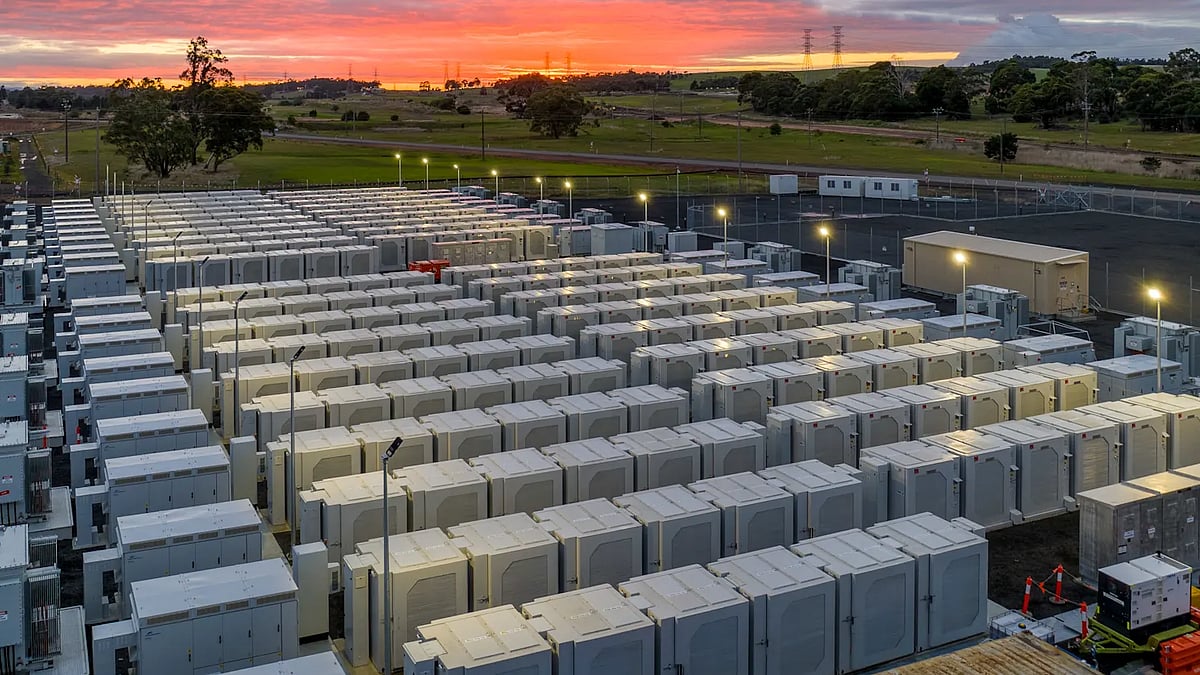
From humble powerbanks for everyday gadgets to gigawatt-rated packs, a new calculus is driving a serious rethink about batteries across the planet.
Giant energy storage banks have proven to be silent, fast-acting gladiators popping up everywhere energy storage needs to scale.
Grid operators, utilities, and policymakers worldwide are rolling out billions of dollars, while many more are making plans to harness a cleaner, more flexible power system for millions of electricity users.
New battery-based ecosystem
With batteries, a new "ecosystem" has emerged.
And it's booming.
Solar generating capacity has made a dramatic jump, from 228 gigawatts in 2015 (1% of the world's electricity) to 2,919 GW in 2025 (10% of the world's energy), more than nuclear at 9%, batteries solve the intermittency challenge of renewables, according to an industry report.
While wind and solar provide clean electricity, grid-scale batteries store excess energy to handle supply gaps.
EVs, too, now act as mobile storage via vehicle-to-grid (V2G) technology, stabilising the grid and accelerating the transition to renewable living.
And an emerging trend is becoming more compelling: where wind-solar-batteries are in use, power rates have gone down, as per latest industry data.
An example: the Hazelwood Battery Energy Storage System (HBESS), a 150MW/150MWh utility-scale lithium-ion battery in Victoria, Australia.
Commissioned in June 2023 and located at a former coal-fired power station, it stores electricity generated by solar and wind, improving grid stability, reducing peak demand strain, and supporting the state's transition to clean energy.
It's not just in Australia.
California just set a massive new record for battery storage on the grid, thereby showing the way for energy transition.
On March 29, 2026, California’s power grid (operated by CAISO) hit a striking milestone: battery storage delivered 12.3 gigawatts (GW) of electricity at 7pm PDT — supplying 42.8% of the entire state’s electricity demand at that moment.
That’s not just a brief spike. Batteries stayed above 20% of total grid supply for nearly four straight hours (from 5:50 PM to 9:35 PM), smoothing out the evening “ramp” when solar power drops off but people are still cooking, charging EVs, and turning on lights and AC.
What the data actually shows
Here’s what the data shows (sourced from GridStatus.io):
Batteries (purple): 12.29 GW → 42.8% of demand
Natural gas (blue): 5.97 GW → 20.8%
Large hydro (dark teal): 3.93 GW → 13.7%
Wind (green): 2.45 GW → 8.5%
Nuclear (light green): 2.27 GW → 7.9%
Everything else (geothermal, solar, biomass, etc.): the remaining ~6%
During the middle of the day solar dominates, but after sunset the grid needs something that can respond instantly.
Batteries did that — and at record scale.
By evening, solar (yellow) had already fallen to almost nothing, which is exactly why batteries matter.
How we got here so fast
Utilities and developers have raced to install giant lithium-ion battery systems (such as Tesla Megapacks and Hazelwood BESS in Australia), that charge with cheap daytime solar and wind, discharging when needed most.
Now, for example, more than 90% of California’s battery storage capacity was built only in the last five years.
This isn’t ancient infrastructure slowly improving: it’s a rapid build-out driven by the state’s aggressive renewable targets and the well-known “duck curve” problem (midday solar glut followed by a steep evening demand spike).
The spike in utility batteries is being driven by economies of scale already seen in the electrification of transportation, thanks in a huge part to the 99% price drops in batteries over the last 30 years.
Putting 12.3 GW in perspective
To put this in perspective, a virtually non-existent solution in the past is now available at scale:
Roughly the output of 15–20 large combined-cycle natural gas plants running at full throttle.
Equivalent to six Hoover Dams.
More power than the all-time peak demand of entire countries like Portugal or Greece.
In other words, a technology that barely existed at scale a decade ago is now acting like a fleet of power plants — but without burning fuel or emitting carbon during operation.
Why this matters
Batteries are solving one of the biggest knocks against solar and wind: intermittency.
They don’t generate power from scratch; they shift it from when it’s abundant (sunny afternoons) to when it’s needed (evenings and peaks).
This record shows they’re no longer a niche experiment — they’re becoming a core part of keeping the lights on in the world’s fifth-largest economy.
California still uses natural gas, hydro, nuclear, and imports to fill the gaps.
This wasn’t a one-off fluke — it’s the latest in a string of “battery records” unfolding across the planet.
Sign up for the Daily Briefing
Get the latest news and updates straight to your inbox
Network Links
GN StoreDownload our app
© Al Nisr Publishing LLC 2026. All rights reserved.