UAE reveals ‘control tower’ to monitor AI government agents
Every federal AI agent will be monitored as UAE moves to automate government services
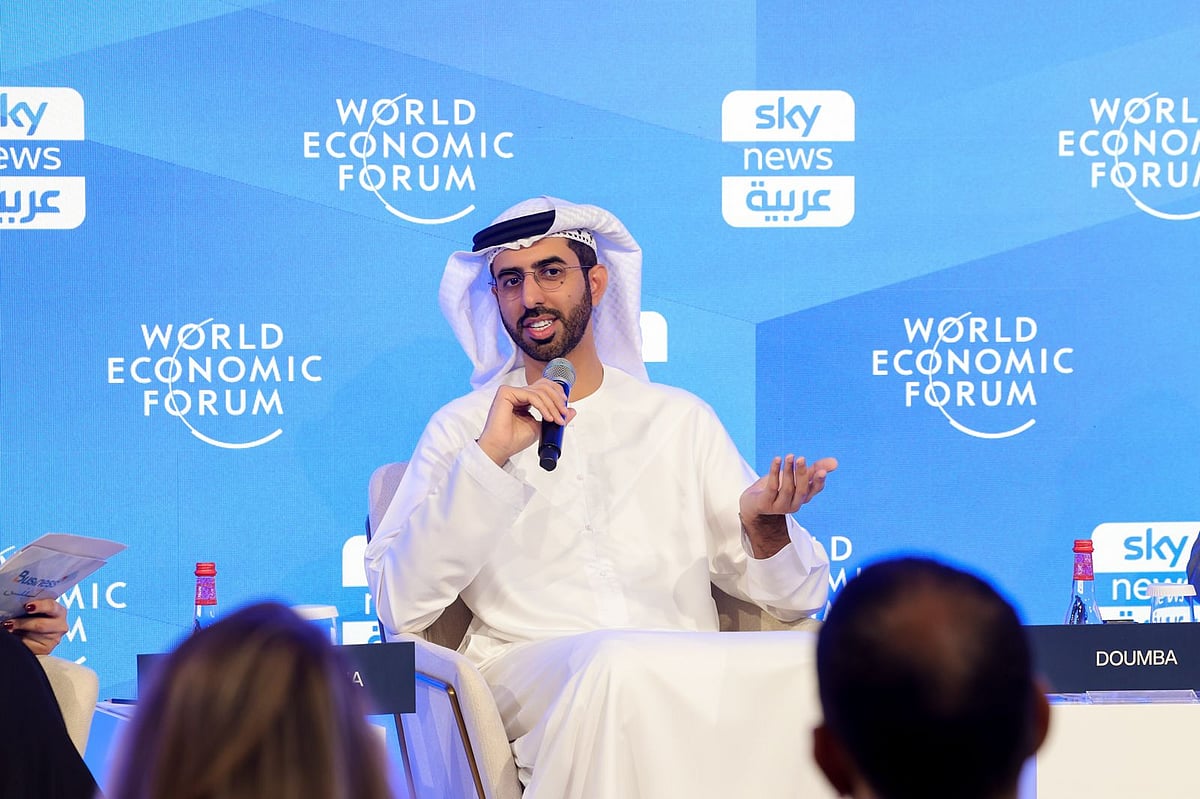
Dubai: The UAE has built an artificial intelligence “control tower” for the federal government that will monitor the actions of AI agents as the country moves to deploy the technology across government services, the Minister of State for AI, Digital Economy and Remote Work Applications Omar Al Olama said.
Every AI agent deployed across the UAE federal government will be required to connect to the control tower, with its actions and decision-making process logged for oversight, Al Olama said during a panel discussion at the World Economic Forum’s Annual Meeting of Global Future Leaders in Dubai.
The system will be subject to continuous auditing by both AI systems and humans to ensure that government agents do not operate beyond their intended authority, he said.
“We have an agent control tower on the UAE federal government side that every agent needs to plug into, and every action and every specific thought that the agent thinks of or action that it takes is logged. So, there is an oversight that ensures that we understand what agents are doing, how they're taking certain actions. There's a continuous audit that is being done,” Al Olama explained.
His comments come as the UAE pushes ahead with an ambitious plan to transform 50 per cent of government sectors, services and operations through agentic AI within two years.
AI control tower
In May, the UAE Cabinet approved a federal framework for deploying agentic AI across ministries and government entities, including a target of shifting at least 50 per cent of federal services and operations to AI-based systems within two years.
The framework includes dedicated teams within government entities, performance indicators and measures to assess the impact of the transformation. The Cabinet also approved an 80,000-employee training programme covering federal government workers.
The government has also begun developing a Federal Agentic AI Technology Platform, known as FedAI, to provide federal entities with common infrastructure for developing and adopting agentic AI systems.
A National AI Gateway is intended to provide secure access to different AI platforms, including commercial and open-source models hosted on sovereign infrastructure.
The UAE's 50 per cent target was announced by Prime Minister Sheikh Mohammed bin Rashid Al Maktoum in April, when he said AI would become an “executive partner” for government, capable of monitoring changes, providing analysis, making recommendations, managing operations and carrying out sequences of actions without human intervention.
The government has since launched initial AI agents covering areas including procurement, tax auditing, customer happiness and technical support.
Al Olama said the UAE had mapped government services to determine where autonomous AI could safely be introduced.
About 70 per cent of services have some tolerance for AI deployment, he said, while the remaining 30 per cent currently carry a level of risk that is above the government's tolerance.
“That's why we said 50 because we mapped out all government services, and we realized that around 70 per cent of them there is some sort of tolerance to deploying AI in them, 30 per cent the risk of making a mistake is actually higher than our tolerance, so we're not even looking at them,” Al Olama said.
UAE is not seeking to put AI agents into every government service immediately but is instead assessing services according to the potential consequences of an incorrect decision.
Mark-Alexandre Doumba, Gabon's Minister of Digital Economy and Innovation, said governments needed to establish rules both within the technology itself and through coordinated policy frameworks between countries.
“We need to govern it,” Doumba said, arguing that safeguards should be built into the coding and standards governing what AI agents can and cannot do, as well as which decisions they can make without human intervention.
‘Human livelihood is a red line’
Al Olama said the UAE's most important restriction was where an AI agent's decision could affect a person's livelihood.
“If human livelihood is going to be affected by the agent, then it's a red line,” he said. The UAE does not yet know the full capabilities of the technology, Al Olama said, adding that human life and livelihoods should not be treated as having a monetary value.
The government is therefore assessing AI applications according to the potential harm they could cause if an agent makes the wrong decision.
For lower-risk services, such as some document renewals, there is greater tolerance for autonomous decision-making, he said. Higher-risk services require a stricter standard of oversight.
Al Olama compared the proposed system of permissions for AI agents to controls already used by banks, where transactions are subject to different authority levels and “maker and checker” systems.
“If something is harmful to a citizen, the responsible entity is not the AI agent; it's the institution that has deployed the AI agent,” he said.
Meanwhile, Yalda Aoukar, co-founder and managing partner at Bracket Capital, said safeguards around agentic AI were increasingly becoming an investment opportunity in their own right.
“As we move from information on demand to execution on demand, I think we all need to ask ourselves what happens when an AI model, when an agentic AI takes a decision at super machine speed before a human intervention is really possible,” Aoukar said.
She said infrastructure that allows companies and governments to establish trust in agentic AI was becoming a business necessity, including areas such as cybersecurity, identity verification and fraud prevention.
The UAE is also measuring the success of its AI deployment differently from simply counting productivity gains or financial savings. Al Olama said the government's focus was on whether the use of AI improves people's quality of life.
‘The train has left the station’
Al Olama said governments should not frame the debate as a choice between slowing down AI development and accelerating it. “I don't think the conversation is about whether we should slow down AI or whether we should speed it up, because that train has left the station,” he said.
Instead, governments should focus on setting clear rules for the areas where AI poses the greatest risks, he said.
Al Olama pointed particularly to autonomous weapons systems that could make decisions about whether to kill people or deploy weapons. He said countries should agree on a deadline for addressing such risks rather than continuing to debate them without a defined endpoint.
The UAE minister said the lack of global consensus on AI safeguards remained a concern, noting that countries could be reluctant to impose restrictions if rival states did not do the same.
“If you sign up to it, and your adversary doesn't, it puts you at a disadvantage,” he said. He called for countries and international bodies including the United Nations to work towards agreement on the most extreme AI risks first, before moving on to less critical areas.
The UAE's approach is being developed as governments worldwide grapple with how much authority autonomous AI systems should have and who should be held responsible when those systems make mistakes.
For the UAE, Al Olama said, the priority is to move ahead with agentic AI while building oversight into the systems from the outset.
Network Links
GN StoreDownload our app
© Al Nisr Publishing LLC 2026. All rights reserved.