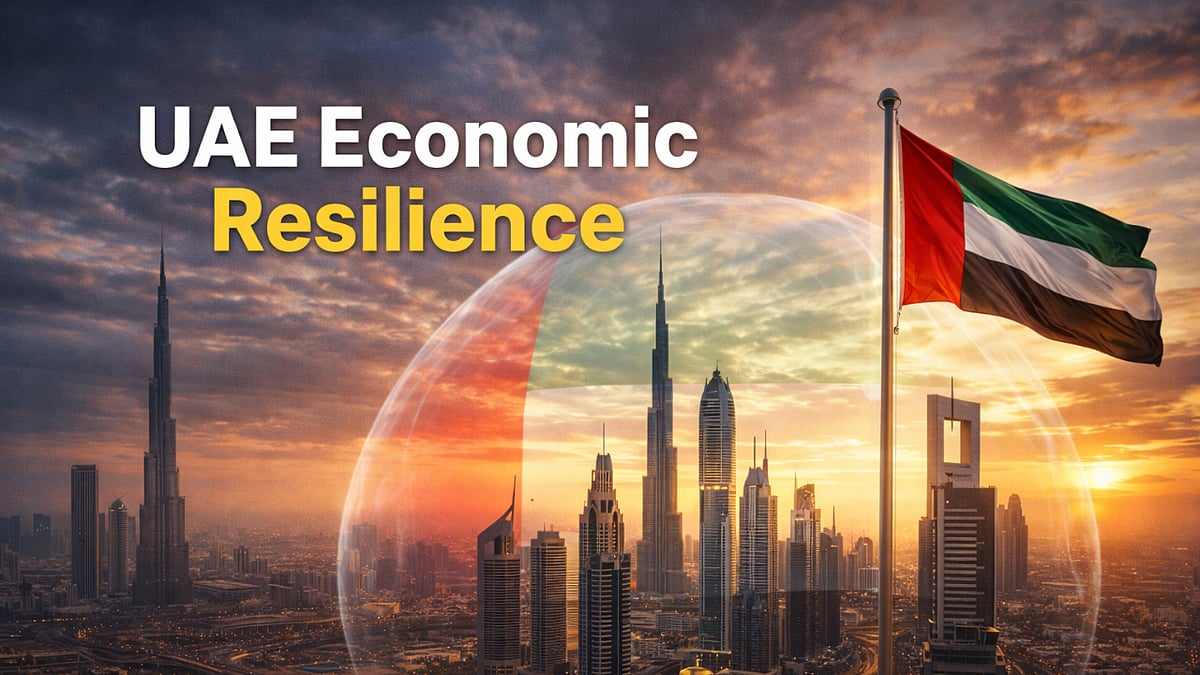
Surging non-oil sectors and Dh6tn trade cement UAE as a top global hub
The UAE economy has once again demonstrated exceptional resilience and agility in the face of global financial and geopolitical volatility, emerging as one of the fastest-recovering economies worldwide. Built on strong fiscal foundations, diversified growth strategies, and forward-looking policies, the country continues to attract global investor confidence and sustain long-term economic momentum.
International credit rating agencies—including Moody’s, S&P Global, and Fitch—have reaffirmed the UAE’s robust sovereign ratings, citing substantial financial buffers, low public debt, and vast sovereign assets.
Get updated faster and for FREE: Download the Gulf News app now - simply click here.
The nation’s banking sector remains highly capitalized and liquid, while non-oil sectors, trade, and real estate markets are witnessing record-breaking growth. With total foreign trade reaching Dh6 trillion in 2025 and the UAE entering the world’s top 10 goods exporters, the country is reinforcing its position as a global economic hub. Strong real estate performance in Abu Dhabi and Dubai further underscores sustained investor confidence and economic vitality.
In times of crisis, emergency, and major events, the strength of a country's economy becomes apparent. The economy of the United Arab Emirates has once again demonstrated its strength and resilience in the face of financial and geopolitical challenges at both the regional and global levels.
Demonstrating exceptional efficiency and flexibility, it has emerged among the fastest economies to recover and return to accelerated growth, supported by solid foundations and unique capabilities that enable continuous adaptation and sustained leadership.
During the recent crisis, the national economy achieved unprecedented successes, reflected in high levels of confidence from investors and international rating agencies in the robust fundamentals built over decades. The UAE has firmly established itself as one of the world’s most competitive economies and an attractive destination for talent, expertise, and foreign investment—ensuring sustainable growth.
According to reports by international institutions, the UAE consistently stands out during periods of global market volatility as a model of financial and economic resilience. This is largely due to its proactive approach and pre-established strategies designed to manage crises and unforeseen events, both domestically and globally.
Among the key strengths highlighted is the UAE’s solid fiscal position. The country maintains a strong external surplus and substantial financial reserves, providing significant flexibility to address global economic and geopolitical challenges, including fluctuations in energy prices and regional tensions.
Strong sovereign credit ratings
Amid the latest crisis, the world’s three leading credit rating agencies—Moody’s, S&P Global, and Fitch—reaffirmed their confidence in the UAE and Abu Dhabi’s ability to maintain strong sovereign ratings despite regional developments. This confidence is underpinned by extensive financial buffers, large external reserves, and solid sovereign assets.
Moody’s reaffirmed the UAE’s Aa2 rating with a stable outlook, reflecting global confidence in the resilience of its economy and the sustainability of its fiscal policies despite geopolitical tensions. Key drivers include effective economic diversification policies, low federal government debt, strong financial reserves accumulated from years of budget surpluses, high per capita income, and robust institutional frameworks.
S&P Global Ratings maintained the UAE and Abu Dhabi’s long- and short-term sovereign ratings at “AA/A-1+” with a stable outlook, citing abundant financial and external reserves that provide the country with substantial capacity to manage potential geopolitical developments. The agency also emphasized Abu Dhabi’s disciplined fiscal policy and one of the strongest financial buffers among rated sovereigns.
Fitch Ratings noted that the UAE and most GCC countries possess vast sovereign assets that serve as a protective cushion against short-term disruptions in energy revenues, while low taxation on non-oil sectors limits fiscal impact from economic fluctuations.
Ratings, trade and real estate boom showcase UAE’s robust economic momentum
Robust financial base and banking sector strength
The UAE’s strong fiscal base positions it to effectively manage regional volatility and absorb economic shocks. The banking sector continues to demonstrate remarkable resilience and stability, supported by strong non-oil economic performance expected over the next 24 months.
The country’s banking and financial sector maintains exceptionally high levels of capital adequacy (17%) and liquidity coverage (146.6%), exceeding international regulatory requirements. Total banking sector assets surpass Dh5.42 trillion, underscoring the strength of financial institutions and their ability to support economic activity under all conditions.
Global trade leadership and exceptional growth
The UAE has further cemented its position as a global trade hub by entering the world’s top 10 goods exporters for the first time, ranking ninth globally according to the World Trade Organization.
The country recorded exceptional growth in total foreign trade, reaching Dh6 trillion ($1.63 trillion) in 2025, up from AED 5.23 trillion ($1.42 trillion) in 2024—an increase of nearly 15%. Notably, services trade surpassed Dh1.14 trillion for the first time, while non-oil goods trade reached Dh3.8 trillion.
Record-breaking real estate performance
The UAE’s real estate sector continues to perform strongly, supported by sustained investor confidence and robust demand. Developers remain optimistic about continued growth and expansion, as reflected in the steady launch of new projects and ongoing construction activity.
Abu Dhabi’s real estate market recorded an unprecedented performance in the first quarter of 2026, with transactions surging by 160.7% year-on-year to Dh66 billion across more than 13,500 deals—marking the best quarterly performance on record and reinforcing the emirate’s status as a leading global investment destination.
Dubai also achieved its strongest quarterly performance ever, with real estate transactions reaching Dh251 billion across 61,578 deals. This represents a 30% increase in value compared to the same period in 2025, alongside significant growth in both transaction volume and sales value.
Network Links
GN StoreAbout Gulf NewsTerms & ConditionsReach by GNSitemapContact usPrivacy PolicyGN FocusHave your sayWork with usAdvertise with usGulf News epaperPrinting Services
Download our app
© Al Nisr Publishing LLC 2026. All rights reserved.