Aircraft production activities at Embraer’s main manufacturing complex in São José dos Campos, one of Brazil’s largest aerospace hubs.
Embraer bets on India, Gulf to challenge Airbus-Boeing duopoly
Brazilian planemaker pushes regional jet growth as airlines rethink fleet strategies
Last updated:
4 MIN READ
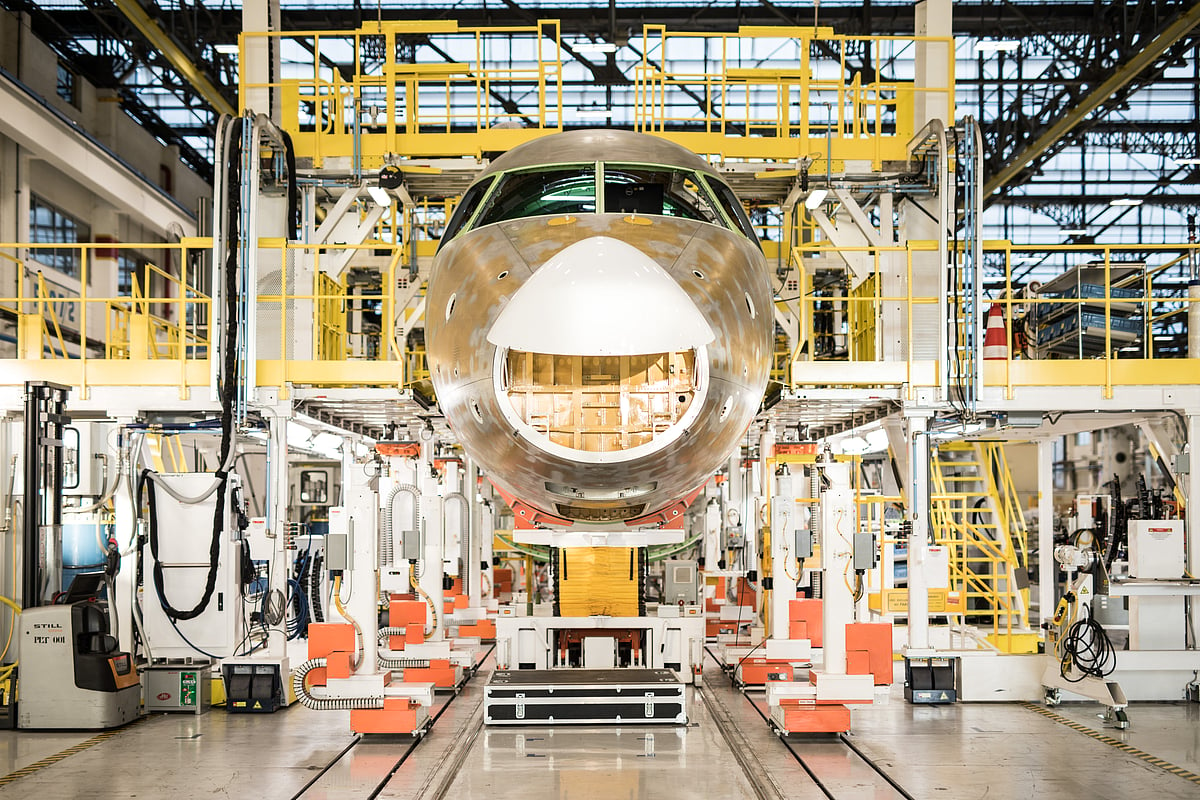
Embraer aircraft assembly operations at the company’s facilities in São José dos Campos, São Paulo, Brazil.
Embraer
São Paulo: As airlines grapple with rising fuel costs, aircraft delivery delays and growing pressure on regional connectivity, Brazilian plane maker Embraer is positioning itself as a stronger alternative to the long-standing duopoly of Airbus and Boeing.
The company is now placing particular focus on India and the Gulf, two markets where it sees major growth opportunities for smaller, fuel-efficient aircraft capable of serving secondary cities and thinner routes.
Speaking during a media briefing from its São José dos Campos in Sao Paulo, following the IATA Annual General Meeting in Rio, Embraer executives said discussions are progressing around a potential manufacturing and assembly presence in India.
“It’s the cooperation with the partner to set up the line,” Embraer Commercial Aviation CEO Arjan Meijer said. “Secondly, we need to get the commitments from the airlines… and the third one are the discussions that we have collectively also with the government.” He added: “Stay tuned,” without sharing any additional details about where in India the assembly line could be built.
Embraer currently has two massive deals/partnerships in the works in India, targeting both the commercial and defense sectors. Embraer and Adani Defence and Aerospace signed an MOU and expanded a framework to establish a final assembly line for Embraer’s popular E-Jets (such as the E175) in India.
India in focus
Embraer believes India’s next aviation growth phase will depend less on major metro routes and more on linking smaller cities across the country.
“We know, and also India knows, that to develop a country from within… you need smaller aircraft to connect to secondary and tertiary cities,” Meijer said.
Embraer’s Defense and Security division and Mahindra Group have partnered to produce the C-390 Millennium military transport aircraft locally in India.
Embraer said it sees strong potential for its E-jet family in the country, particularly in the 75-seat segment, as India continues to expand regional connectivity schemes.
The manufacturer has increasingly been highlighting how airlines can use smaller jets more efficiently instead of relying entirely on large narrowbody aircraft.
Gulf ambitions growing
The Gulf is another market Embraer is closely watching, although the company admitted it had previously been cautious because of engine performance concerns in hot weather conditions common across the Middle East.
Meijer said the company now believes those issues are improving.
“We now see that in both of those countries the E2 is really operating well,” he said, referring to existing Middle East operations, such the Royal Jordanian.
He also added that Embraer had intentionally “been holding back a little bit” while ensuring the aircraft and engines were fully ready for harsher operating environments.
Additionally, Embraer and UAE's Generation 5 Holding have signed an exclusive strategic partnership agreement focused on the UAE market for the C-390 Millennium multi-mission military transport aircraft.
The partnership will focus on building maintenance, repair and after-sales support capabilities for the C-390 Millennium aircraft in the UAE and wider Middle East.
The two companies will also explore opportunities in manufacturing, supply chain integration and training programmes for technical and operational staff to support long-term aircraft operations in the region.
Furthermore, in May this year, the UAE also signed a deal with Embraer for 10 C-390 Millennium military transport aircraft, with options for 10 more, in one of the largest defence agreements announced at Make it in the Emirates 2026.
The agreement also includes plans to develop maintenance, repair and overhaul (MRO) and after-sales support capabilities for the aircraft in partnership with a UAE defence company.
The company had signed an MoU in Saudi Arabia in 2024 to explore domestic production, assembly and MRO opportunities in the kingdom. “Stay tuned,” Meijer said when asked about progress on the Saudi discussions.
Sheikh Mansour bin Zayed Al Nahyan, Vice President, Deputy Prime Minister, and Chairman of the Presidential Court, witnessed the signing of a contract to purchase C-390 Millennium aircraft for the UAE Air Force.
Challenging the aviation duopoly
Embraer has increasingly been trying to position its E2 jets as more flexible aircraft that can complement — rather than directly compete with — larger Airbus and Boeing narrowbody aircraft.
“We stopped calling it the regional jet,” Meijer said. “This is an aircraft that can complement narrowbody operations.”
He argued airlines are increasingly looking beyond simply maximising seat numbers and are instead focusing on overall trip costs and route profitability.
The company says its E195-E2 aircraft can reduce trip costs significantly while allowing airlines to maintain frequency on routes where larger aircraft may be too expensive to operate profitably.
That argument appears to be gaining traction globally. Over the last 18 months, Embraer has secured orders and commitments from airlines including Virgin Australia, ANA, SAS, Finnair and Mexicana.
The company said the E2 programme has now crossed 500 firm orders.
Supply chain pressures remain
Like the wider aviation industry, Embraer is still dealing with supply chain disruptions that have affected aircraft manufacturing globally since the pandemic.
Executives said the company is working closely with suppliers while investing in production capacity in Brazil and the US. Embraer expects to deliver between 77 and 85 commercial aircraft this year alongside up to 170 business jets.
The company’s total backlog reached $32.1 billion at the end of the first quarter, excluding some recently announced deals.
Including purchase rights and options, that figure rises to roughly $52 billion.
Get updated faster and for FREE: Download the Gulf News app now - simply click here.
Betting on smaller aircraft
A key part of Embraer’s strategy is centred on convincing airlines that smaller aircraft can make networks more profitable during uncertain economic periods.
“When the crisis hits, airlines start to shift capacity,” Meijer said.
He argued regional jets become especially valuable during periods of higher fuel prices or weaker demand because airlines can continue operating routes without flying too many empty seats. “We believe the benefits… outweigh any complexity,” he said.
Sign up for the Daily Briefing
Get the latest news and updates straight to your inbox
Network Links
GN StoreAbout Gulf NewsTerms & ConditionsReach by GNSitemapContact usPrivacy PolicyGN FocusHave your sayWork with usAdvertise with usGulf News epaperPrinting Services
Download our app
© Al Nisr Publishing LLC 2026. All rights reserved.