Dubai Airports CEO Paul Griffiths says the Al Maktoum International Airport project has entered an intensive construction phase, with major contracts being discussed and awarded.
Dubai's $35 billion Al Maktoum airport project: Over 100,000 workers on site, says CEO
Piling and groundwork advance as Dubai prepares for the massive shift from DXB to DWC
Last updated:
3 MIN READ
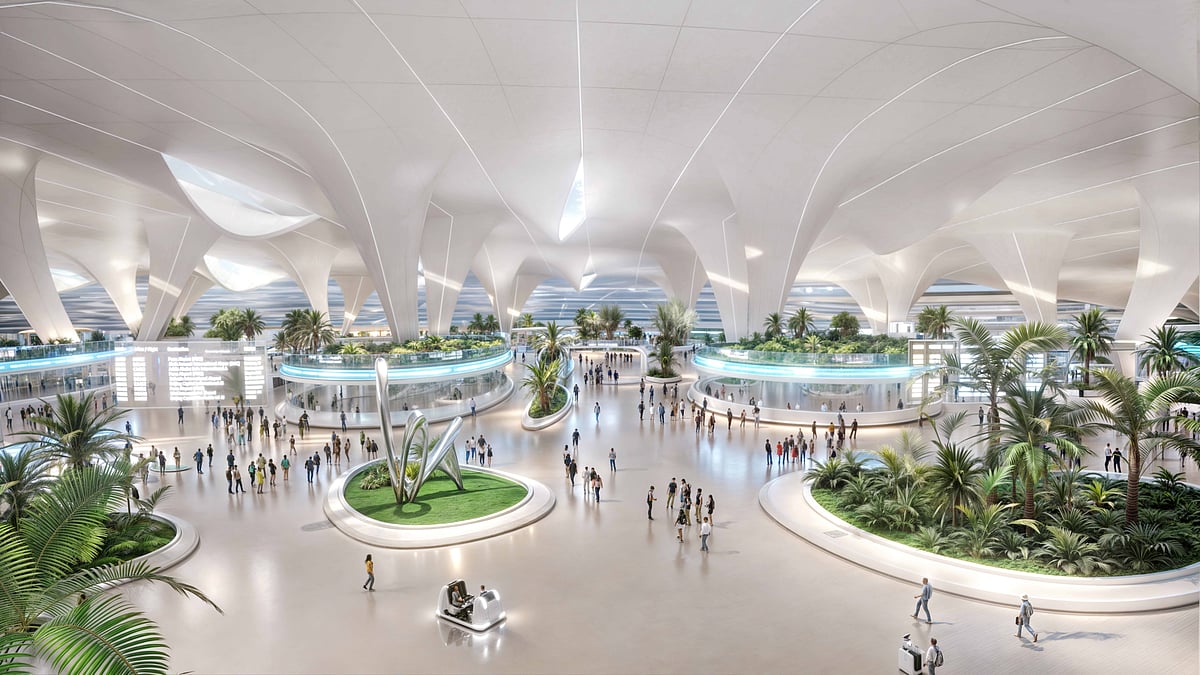
More than 100,000 workers are now on site at Dubai's $35 billion Al Maktoum International Airport expansion, according to Dubai Airports CEO Paul Griffiths.
Supplied
Dubai: Construction of Dubai's $35 billion (Dh128 billion) Al Maktoum International Airport expansion is advancing, with more than 100,000 workers on site and major groundwork and piling operations underway, Dubai Airports CEO Paul Griffiths told media on Tuesday.
Griffiths said procurement for the project was progressing, with major construction contracts being discussed and awarded as Dubai prepares to build an aviation hub capable of eventually handling 260 million passengers annually.
“The budget is something like 35 billion US, and I know major contracts are being discussed and let as I speak,” Griffiths said. “There are more than 100,000 workers on site, piling is commencing. Groundworks are well underway, so it's definitely a live project," he explained.
Construction progress
The expansion has been moving through major civil engineering and infrastructure packages ahead of the planned opening of its first phase in 2032.
In June, Dubai Aviation Engineering Projects said more than 17,000 concrete piles had been installed and over 45 million cubic metres of earth excavated. At the time, the developer expected the workforce to reach approximately 120,000 at peak construction.
Earlier this year, officials also outlined plans to award more than Dh55 billion in additional contracts during 2026, covering terminal structures, concourses and supporting infrastructure.
Griffiths' latest comments suggest work is continuing on a substantial scale, although he did not provide an updated value for contracts awarded or specify which construction packages had entered their next phase.
A $35 billion investment
The latest phase of the Al Maktoum International Airport expansion was approved on April 28, 2024, by His Highness Sheikh Mohammed bin Rashid Al Maktoum, Vice-President and Prime Minister of the UAE and Ruler of Dubai.
The Dh128 billion development is intended to create a new aviation hub that will eventually replace Dubai International Airport (DXB) as the emirate's primary international gateway.
The airport's long-term master plan provides for five runways, hundreds of aircraft stands and the capacity to handle 260 million passengers and 12 million tonnes of cargo annually.
The first phase is targeted to begin operations in 2032, with capacity to expand progressively as Dubai's aviation demand grows.
Moving an airport
Griffiths said the development represents a much bigger challenge than constructing new terminals and runways.
The airport operator must continue expanding capacity at DXB while preparing to transfer a vast aviation operation to DWC, approximately 70 kilometres away.
“Our real measure of success is: can we keep growth going in the city without constraining the supply of capacity? And can we seamlessly manage the transition?” he said.
“You know, if you think about it, we're taking the entire top left corner of Dubai, where we're sitting now, and we're transplanting it in the bottom right-hand corner, 70 kilometres away.”
He added: “That's much, much more than just an airport project.”
The transition will also require residential communities and supporting infrastructure for airport employees, particularly those currently living in Dubai's northern areas or neighbouring emirates.
“The whole city has got to move,” Griffiths said, adding that new communities would be needed to accommodate airport-sector workers.
Testing before opening
Dubai Airports is already preparing for the operational challenge of transferring services to DWC, including recruiting employees, training staff and testing new technologies.
Griffiths said the operator intends to run the new airport without passengers for at least a year before opening it to the public.
“We can test the baggage systems. We can test the check-in. We can test the Wi-Fi. We can test all of the systems,” he said.
He also emphasised the importance of using DXB to trial new technologies before introducing them at the larger airport.
“We cannot be late. We cannot allow any delay on our side to prevent us from being ready when we arrive at Al Maktoum for day one of operation,” Griffiths said.
The operator hopes to minimise the period during which both airports run major operations simultaneously, although the timing and eventual future of the existing DXB site will depend on government decisions.
Griffiths said the scale of the planned migration would be unprecedented, with Dubai expecting to move an operation several times larger than the approximately 20 million passengers involved when Hong Kong relocated its main airport in the 1990s.
“That's never been done on that scale,” he said.
Network Links
GN StoreAbout Gulf NewsTerms & ConditionsReach by GNSitemapContact usPrivacy PolicyGN FocusHave your sayWork with usAdvertise with usGulf News epaperPrinting Services
Download our app
© Al Nisr Publishing LLC 2026. All rights reserved.