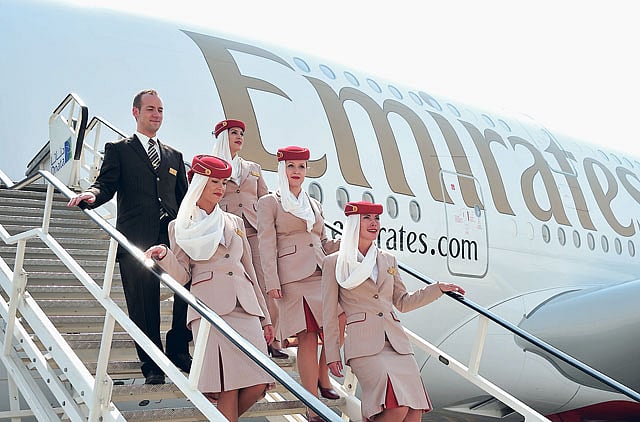
Emirates Skywards is the airline's loyalty programme, with 20 million members.
Dubai: Here's the incredible journey of Dubai-based Emirates airline.
We start from the year it leased two small aircraft in 1985 to serve a few destinations in the Sub-continent, to what is has become today — the world's biggest international airline, carrying millions in style to more than 160 destinations.
2019
Emirates Group announces half-year performance for 2019-20, with Dh1.2 billion profit, and a 7.9% increase in passengers carried to Dubai.
Group revenue was Dh53.3 billion ($14.5 billion) for the first six months of 2019-20, down 2% from Dh54.4 billion ($ 14.8 billion) during the same period last year. This slight revenue decline was down to planned capacity reductions during the 45-day Southern Runway closure at Dubai International airport (DXB), and unfavourable currency movements in Europe, Australia, South Africa, India, and Pakistan.
dnata revenue was up 5% to Dh7.4 billion ($ 2.0 billion). During the six months to June 2019, the airline served 51.9 million, up 67 per cent due to major business expansion.
51.9 million
number of meals served by Emirates in the first six months of 2019
2018
Emirates Skywards, the airline's loyalty programme, has reached 20 million members. In an average month, the programme welcomed 220,000 new members across the globe.
It also has strategic partnerships with FlyDubai, Easyjet and Qantas, and 13 other airlines offering members access to one of the world’s largest networks of global travel destinations. In addition, members can also earn and redeem Skywards Miles at 1.8 million properties worldwide through its 23 partner hotel groups, making for a seamless travel journey.
2017
Emirates, already the world’s largest international airline, concludes another banner year. Since January 2017, Emirates has carried over 59 million passengers, served over 63 million meals on its flights departing Dubai, and moved over 35 million pieces of baggage in Dubai to its network of 156 destinations.
Emirates registered over 3,600 passenger flights on average per week, or over 191,000 flights in 2017, travelling more than 886 million kilometres around the globe, which is equivalent to over 16,000 trips to Mars.
2016
Emirates scaled up its fleet in 2016 with the addition of 36 new aircraft, consisting of 20 A380s, 16 Boeing 777-300ERs, while retiring 29 older aircraft. The airline concluded the year with 255 aircraft in service, with an average age of 5.0 years, significantly below the industry average of over 11 years.
Emirates aircraft parked at Dubai Airport. Emirates, with a fleet of 171 planes, signed an
$18 billion deal with Boeing for its 777 aircraft at November’s Dubai Airshow.
Keeping its fleet young not only minimises Emirates’ overall carbon footprint, but it also enables the airline to put the latest products and services onboard its aircraft.
In April, Emirates placed an order for two additional A380 aircraft, taking its total A380 order book to 142, cementing its position as the world’s largest operator of the popular double-decker aircraft.
2014
2010
Emirates tops up A380 orderbook of 58 by placing 32 more to 90.
2009
2008
Chinese visitors at Dubai International Airport Terminal 3.
2007
To celebrate HH Sheikh Zayed’s centennial, the 100th Emirates A380 ‘Year of Zayed’ aircraft landed in Sao Paulo.
courtesy emirates
2006
Emirates signs an agreement for 10 Boeing 747-8F freighters in a deal worth $3.3 billion.
2005
An Emirates A-380 prepares for take off to Dubai
2004
Emirates’ Boeing 777 is welcomed with a water cannon salute after touchdown at Porto Airport.
Emirates orders four Boeing 777-300ERs, with nine options, in a $2.96 billion deal.
Emirates makes its first flight to North America – a non-stop 14-hour flight to New York’s JFK Airport. This marked the first non-stop passenger service from the Middle East to North America.
2003
Emirates aircraft at Dubai International Airport.
2002
Four million passengers vote in the Skytrax internet poll and Emirates is again named Airline of the Year.
An Emirates Boeing 777 freighter from Hong Kong touches down at Dubai World Central.
Logistics and air freight companies are constructing their own buildings in the complex.
Global passenger levels drop by four per cent but Emirates figures rise 18.3 per cent to 6.8 million.
2001
Emirates signs £24 million deal to sponsor English Premiership football club Chelsea for four years.
In a survey of 2.7 million airline passengers by Skytrax Research, Emirates is voted Airline of the Year.
Emirates
2000
1999
1998
In 1998, Terminal 2 was built. The second stand, Concourse 1 opened in April 2000.
1997
Airline defies high fuel prices to again post record profits as passenger figures top three million and cargo hits 150,000 tonnes.
1996
Airline takes delivery of its first Boeing 777-200 and becomes the first airline to show take-offs and landings live. Its maiden flight to London is followed by Emirates’ inaugural flight to Melbourne.
1995
As the airline celebrates its tenth birthday, it has a fleet flying to 34 locations in the Middle East, Far East and Europe.
1994
Emirates is the first airline to equip an Airbus fleet with an inflight fax facility.
1993
Emirates becomes the first airline to introduce telecommunications on an Airbus in all three classes.
1992
1991
On January 17, Emirates grounds its fleet for several hours as the battle to liberate Kuwait begins. Operations resume and Emirates maintains 90 per cent of its normal services during the first month of the conflict.
Emirates Boeing 727-200 at Dubai International Airport (1991).
1990
Emirates bucks the industry trend and continues to expand despite the Iraqi invasion of Kuwait and adds Manchester to its schedule.
1989
Flights are added to Singapore, Manila and Bangkok.
In the late 1980s and early 1990s, longer-range aircraft — such as the Boeing 747, A340 and B777 series aircraft were introduced, which had the range to fly between Europe and South East Asia non-stop.
1988
Damascus is added to the Emirates route network, giving it 12 destinations in just 38 months of business.
1987
1986
Inaugural flight EK600 took off for Karachi on October 25, 1985 from Dubai International Airport. Over the last four decades, the UAE has gained global prominence in the aviation industry with Emirates airline in the cockpit
1985
The first Emirates flight to Karachi prepares to leave Dubai.
1984
1978
Maurice Flanagan moves to Dubai to become director and general manager of Dnata.
Maurice Flanagan, Group Vice-Chairman, Emirates
Dubai International airport in 1971. From 4-5 flights a week and just 40,000 passengers a year, the airport today handles 34,000 flights a month and 88.8 million passengers a year.
1960
Shaikh Rashid Bin Saeed Al Maktoum opens the airport and implements innovative open-skies policy.
The first airport came in Dubai in 1961, see this old picture of Dubai airport
1959
Dnata is established by the Dubai Government with just five staff to provide ground handling services at the new Dubai International Airport.
Sign up for the Daily Briefing
Get the latest news and updates straight to your inbox
Network Links
GN StoreAbout Gulf NewsTerms & ConditionsReach by GNSitemapContact usPrivacy PolicyGN FocusHave your sayWork with usAdvertise with usGulf News epaperPrinting Services
Download our app
© Al Nisr Publishing LLC 2026. All rights reserved.