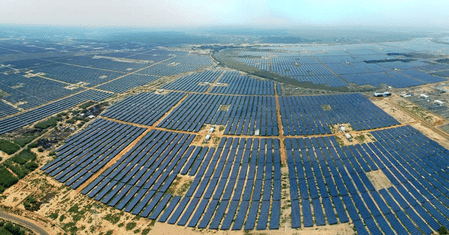
India has hit a significant milestone in the global energy transition, with its rapid ramp in renewable energy generating capacity.
As of April 2026, the subcontinent has achieved over 50% of its installed electricity capacity from non-fossil sources — reaching this milestone five years ahead of its 2030 Paris Agreement target.
Total non-fossil capacity stands at approximately 283 GW (including 274.68 GW renewable energy and ~8.78 GW nuclear), out of a total power capacity exceeding 520 GW, according to Ember data.
This underscores a key multiplier: as India builds world-class AI data centre infrastructure, it simultaneously strengthens its renewable energy backbone.
The massive data centre buildout represents an underlying ecosystem: As AI drives data centre growth, it entails increased power demand, which drives investments in energy infrastructure, which leads to multi-sector "supercycle" involving technology, energy and property sectors.
Solar, wind lead
Solar is the star industry, leading the power generation surge, with installed capacity at 150.26 GW, up more than 50-fold — from just 2.82 GW in 2014.
Wind contributes 56.09 GW, large hydro 51.41 GW, small hydro 5.17 GW, and bioenergy 11.75 GW.
In FY 2025–26 alone, India added a record 55.3 GW of non-fossil capacity.
Solar often accounts for over 67% of monthly renewable output, with February 2026 seeing 25,295 MU from renewables (excluding large hydro), up 25% year-on-year.
This growth supports India’s ambitious goals: 500 GW of non-fossil capacity by 2030 and net-zero emissions by 2070.
Policies like PM KUSUM, rooftop solar schemes, hybrid projects, and viability gap funding for battery storage are accelerating deployment.
The boom is driven by falling technology costs, private sector participation (including large players like Adani and Reliance), and the need to meet surging electricity demand from economic growth, urbanisation, and digital infrastructure.
AI compute boom
This highlights how India’s exploding data centre pipeline (~7-8 GW total, with major contributions from Google, Reliance, Macrotech, Airtel’s Nxtra, and others) is not just a tech story but a massive power infrastructure challenge.
A single 100 MW data centre can consume electricity equivalent to tens of thousands of homes and demands 24/7 uptime.
This AI-driven compute boom is triggering parallel investment in captive power, dedicated renewable parks (especially solar + storage), battery systems, and high-voltage transmission.
Data centres are thus catalysing further renewable energy and grid modernisation.
Comparison: India vs China, EU, and US
China dominates globally with ~2,258 GW of renewable capacity (as of late 2025 data), accounting for roughly half the world’s total. It added hundreds of GW annually in solar and wind, with solar generation alone surging dramatically. China’s scale is unmatched due to manufacturing dominance and state-driven investment, though its overall energy mix still includes substantial coal.
United States ranks second at ~468 GW renewable capacity. It has strong growth in solar and wind, supported by Inflation Reduction Act incentives, but additions are smaller than China’s. Renewables are making solid inroads into the generation mix.
EU has seen solar capacity double in recent years (over 300 GW) and wind exceeding 220 GW in some estimates. Policy focus on decarbonization has driven consistent growth, with renewables projected to supply a large share of electricity by 2030. However, total capacity trails the US and is far behind China.
India (250+ GW renewables, third globally after China and US, ahead of Brazil) stands out for its speed relative to its development stage. It added ~37 GW in a strong recent year and recorded massive FY26 additions.
While absolute numbers are lower, India’s growth rate in solar is impressive, and it has crossed the 50% non-fossil capacity threshold faster than anticipated. Challenges include grid integration, land acquisition, and balancing variable renewables with baseload needs (still met partly by coal).
Geothermal energy drive
India has also recently inaugurated its first geothermal energy project by retrofitting unused oil and gas wells in Gujarat. It marks a significant step in renewable energy deployment, with the potential to generate up to 450 kW of continuous power, according to the government.
Rapid demand growth
India’s per-capita energy consumption remains much lower, so its transition must accommodate rapid demand growth — unlike the more mature markets of the US and EU.
What’s nextIndia must focus on system integration: scaling battery storage, pumped hydro, and hybrid projects to handle solar/wind intermittency.
Grid modernisation (Green Energy Corridors, HVDC lines) and transmission upgrades are critical to reduce curtailment.
Green hydrogen, EVs, and domestic manufacturing (solar modules, batteries) will gain momentum. The data centre and AI boom will intensify demand for reliable, low-cost clean power, creating a “supercycle” in power, transmission, and storage.
Obstacles remain — financing gaps (hundreds of billions needed), execution delays, supply chain issues, and coal dependency for baseload.
Yet continued policy support, falling costs, and private investment position India to add 300 GW+ of renewables by 2030.
Success here could accelerate its path to a developed economy by 2047 while contributing meaningfully to global climate goals. The interplay between surging digital demand and clean power expansion makes India’s energy story uniquely dynamic.
Sign up for the Daily Briefing
Get the latest news and updates straight to your inbox
Network Links
GN StoreDownload our app
© Al Nisr Publishing LLC 2026. All rights reserved.