A UAE astronomical observatory said it tracked the impact of the upper stage of a SpaceX Falcon 9 rocket on the Moon on Wednesday, with the collision estimated to have ejected around 1,100 tonnes of lunar soil and rocks into space.
When will NASA release photos of the Moon crater left by SpaceX's rocket impact?
A SpaceX rocket hit the Moon, but scientists say the first images are still weeks away
Last updated:
4 MIN READ
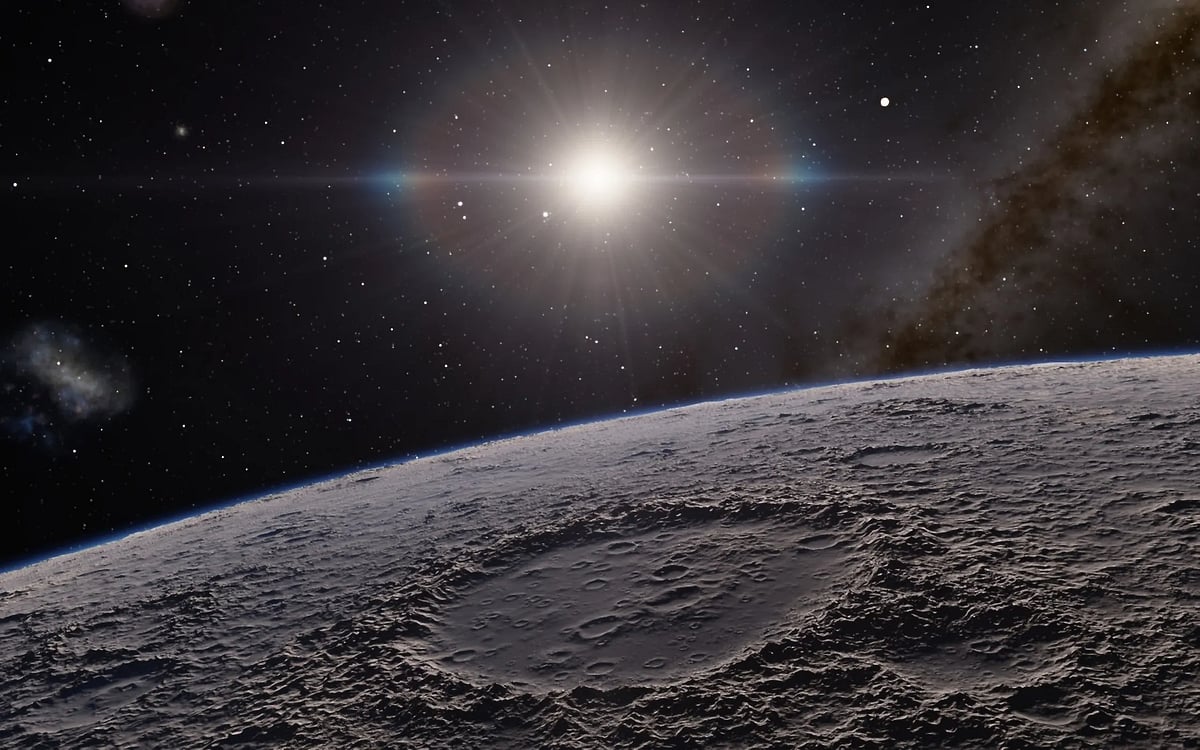
Eleven hundred tonnes of moon went up on Wednesday morning, and nobody on Earth watched it happen.
Dubai: Eleven hundred tonnes of moon went up on Wednesday morning, and nobody on Earth watched it happen.
The upper stage of a SpaceX Falcon 9, designated 2025-010D, struck the Moon at 06.34 GMT on Wednesday 5 August, which was 10.34am UAE time. It was travelling at around seven times the speed of sound.
The rocket had launched on 15 January 2025, carrying two lunar landers, the American-built Blue Ghost and Japan's Hakuto-R. Once those were released onto their trajectories, the upper stage separated and stayed in a highly elongated Earth orbit, pushed around by the gravity of both the Earth and the Moon and by solar radiation pressure.
It stayed there for eighteen months before this week.
What the Abu Dhabi observatory found
The Al Khatim Astronomical Observatory, part of the International Astronomy Centre, tracked the event and produced the most detailed estimate of what the impact actually did.
Mohammad Shawkat Odeh, the centre's director, said the collision excavated around 450 cubic metres of lunar soil and rock, roughly 1,100 tonnes of material. Under the Moon's weak gravity, some of that ejecta could have risen as high as three kilometres above the surface before falling back, with faster fragments going higher still.
He confirmed the debris posed no danger to Earth.
Then comes the part that matters for anyone waiting on pictures. The observatory pointed its main telescope at the predicted impact site from one minute before the collision until five minutes afterwards.
It detected neither a flash nor visible ejecta.
Who is taking the pictures
Two spacecraft are involved, and both work from orbit rather than from Earth.
NASA's Lunar Reconnaissance Orbiter is the main one. It has been mapping the Moon since 2009 and holds extensive imagery of the surface, which is what makes a before-and-after comparison possible at all.
NASA has confirmed that before-and-after images from the Lunar Reconnaissance Orbiter will likely take a week or two to appear.
The Korea Pathfinder Lunar Orbiter will also look for opportunities to capture imagery of the impact site, a NASA spokesperson told Space.com.
NASA has said its scientists plan to collect data from the event and refine techniques for tracking objects in space.
That puts the first pictures somewhere between the middle and end of August. No date has been promised, because locating a crater roughly 25 metres across on a surface the size of Africa takes time even when you know approximately where to look.
A section of SpaceX January 2025 Falcton 9 launch, pictured here, has crashed into the Moon
Why nobody saw it
Scientists had been uncertain all along. Predictions ranged from a brief flash, to a visible cloud of dust and rock, to nothing at all.
The complication was that the rocket struck the lit side of the Moon. A preprint study by a group including NASA researchers judged that this made any impact flash difficult or impossible to detect, and no natural or artificial impact flash has ever been observed on the lit side.
There is one loose end. Detections by the Lowell Observatory in Flagstaff, Arizona suggest evidence of a plume. Al Khatim is now waiting on observations from other ground-based observatories and space telescopes before drawing conclusions.
Why it takes this long
An orbiter cannot point at a spot on demand. It has to pass over the right patch of ground, in the right lighting, at the right altitude for the resolution needed.
Then the images must be downlinked, processed and compared against the existing archive to confirm the new feature is the crater rather than something already there.
There is precedent for how this unfolds. When a rocket body hit the far side of the Moon in March 2022, the Lunar Reconnaissance Orbiter eventually located it, and the result was strange enough to justify the wait. It had produced not one crater but two, overlapping, suggesting the object had significant mass at both ends rather than being a spent tube.
If this impact produces anything similarly unexpected, that is what the photographs will show.
What we can expect
A greyscale image of a small fresh crater, ringed by a bright halo of ejected material. Visually underwhelming, perhaps. Scientifically, very useful.
The value lies in the physics. When a natural rock hits the Moon, scientists are guessing at nearly everything: how big it was, how heavy, how fast it was going. Here they know all three. That makes this a controlled experiment of a kind they almost never get. Estimates put the crater at 20 to 30 metres across and around five metres deep, and measuring the real thing against the prediction will tell them things about the lunar surface no natural impact could.
For now, the best account of Wednesday morning comes from a telescope in Abu Dhabi that saw nothing at all, and worked out 1,100 tonnes of moon dust anyway. And we wait for NASA to release the images.
Network Links
GN StoreAbout Gulf NewsTerms & ConditionsReach by GNSitemapContact usPrivacy PolicyGN FocusHave your sayWork with usAdvertise with usGulf News epaperPrinting Services
Download our app
© Al Nisr Publishing LLC 2026. All rights reserved.