UAE observatory tracks Falcon 9 rocket stage impact on Moon
Collision ejected about 1,100 tonnes of lunar soil and rocks, posing no risk to Earth
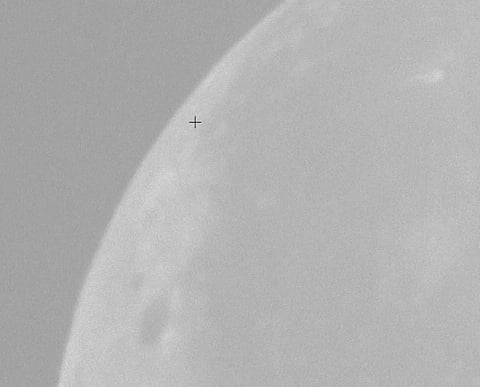
A UAE astronomical observatory said it tracked the impact of the upper stage of a SpaceX Falcon 9 rocket on the Moon on Wednesday, with the collision estimated to have ejected around 1,100 tonnes of lunar soil and rocks into space.
The Al Khatim Astronomical Observatory in Abu Dhabi, part of the International Astronomy Centre, said astronomical calculations had predicted that the Falcon 9 upper stage, designated 2025-010D, would strike the lunar surface at 0634 GMT.
Get updated faster and for FREE: Download the Gulf News app now - simply click here.
Mohammad Shawkat Odeh, director of the centre, said the rocket stage originated from a Falcon 9 mission launched on Jan. 15, 2025, carrying two lunar landers – the U.S.-built Blue Ghost and Japan's Hakuto-R. After delivering the spacecraft onto their trajectories towards the Moon, the upper stage separated and remained in a highly elongated Earth orbit influenced by the gravity of the Earth and Moon, as well as solar radiation pressure.
Odeh said the debris produced by the impact posed no danger to Earth. He estimated that the collision excavated about 450 cubic metres of lunar soil and rocks, equivalent to roughly 1,100 tonnes of material. Under the Moon's weak gravity, some ejecta could have risen as high as three kilometres above the surface before falling back, while faster-moving fragments may have reached even greater heights.
Scientists had been uncertain whether the impact would be visible from Earth, with predictions ranging from a brief flash or a cloud of dust and rocks to no visible effect at all.
The observatory pointed its main telescope at the predicted impact site from one minute before the collision until five minutes afterwards but detected neither a flash nor visible ejecta. Researchers are awaiting observations from other ground-based observatories and space telescopes to further analyse the impact.