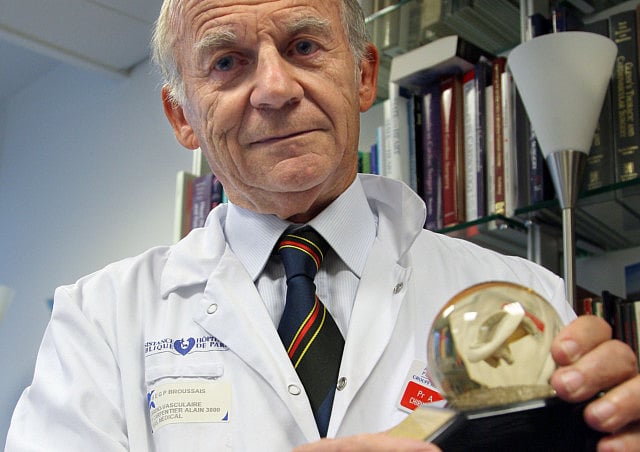
France has claimed a breakthrough in human organ technology with the first implant of an artificial heart designed to replace the need for a transplant from another person.
President Francois Hollande, anxious to lift a mood of pessimism over the country’s economy, hailed the event as an example of French innovation.
“France can be proud of this exceptional deed in the service of human progress,” Hollande wrote in a letter to Alain Carpentier, the veteran inventor of the artificial heart, and the medical team that carried out the operation.
The device, which autonomously mimics the action of a real heart, was implanted in an anonymous 75-year-old man with terminal heart disease on December 18 at the Georges Pompidou European hospital in Paris. He was said by the hospital at the weekend to be awake and talking, making jokes with his family and doctors.
The operation represents a critical moment for Carmat, the quoted company founded by Prof Carpentier and his industrial backers in the 1990s to develop the artificial organ. The implant was confirmed in a statement by Carmat after the market closed on Friday.
Prof Carpentier, 80, was a pioneer of replacement heart valves using animal tissue and combined with aeronautic engineers from what was to become EADS, the aerospace company, to develop the prosthetic heart. EADS continues to hold a 33 per cent stake in Carmat, which was listed on the Paris bourse in 2010.
Unlike other artificial hearts, which act as a temporary bridge for patients until a compatible human heart is available for transplant, the battery-powered Carmat heart is intended to be a permanent replacement for a diseased heart, extending life for five years.
Prof Carpentier said patients would experience some constraints from the need to maintain its electricity supply. But he said the prosthetic heart, using biological and synthetic materials, was designed to avoid the problems of rejection that confront heart transplants and would require little or no use of anticoagulants.
“It is about giving patients a normal social life with the least dependence on medication,” he said.
The professor said in an interview with the Sunday newspaper Journal du Dimanche that the heart incorporated an “algo-rhythm” that allowed it to “reproduce exactly the contractions of a real heart”.
“If you see your lover walk through the door, your Carmat heart will beat faster just like a real one,” he said.
The medical team said the first month would be critical in assessing the performance of the implant, which has been fitted to 30 cows. It has been subjected to tests based on aircraft proving technologies that Carmat said assured “similar reliability to an aeroplane on its maiden flight”.
Several implants were likely in the next few weeks, the company said. Permission has also been given for the procedure in Belgium, Poland, Slovenia and Saudi Arabia. Carmat estimates a potential worldwide market of EURO20bn for its device, based on 125,000 patients seeking transplants annually.
However, the heart still requires development, not least to make it smaller. The current model weighs 900 grammes, three times the weight of a male human heart. It is therefore only suitable for about 75 per cent of male patients and 20 per cent of women.
Sign up for the Daily Briefing
Get the latest news and updates straight to your inbox
Network Links
GN StoreDownload our app
© Al Nisr Publishing LLC 2026. All rights reserved.