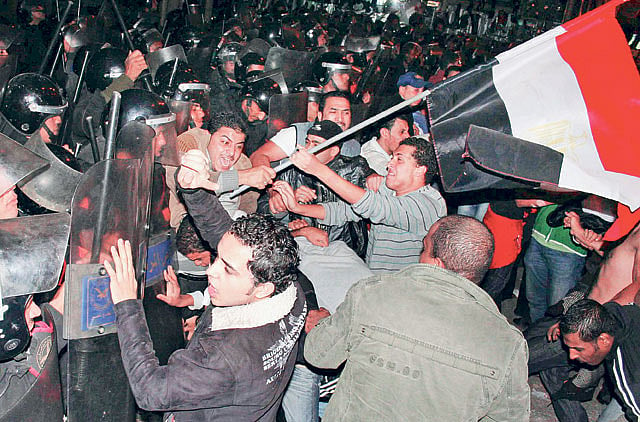
Cairo: An American reporter once asked president Jamal Abdul Nasser in 1963: "What is Egypt's identity?" He answered assertively: "Arab, of course."
Things were very clear for Egyptians back then. But now many voices within the society are demanding that the Arab identity be replaced with an Egyptian national identity.
Heated identity debates were triggered in Egypt after reports revealed in December that an underground wall along the Rafah border would be built to block up smuggling tunnels which serve as a crucial lifeline for Gazans since Hamas took over the Strip in June 2007.
Between people who openly doubt their long embraced belief in Arab nationalism, preferring plainly to be known as Egyptians or Middle Easterners, and others who still cling to the one unified Arab world dream, a clear comprehensive self identity vision was lost.
Dr Mustafa Al Fiqqi, Foreign Relations Committee chairman at the People's Assembly, said Arab identity was a complex issue and couldn't be abandoned because of a few irresponsible acts.
"I am an Arab, it is Egypt's interest to be an Arab country. Our destiny has always been to be the leader of the twenty-two Arab countries. This is what distinguishes us from other major countries in the region." On the other hand, Ambassador Ahmad Eisa pointed out that Egypt must stick to its unique identity.
"We have to be extremely proud of our special Pharaonic history. We have a unique blend of various identities. That doesn't mean we should cancel our belonging to the Arab world but this means that Egypt is not exclusively an Arab country," he confirmed
As the debate went on, then came the news that an Egyptian soldier was shot on the Gaza border allegedly by a Palestinian sniper. This again provoked a widespread wave of resentment among officials as well as people.
Agony
"Egypt has absolute freedom to do what it believes is in its best interest. Our borders are sacred and no violations are allowed in one way or another," Egyptian Foreign Minister Ahmad Abu Al Geit told Egyptian national television earlier this week.
Identity debates have been extended to include ordinary Egyptians who are as much divided on their identity as their intellectual counterparts.
Hamdi Mahmoud, a 67-year-old retired army officer, expressed his agony over the questioning of the Egyptian Arab identity.
"We are Arabs, it is our language, history, and future. I witnessed three wars that Egypt fought side by side with Arabs for one goal, one aim, and against one enemy. We can't give up our Arab identity. That is all we have."
But Omar Salim, a 45-year-old lawyer, argues Egypt should re-evaluate the idea of Arab nationalism as whole.
"During the past twenty years, Arab identity didn't do Egypt any good. On the contrary, Egyptians are insulted in every Arab country. We are fed up with this entire ‘big sister' slogan. Whenever there is a crisis in Palestine they point fingers at us, as if we were occupying the Arab lands not Israel," Salim stressed
One of the big issues to fuel Egypt's rage with other Arab nations was last November's clashes in Khartoum between Egyptian and Algerian soccer fans.
The aftermath of the game witnessed a diplomatic row between the two North African countries with Egypt recalling its ambassador to Algiers.
Mohammad Farouq, a 23-year-old university student, told Gulf News that he believes that Arabs don't respect Egypt, and deny what Egyptians had done for the Palestinian cause.
"The recent street clashes between Algerian and Egyptian fans in Sudan after the match showed the real hate feelings of Arabs towards Egypt.
"It was obvious that this hatred is far beyond a mere game"
Activism
At the same time a growing number of people, who were recently swept up by Islamic activism, prefer to think of themselves, first and foremost, as Muslims, suspending their belief in both Arab and Egyptian identities.
Salma Qasim, a 37-year-old member of a large Facebook group that calls for the end of the Rafah wall, stressed that Palestinians are Muslims in the first place.
"They are Muslims and that's what matters. We can't act like Israel who suffocate and torture the Palestinians on a daily basis. We have to stop the offensive wall now," Qasim said
In the same context, Dr Ali Abu Hassan, Assistant Secretary-General of the Islamic Research Academy and former Chairman of Al Azhar Fatwa Committee, assured Gulf News that building the separation wall between Rafah and Gaza is religiously impermissible because it means serving your enemy at the expense of your brother.
Although Egypt was known as one country for more than 5,000 years, the search for an Egyptian identity started crystallising in the middle of the 19th century when Egypt freed itself from foreign occupation
Three chief ideologies came to surface: the ethno-territorial Egyptian nationalism and by extension Pharaonism, pan-Arabism, and Islamism, each one of them was supported by intellectuals, politicians, and parties.
Hazem Hussain, a 36-year-old blogger, believes that Arab nationalism which was once led by Abdul Nasser, who is wildly popular across the Middle East as the most prominent advocate of pan-Arab nationalism, is now at a turning point.
Raghda Al Halawani is a journalist based in Cairo.
Sign up for the Daily Briefing
Get the latest news and updates straight to your inbox
Network Links
GN StoreDownload our app
© Al Nisr Publishing LLC 2026. All rights reserved.