Midterms over, restraint gone? Will Trump unleash fresh strikes on Iran?
US carrier heads to region as Trump weighs military action amid last-ditch diplomacy
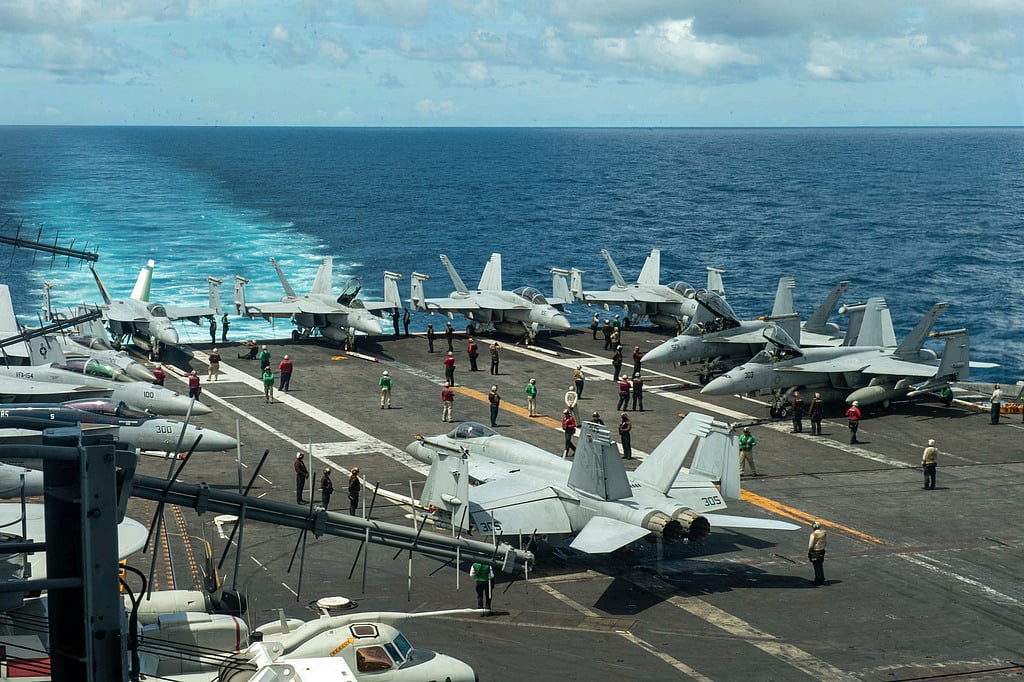
Dubai: With the US midterm elections over, President Donald Trump faces a crucial decision on Iran: Launch another major military offensive or pursue a diplomatic settlement as American warships move towards the Middle East and limited US strikes continue near the Strait of Hormuz.
Trump has warned of a possible “heavy hit” against Iran, while insisting Tehran will never be allowed to acquire nuclear weapons. Yet he has also suggested that an agreement could make further military action unnecessary.
The conflicting signals come as Washington's military preparations, renewed strikes on Iranian positions and unresolved negotiations over the Strait of Hormuz raise questions about Trump's next move.
The political calculations have also changed dramatically.
In September, Reuters reported that senior Trump aides wanted to avoid a major escalation before the November 3 elections, fearing that higher fuel prices and public opposition to the Iran war could damage Republican prospects.
With the elections over, that immediate constraint has disappeared.
Reuters reported that some Gulf governments believe Trump's election setback could push him towards a diplomatic settlement with Iran rather than another major military offensive. But others fear Tehran could misinterpret his weakened position as a sign of American weakness, raising the risk of renewed confrontation.
“Every time Trump has been backed into a corner, he has shouted more and come out fighting,” Peter Loge, director of George Washington University's School of Media and Public Affairs, told AFP.
But the Republicans' defeat, which handed Democrats control of both chambers of Congress, has introduced another pressure: Trump must now weigh the political consequences of a renewed offensive against the possibility of securing a deal.
Trump warns of heavier strikes
Speaking to Fox News, Trump reiterated that Iran would never be permitted to develop nuclear weapons and discussed the possibility of a substantial military operation.
His remarks followed repeated warnings that Washington could resume large-scale attacks if Tehran refused to meet American demands.
However, Trump has stopped short of announcing a decision.
As election results emerged, he acknowledged that the Iran war had contributed to Republican losses but defended the military campaign as necessary for American security.
He also left open the possibility of further attacks, saying he might or might not act depending on Iran's response.
The uncertainty has left regional governments watching both Washington's statements and its military deployments.
US strikes near Hormuz
American military operations against Iran have continued despite diplomatic efforts.
On November 2, US forces struck targets on Qeshm Island, a strategically important Iranian position near the Strait of Hormuz.
Reuters, citing American officials, reported that the strikes targeted Iranian surface-to-air missiles threatening US military assets.
Officials described the operation as limited and defensive, rather than the beginning of a major new offensive.
The Washington Post reported that the Qeshm attack formed part of a series of smaller US strikes carried out in recent weeks, some without public announcements.
Iranian media also reported explosions on Qeshm and nearby areas.
The operations underline how military confrontation has continued even as both governments discuss possible arrangements to end the conflict.
American carrier heads to region
The military picture is further complicated by the movement of additional American naval forces.
Fox News reported on Wednesday that the USS Theodore Roosevelt aircraft carrier strike group was travelling through the South China Sea towards the Middle East.
The deployment was announced earlier, but its continuing movement has attracted attention as Trump considers whether to authorise further strikes.
US officials previously outlined plans to reinforce the region with additional sailors, Marines and naval assets.
The buildup gives Washington greater operational flexibility, although military deployments can also serve defensive and deterrent purposes.
There has been no confirmed presidential order for a new large-scale offensive.
Can diplomacy prevent another war?
Despite the military pressure, negotiations have not collapsed.
Qatar has intensified mediation efforts between Washington and Tehran, while other regional countries continue pressing for a political settlement.
A central obstacle remains the Strait of Hormuz, whose disruption has affected global energy supplies and shipping.
Iran has proposed reopening the waterway if Washington meets a series of demands, including changes to sanctions and the American naval blockade.
But Mohsen Rezaei, secretary of Iran's Supreme National Security Council, said the US response to Tehran's seven conditions was unconvincing.
Iranian officials insist that Washington must explicitly address their demands before the waterway can be reopened.
US Vice-President JD Vance has expressed optimism about diplomatic progress, highlighting the competing military and negotiating approaches within the administration.
Gulf states brace for uncertainty
For Gulf countries, the stakes extend far beyond Washington's domestic politics.
Another round of US-Iran fighting could threaten oil installations, commercial shipping, airports and other vital infrastructure.
The UAE and its regional partners have repeatedly urged restraint and diplomatic engagement.
At the recent Manama Dialogue, UAE presidential diplomatic adviser Anwar Gargash said the country hoped for a diplomatic breakthrough but remained prepared for the worst.
His warning reflected a broader regional concern that another confrontation could reverse efforts to restore stability.
For Trump, the choices remain difficult.
Military escalation could increase pressure on Tehran but also risk Iranian retaliation, higher energy prices and a prolonged conflict.
A negotiated settlement could ease economic pressure and restore shipping through Hormuz, but major differences remain unresolved.
The midterms have ended one period of political uncertainty without resolving the crisis confronting the Middle East.
Trump no longer faces an approaching election. But with US forces reinforcing the region and negotiations still fragile, the question now is whether he will use that freedom to strike Iran — or to make a deal.

Sign up for the Daily Briefing
Get the latest news and updates straight to your inbox
Network Links
GN StoreDownload our app
© Al Nisr Publishing LLC 2026. All rights reserved.