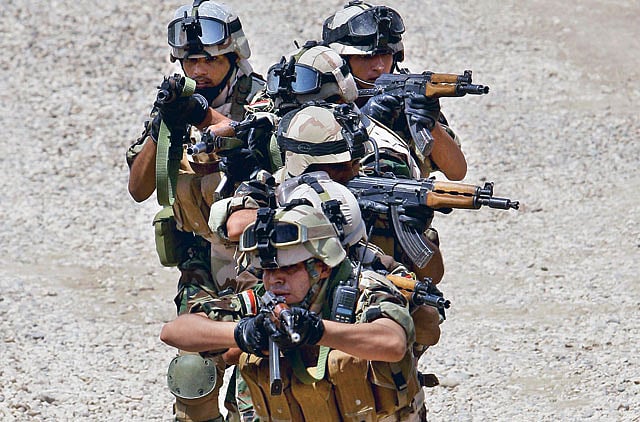
Baghdad: Some form of US military presence will be needed in Iraq at least until 2016 to provide training, support and maintenance for the vast quantity of military equipment and weaponry that Iraq is buying from America, Iraqi Defence Minister Abdul Qadir Al Obaidi said.
In addition, Iraq will also continue to need help with intelligence gathering after 2011, and the fledgling Iraqi air force will require US assistance at least until 2020, the date by which Iraq aims to achieve the capability to defend its own airspace, Al Obaidi said.
The comments were made in an interview a week after President Barack Obama declared the end of American combat operations and reaffirmed America's commitment to pull out all its troops by the end of 2011, under the terms of a security agreement reached by the Bush administration and the Iraqi government in 2008.
"Maybe endlessly," Al Obaidi said when asked how long US support may be necessary. "As long as I have an army and I'm a Third World country, and I can't pretend that I'm better than that ... I will need assistance." "I don't think any reasonable person would reject any kind of help from the US and the European nations," he added. Iraq has an agreement with Britain to help train its navy and patrol its waters, which expires in November.
Al Obaidi, who is regarded as a close ally of Prime Minister Nouri Al Maliki, stopped short of calling for the continuation of US bases in Iraq beyond the December 31, 2011, deadline for withdrawal of all troops.
Negotiations
At this point, 50,000 US troops remain in Iraq to advise and assist Iraqi forces. The form of any future presence will be up to the next Iraqi government to decide, in negotiations with Washington, Al Obaidi said. But it is becoming increasingly clear that many in Iraq's defence establishment, as well as within the US military, believe that Iraq's security forces will need US military assistance for many years to come, despite America's commitment to pull out all troops by 2012.
In an interview last month, the chief of staff of the Iraqi armed forces, General Babakir Zebari, predicted the need for US forces to remain in Iraq until 2020, and said he would like to see America maintain "three or four bases" to help deter possible threats from Iraq's neighbours.
US officials have also said Iraq's army will need assistance beyond the 2011 deadline. Al Obaidi said he didn't envisage a need for US troops to help defend Iraq's borders, even though Iraqi troops won't be ready to do so until 2016.
There are other means to defend a country, he said, such as through peace treaties with neighbouring countries. But, he said, trainers and advisers will continue to be necessary, and they will need troops to protect them.
Equipment
Iraq has ordered or requested more than $13 billion (Dh47.71 billion) worth of US arms, as well as a shipment of 18 F-16s, which aren't expected to arrive at least until 2013 even if the order receives swift congressional approval. "It's inevitable," he said. "We have equipment such as tanks, aircraft, naval equipment, and it's all coming from the United States. They won't be fully ready until 2016, so how are we going to train on them? By mail? We will need the help of specialists and experts and trainers and those people are going to need life support and force protection." Otherwise, he added, "all the expenses I paid for ... will be in vain."
The question of what kind of presence would be necessary is likely to come to the fore only after a new Iraqi government is in place. Negotiations dragged into a seventh month this week, and the competing political factions have yet to make any significant progress toward agreeing on who will be in charge. The issue of a continuing American presence is politically sensitive in both Baghdad and Washington. No Iraqi politician seeking to head the next government could currently risk calling for the American military, which led the 2003 invasion of their country, to stay on longer.
Faction
The Sadrist faction loyal to radical Shiite cleric Moqtada Al Sadr, whose support could prove crucial to any future government, opposed the agreement that allowed US troops to stay as long as 2011, and has said it will not back any government that permits them to stay any longer.
Neighbouring Iran campaigned hard to prevent the signature of the 2008 security agreement, and would likely exert renewed pressure on its Shiite allies in Baghdad to prevent any long-term American presence.
Al Maliki, who is hoping to retain his leadership post in the new government, matched Obama's address to Americans last week with a televised speech of his own in which he welcomed the end of the combat mission and pledged that the agreement calling for the total withdrawal of all US troops by 2012 would be implemented in full.
Do you agree that US military presence would be needed in Iraq until 2016? What is your view on the US combat operations ending in the country?
Sign up for the Daily Briefing
Get the latest news and updates straight to your inbox
Network Links
GN StoreDownload our app
© Al Nisr Publishing LLC 2026. All rights reserved.