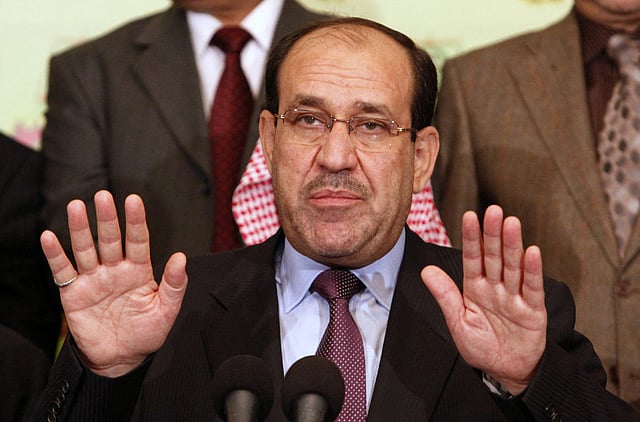
Baghdad: Some of Iraq's Sunni minority swore not to vote again after the main political blocs agreed on Thursday to appoint incumbent Nouri Al Maliki, a Shiite, to a second term as prime minister.
The country's main political factions broke an eight-month deadlock and agreed on the country's top government posts.
Some Sunnis said Allawi's Iraqiya, which won two more seats in a March election but not enough for a majority, should have had the first chance to form a new government.
Under the deal, Al Maliki will remain prime minister and Jalal Talabani, a Kurd, will keep the presidency. Allawi's bloc gets the third top post, that of parliamentary speaker, while Allawi himself will head a council of strategic policies.
"I won't participate in any elections in the future because Iraqiya was the winner but the premiership went to Maliki through Iranian interference. This means that sectarianism will not finish," said Ali Mahmoud, 36, a teacher in the mainly Sunni town of Falluja in Iraq's western province of Anbar.
"What is the use of the parliament speaker? He is just an employee that logs the names of those who attend and does nothing."
Iraq's Sunnis, who dominated the country under Sunni dictator Saddam Hussain, have felt marginalised since the 2003 US-led invasion propelled majority Shiites into power. Sunni anger helped fuel a fierce insurgency and sectarian war.
University student Osama Mohammad, 20, said: "I reprimand Iraqiya because it didn't manage to hold out longer in the face of pressure. They didn't even get the presidency."
Allawi has said Sunni anger might reinvigorate the insurgency if his alliance was sidelined.
Sectarian divide
The distribution of the top posts along ethnic and sectarian lines highlights the sharp divisions that continue to define Iraq, although a new government including all of Iraq's main blocs was viewed as important for stability.
"It was unjust to give (Iraqiya) these posts. Of course, there is disappointment for the people who voted for them," said Shaikh Ayad Al Jibouri, the head of a Sunni group in Radhwaniya, west Baghdad.
Another member of a Sunni group, which is credited with helping to turn the tide in the violence unleashed after the invasion, said that while Sunnis were frustrated by the political outcome, he did not expect a return to sectarian carnage.
"People are fed up and only want to see the government formed. But the next election will have many surprises," said Saif Khider, a militia leader in Baghdad's southern area of Doura.
"I think people won't go to vote because whether they vote or not, the government does what it wants under the influence of neighbouring countries."
Not all Shiite Muslims were happy with the outcome, either.
Talib Al Ugaili, 48, an unemployed man from Baghdad's central Karrada district, said he believed Iraqiya should withdraw from the political process.
"As a Shiite man, I would say this is a betrayal for every Sunni person in the country," he said.
UAE leaders greet Iraqis
President His Highness Shaikh Khalifa Bin Zayed Al Nahyan has sent a cable congratulating Iraqi President Jalal Talabani on the power-sharing agreement
reached by the political blocs in the Iraqi parliament.
His Highness Shaikh Mohammad Bin Rashid Al Maktoum, Vice-President
and Prime Minister of the UAE and Ruler of Dubai, sent congratulatory cables to
Talabani, Iraqi Prime Minister Nouri Al Maliki and Eyad Allawi.
General Shaikh Mohammad Bin Zayed Al Nahyan, Abu Dhabi Crown Prince and Deputy
Supreme Commander of the UAE Armed Forces, also sent cables.
Shaikh Abdullah Bin Zayed Al Nahyan, Foreign Minister, congratulated the Iraqi people
and its national leadership. He said the deal paves the way for a new phase in Iraq where security and stability will prevail, allowing it to play a pivotal role in regional and international levels. Abdul Aziz Al Ghurair, Federal National Council Speaker, sent
a congratulatory cable to Iraqi Speaker Osama Al Nujaifi.
-WAM
Sign up for the Daily Briefing
Get the latest news and updates straight to your inbox
Network Links
GN StoreDownload our app
© Al Nisr Publishing LLC 2026. All rights reserved.