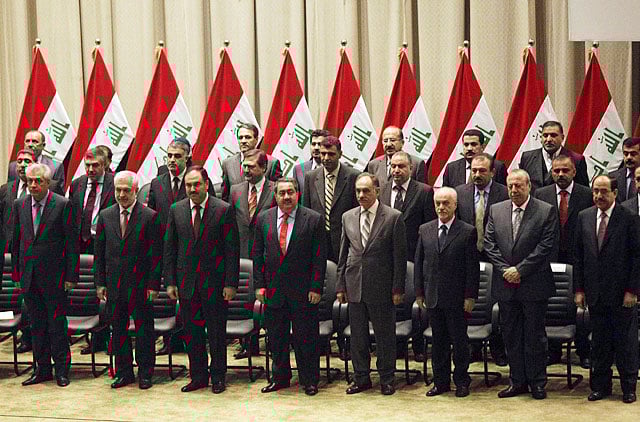
Baghdad: Iraq's parliament approved Prime Minister Nouri Al Maliki and his new government on Tuesday, nine months after an inconclusive election left politics in limbo and delayed investments to rebuild the country after years of war.
Lawmakers voted Maliki and a new slate of ministers into office, elevating Oil Minister Hussain Al Shahristani to deputy prime minister for energy, and leaving in place Kurdish veteran Foreign Minister Hoshiyar Zebari.
Highlighting the ethnic and sectarian divides that pervade the war-ravaged country, parliament had to postpone the vote on Monday after last-minute factional disputes and political horse-trading over posts delayed the government's formation.
As Al Maliki read out the chosen ministers' names one by one, parliament speaker Osama Al Nujaifi scanned the chamber for raised hands and said "approved by the majority" each time. The speaker did not ask for a show of hands from those opposing the candidate or abstaining from the vote.
In separate votes, parliament approved three deputy prime ministers as well as other cabinet ministers and the government's programme. The government was then declared formed with Maliki as the prime minister.
Al Maliki acknowledged his ministerial list was not perfect.
"I do not say that this government, with all its formations, satisfies its citizens' aspirations, nor the political blocs', nor my ambition, nor any other person's ambition, because it is formed ... in extraordinary circumstances," he told lawmakers.
"This is what we have, and what we have could be better than what we had if we stand by our decisions," Al Maliki said.
Former Prime Minister Iyad Allawi, who failed to gain enough support for a majority after his cross-sectarian Iraqiya bloc won the most seats, told the assembly his Sunni-backed coalition would participate fully in the government.
"Iraqiya will play an active, productive and cooperative role," he told the session, broadcast on national television.
Two female lawmakers protested at Tuesday's assembly against the absence of women in the new cabinet.
Fragile deals
Al Maliki has yet to decide on permanent choices for 11 positions, including sensitive security-related ministries such as defence and interior. Acting ministers were put in charge.
The prime minister promoted deputy oil minister Abdul Kareem Luaibi to minister and made prominent Sunni leader Rafie Al Esawi finance minister.
"The deal the parties worked out is rather elaborate but the critical thing is that they were able to get to this point through peaceful negotiations without any return to large-scale violence," said Shadi Hamid, director of research at the Brookings Doha Center.
"That said, power-sharing deals like this one tend to be quite fragile and so the next few months will present a crucial test for the ... rival blocs."
International investors are watching developments in Iraq's energy sector with great interest as the country embarks on an ambitious programme to exploit its vast oil resources and rebuild its neglected and damaged infrastructure.
While Al Shahristani was minister, the oil ministry reached a series of deals with oil majors that could boost Iraq's output capacity to 12 million barrels per day, rivalling global leader Saudi Arabia, from about 2.5 million barrels per day now.
For international oil companies, Al Shahristani's continued control over the oil sector will be seen as assurance that contracts he agreed will be honoured in the absence of formal guarantees, since Iraq still lacks a new hydrocarbons law.
The appointment of Luaibi could also be seen as a sign of continuity for companies that signed deals with Iraq to develop its oilfields, which are among the largest in the world but suffered from a lack of investment during decades of war and international economic sanctions.
A power-sharing deal on November 10. between Shiite, Sunni and Kurdish blocs put Al Maliki on track for a second term as prime minister. The pact returned Kurd Jalal Talabani as president and made Osama Al Nujaifi, a Sunni, parliament's speaker.
Allawi, a secular Shiite, has said he will join the government as head of a new national strategic policy council. His decision, announced on Sunday after weeks of wavering, could soothe worries about renewed sectarian violence.
After decades of war and sanctions, and seven and-a-half years after a US-led invasion that toppled Sunni dictator Saddam Hussein, Iraq is seeking to rebuild its shattered infrastructure. The country relies on oil for 95 percent of federal revenues
.
Eman Ragab, an Iraq expert at Cairo's Al Ahram Centre for Political and Strategic Studies, said the new government would not be granted a honeymoon period due to public impatience after nine months of stalemate.
"The new government will not be allowed the luxury of taking months to form a plan and years to implement it. People want fast solutions for the provision of social services and addressing the challenge of security," she said.
Baghdad: Iraqi lawmakers have unanimously approved a new government to be headed by incumbent Shiite Prime Minister Nouri Al Maliki.
The long-awaited vote on the new government ends nine months of political deadlock after an inconclusive parliament election in March.
Lawmakers approved a total of 29 ministers including Al Maliki to form the new government.
The remainder of the 42-member Cabinet is made up of acting ministers for now.
The vote on a new government on Tuesday comes after nine months after an inconclusive election left politics in limbo and delayed investments to rebuild the country after years of war.
Al Maliki's 42-strong cabinet list leaves Kurdish veteran Foreign Minister Hoshiyar Zebari in place and includes current Oil Minister Hussain Al Shahristani as deputy prime minister for energy.
Highlighting the ethnic and sectarian divides that pervade the war-ravaged country, parliament had to postpone the vote on Monday after last-minute factional disputes and political horse-trading over posts delayed the government's formation.
Al Maliki has yet to decide on permanent choices for some positions, including sensitive security-related ministries such as defence and interior.
The prime minister's partial list of proposed ministers, published on Monday, promoted deputy oil minister Abdul Kareem Luaibi to minister and made prominent Sunni leader Rafie Al Esawi finance minister.
"The deal the parties worked out is rather elaborate but the critical thing is that they were able to get to this point through peaceful negotiations without any return to large-scale violence," said Shadi Hamid, director of research at the Brookings Doha Center.
"That said, power-sharing deals like this one tend to be quite fragile and so the next few months will present a crucial test for the ... rival blocs."
Investments in oil
International investors are watching developments in Iraq's energy sector with great interest as the country embarks on an ambitious programme to exploit its vast oil resources and rebuild its neglected and damaged infrastructure.
While Shahristani was minister, the oil ministry reached a series of deals with oil majors that could boost Iraq's output capacity to 12 million barrels per day, rivalling global leader Saudi Arabia, from about 2.5 million barrels per day now.
For international oil companies, Shahristani's continued control over the oil sector will be seen as assurance that contracts he agreed will be honoured in the absence of formal guarantees, since Iraq still lacks a new hydrocarbons law.
The appointment of Luaibi could also be seen as a sign of continuity for companies that signed deals with Iraq to develop its oilfields, which are among the largest in the world but suffer from a lack of investment during decades of war and international economic sanctions.
The final deadline to approve the cabinet is at the end of the week.
A power-sharing deal on Nov 10. between Shi'ite, Sunni and Kurdish blocs put Al Maliki on track for a second term as prime minister. The pact returned Kurd Jalal Talabani as president and made Osama Al Nujaifi, a Sunni, parliament's speaker.
Former Prime Minister Eyad Allawi, a secular Shi'ite whose cross-sectarian coalition won the most seats in the March 7 vote, was unable to gather enough support to secure the premiership. However, he has said he will also join the government as head of a new national strategic policy council.
Allawi's decision, announced on Sunday after weeks of wavering, could soothe worries about renewed sectarian violence.
Sign up for the Daily Briefing
Get the latest news and updates straight to your inbox
Network Links
GN StoreDownload our app
© Al Nisr Publishing LLC 2026. All rights reserved.