A digital shipping showing the Strait of Hormuz. Iran reportedly retains a large estimated stockpile —between 2,000 and 6,000 marine mines.
Iran's Hormuz trap: What to know about IRGC's naval mines deployment
Quiet move, global shock: Iran’s invisible mines turn Hormuz into a controlled chokepoint
Last updated:
5 MIN READ
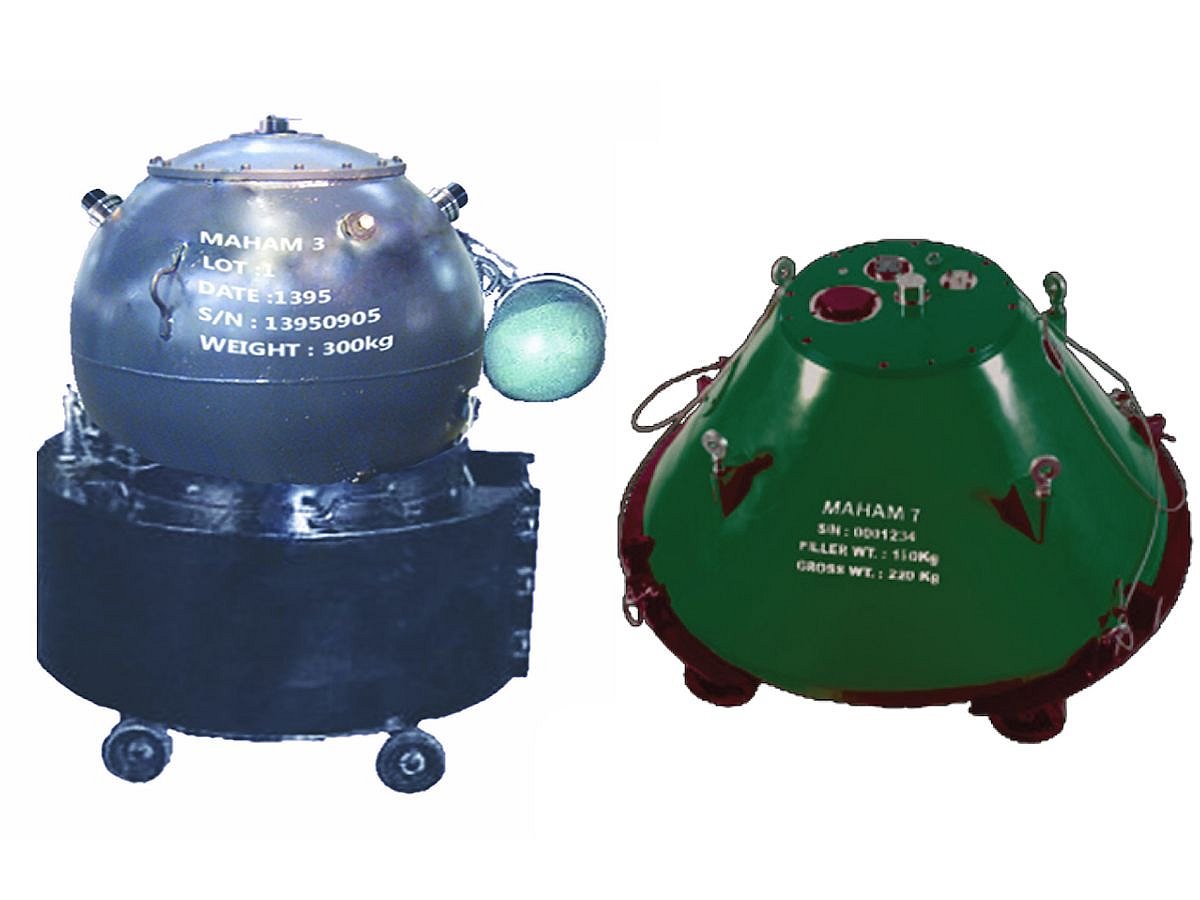
The IRGC has reportedly deployed at least a dozen Maham-3 and Maham-7 naval mines. The regimes's approach reflects a broader strategy: hold the global trade though the Hormuz Strait waterway hostage and/or use it as a negotiating gambit. Even a small number of mines can disrupt global shipping, making rapid detection and clearance essential.
X | OSinttechnical
Nobody knows how many naval mines were deployed by Iran in the Hormuz Strait.
One estimate puts the number to "at least a dozen naval mines, possibly fewer" placed at specific points IRGC elements know in the narrow waterway that carries roughly one-fifth of the world’s seaborne oil.
What we know so far:
US media reports, including CBS News and CNN, say Iran has deployed at least a dozen naval mines in the Strait of Hormuz as of March 23, 2026.
These mines — identified by open-source intelligence sources as Maham-3 and Maham-7 — are modern, sensor-equipped weapons capable of targeting commercial vessels, including oil tankers.
What makes these mines different?
The Maham-3 is a moored mine using magnetic and acoustic sensors, while the Maham-7 is a seabed “limpet-style” mine designed to evade sonar detection.
Both are equipped with sophisticated triggers that allow them to detect and detonate near passing ships with precision—making them highly effective despite their small number.
Why are analysts saying the mines are “fixed”?
Open-source intelligence assessments suggest these mines are deployed in fixed positions, not drifting randomly.
This means Iran likely knows their exact locations — transforming the minefield into something more strategic than chaotic.
Why does that matter?
A fixed minefield allows Iran to control access, not just threaten it.
Safe lanes can be selectively maintained
“Approved” vessels could be guided through
Mines can be quickly cleared if Iran chooses to de-escalate
In effect, this turns the Strait into a managed chokepoint, not a closed one.
Has shipping actually stopped?
Not actually. The Strait remains physically open, and tankers are allowed to sail at a specific pattern/route set by the IRGC. Certain elements of the regime have have reportedly collected a "toll fee" from ship operators.
Still, in practice, traffic has nearly ground to a halt — not because of mines alone, but due to persistent attacks by Iran’s Islamic Revolutionary Guard Corps (IRGC) using drones and unmanned surface vessels.
So far, no confirmed ship has been struck by a mine; most incidents involve drone attacks.
Firefighting vessels douse flames on the Singapore-flagged tanker Norman Atlantic after an attack near the Strait of Hormuz in December 1987, during the Tanker War that exposed the risks of protecting oil routes.
If there are only about a dozen mines, why is this a big deal?
Militarily, a small number of mines is deemed "manageable".
Even basic minesweepers could clear a channel.
But strategically, the impact is disproportionate:
The Strait carries about 20% of global oil shipments
Insurance costs surge instantly
Shipping companies avoid the route
Energy prices react globally
As naval historian John Bulkeley puts it: “You don’t need direct war when you can control the flow of global oil.”
What is Iran’s broader strategy here?
This fits Iran’s long-standing doctrine of asymmetric naval warfare:
Avoid direct confrontation with superior naval forces
Use low-cost, high-impact tools (mines, drones)
Target global economic pressure points
Instead of shutting down Hormuz outright, Iran appears to be controlling uncertainty—enough to disrupt global trade without triggering full-scale war.
Which countries have expressed support to secure and clear Hormuz?
Several countries have either publicly pledged or are widely expected to support efforts to secure and clear the Strait of Hormuz, especially given its critical role in global oil flows.
Countries involved or likely to assist:
US
The United States is leading efforts through its Navy and US Central Command, with extensive mine-clearing capabilities, carrier strike groups, and patrol forces already deployed in the Gulf.
UK
The United Kingdom has committed Royal Navy assets, including mine countermeasure vessels, and typically works closely with U.S. operations in the region.
France
The France maintains a permanent naval presence in the Gulf and has participated in maritime security missions to ensure freedom of navigation.
Japan
Japan has also expressed a "readiness to contribute to appropriate efforts" for safe passage. Tokyo has emphasized a focus on diplomatic efforts, citing legal constraints on military action.
What about a multinational force to oversee Hormuz clearing?
International Maritime Security Construct (IMSC)
This is a US-led coalition that includes several allied countries focused on protecting shipping lanes in the Gulf.
Combined Maritime Forces (CMF)
This is a broader naval partnership of over 30 nations headquartered in Bahrain, tasked with countering threats to maritime security, including mines.
What happens next?
The situation remains fluid.
The current mine deployment acts as both:
A deterrent, raising the cost of transit
A bargaining chip in any potential negotiations
For now, the Strait of Hormuz is open — but increasingly defined not by freedom of passage, but by who controls the risk.
Retired US Gen. Jack Keane says he’s skeptical of Iran, citing the long history of "deception" by the regime.
He argues the goal should be to force them to give up capabilities they would otherwise lose by force.
“We’re dealing with a regime that is pathological liars and cheaters, and they have done everything they can to deceive us in the past...So we have to look at these people — we know who they are, 47 years now. And President Trump knows exactly who these people are, and I think he knows what he wants out of this. He wants, essentially, for them to surrender everything that we would take from them by force. That makes some sense,” Keane told Fox.
How could mines be cleared from Hormuz?
The US military and its allies are believed to have the capability to deploy a "layered" mine-clearing strategy — combining ships, helicopters, and underwater drones — to keep the Strait navigable.
A mix of specialised platforms designed for mine countermeasures (MCM) could be used for the job:
MH-53E Sea Dragon
These heavy-lift helicopters tow minesweeping gear through the water, allowing rapid clearance over large areas. The U.S. Naval Air Systems Command notes that the MH-53E can deploy "sleds" and acoustic devices to detonate or disable mines from a safe distance.Unmanned Underwater Vehicles (UUVs)
These robotic systems conduct underwater reconnaissance, mapping the seabed and identifying mine-like objects. The Office of Naval Research highlights their growing role in reducing risk to human divers and ships.Advanced Sonar Systems
High-resolution sonar is used to detect mines, including those designed to evade traditional scanning, such as low-profile seabed devices.Independence-class mine countermeasuress
USS Santa Barbara (LCS-32) is an Independence-class littoral combat ship of the United States Navy, the 32nd ship of the type, which purpose-built for mine hunting. Equipped with high-frequency sonar and remotely operated systems, they can locate, classify, and neutralise both moored and seabed mines. According to the US Navy, these vessels are specifically designed with non-magnetic hulls to avoid triggering mines.
The USS Santa Barbara littoral combat ship (LCS), uses a "non-magnetic" hull. It is a fast, shallow-draft warship designed for near-shore, or littoral, operations, with capabilities for open-ocean missions. It uses mission packages for surface warfare, anti-submarine warfare, and mine countermeasures. Two variants exist: the Freedom-class monohull and Independence-class trimaran.
What about preemptive strikes?
Beyond detection and clearance, the US military is also reportedly targeting the threat at its source:
Preemptive strikes on minelayers
Reporting from The Japan Times indicates U.S. forces have targeted and “eliminated” Iranian vessels suspected of deploying mines—an effort to stop minefields before they are fully established.Strikes on missile bunkers overlooking Hormuz
This is also in progress.
A US Air Force B1 bomber: The primary 5,000-lb (2,300 kg) class laser-guided "bunker buster" penetrator bomb used by the US is the GBU-28, which uses the BLU-113 warhead. A newer 5,000-lb guided bomb unit, the GBU-72 Advanced 5K Penetrator, has also been developed for enhanced, deep-target penetration, tested for use on F-15E and B-1B platforms.
Why this matters now
Mine-clearing operations have become mission-critical as traffic through the Strait of Hormuz drops sharply, with escalating threats to commercial shipping risking a shock that could send the global economy into a tailspin.
Sign up for the Daily Briefing
Get the latest news and updates straight to your inbox
Network Links
GN StoreAbout Gulf NewsTerms & ConditionsReach by GNSitemapContact usPrivacy PolicyGN FocusHave your sayWork with usAdvertise with usGulf News epaperPrinting Services
Download our app
© Al Nisr Publishing LLC 2026. All rights reserved.