After dropping 5,000-pound bombs on missile bunkers overlooking Hormuz, US CentCom chief says 'will not stop'
Largest takeout of a navy since WWII: Trump says other countries must now secure Hormuz
The US has claimed to have "crippled" the Iranian threat in the Hormuz Strait, even as President Donald Trump has issued a 48-hour ultimatum against Iran amid soaring crude oil prices.
As Iran’s grip tightens upon the Strait of Hormuz, the commander of US Central Command confirmed: multiple 5,000-pound "bunker-busting" munitions had been dropped upon hardened strongholds, buried deep within the rugged heights that loom over the narrow passage.
The Islamic Republican Guard Corps' (IRGC) underground "missile cities", built over decades, enabled the regime to call the shots, selectively denying freedom of navigation in the geopolitically sensitive strait.


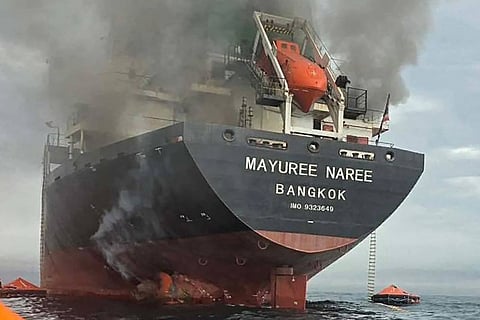
Recently, three vessels (an unnamed container vessel, bulk carrier Mayuree Naree and cargo vessel Expres Rome) were hit by suspected projectiles in the Hormuz "transit zone" within a three-hour period.
It shows the risks to commercial shipping, and demonstrates Iran's chokehold that imperils passage.
This narrow waterway holds significant geostrategic value: it handles about 20% of global oil flows.
More important, it controls about a third of the world's fertiliser supply chain.
Even limited attacks can disrupt shipping routes, spike insurance costs, push oil prices higher, and the price of agricultural products long-term.
The regime used the underground facility to store anti-ship cruise missiles, mobile missile launchers, and other equipment that presented a dangerous risk to international shipping.
It's not immediately clear whether the US bombing run near Hormuz worked as intended against primary targets, or if it was enough to clear the strait for the safe passage of commercial vessels stranded in the Gulf.
In a recent message to troops, Admiral Brad Cooper, commander of the US Central Command in charge of military operations in the Middle East, has confirmed that multiple bombs targetted Iran's underground missile silos.
Penetrator bombs
The bunker busters used the coastal operation are believed to be precision-guided weapons, of which the premier kit is the GBU-57A/B Massive Ordnance Penetrator (MOP).
This 5,000-pound weapon is designed to destroy deeply-buried, hardened targets. Other notable systems include the GBU-28 and GBU-37, optimised for penetrating reinforced concrete and underground bunkers.
Hormuz threat 'degraded'
"We not only took out the facility, but also destroyed intelligence support sites and missile radar relays that were used to monitor ship movements. Iran's ability to threaten freedom of navigation in and around the Strait of Hormuz is degraded as a result."
"We also remain zeroed in on dismantling Iran's decades-old threat to the free flow of commerce throughout the Strait of Hormuz," said Cooper.
He said the order given to military pilots under CentCom are clear: "Our pilots across the board are dynamically hunting threats as well, finding and eliminating targets in real time."
"And we will not stop pursuing these targets," said Admiral Cooper in his latest update on "Operation Epic Fury".
"So far, we’ve struck over 8,000 military targets, including 130 Iranian vessels — constituting the largest elimination of a navy over a 3-week period since World War II. We are taking out thousands of Iranian missiles, advanced attack drones, and all of Iran’s navy, which they use to harass international shipping."Admiral Brad Cooper, Commander of US Central Command
Cooper also noted: Iranian "navy isn’t sailing, their fighters aren’t flying, and they’ve lost the ability to launch missiles at the high rates seen initially."
"Our progress is obvious. US forces maintain air superiority over Iran's skies, having now flown over 8,000 combat flights.
"On day 22 of combat operations, US forces continue to take bold action and remain on plan to eliminate Iran's ability to project meaningful power outside its borders."
He warned that threats to US forces will be met with "overwhelming force".
Iran claims to have killed 50 US service members and hit a Navy ship.
CentCom counters that there have been no reported US casualties and no US Navy ship has been struck, calling the Iranian claims “lies.”
The CentCom commander said they are eliminating imminent threats from the Iranian regime, and that they delivering an “overwhelming and unrelenting blow” as directed.
He said Iran's combat capability is on a steady decline as US-Israeli offensive strikes ramp up.
Admiral Cooper also recognised the air defenders mounting a coordinated defence against Iran's attacks.
Since the start of "Operation Epic Fury", Gulf nations have defended against thousands of Iranian aerial attacks.
Cooper said the successful interception of threats are a "clear demonstration" of the strength of "shoulder-to-shoulder" partnerships.


