Flames and smoke rise from an oil storage facility struck as attacks hit the city during the US–Israeli military campaign in Tehran, Iran
US-Iran war 3 months on: Frozen conflict or fragile ceasefire? What to know
Sanctions, strikes and mistrust keep the region trapped between diplomacy and escalation
Last updated:
5 MIN READ
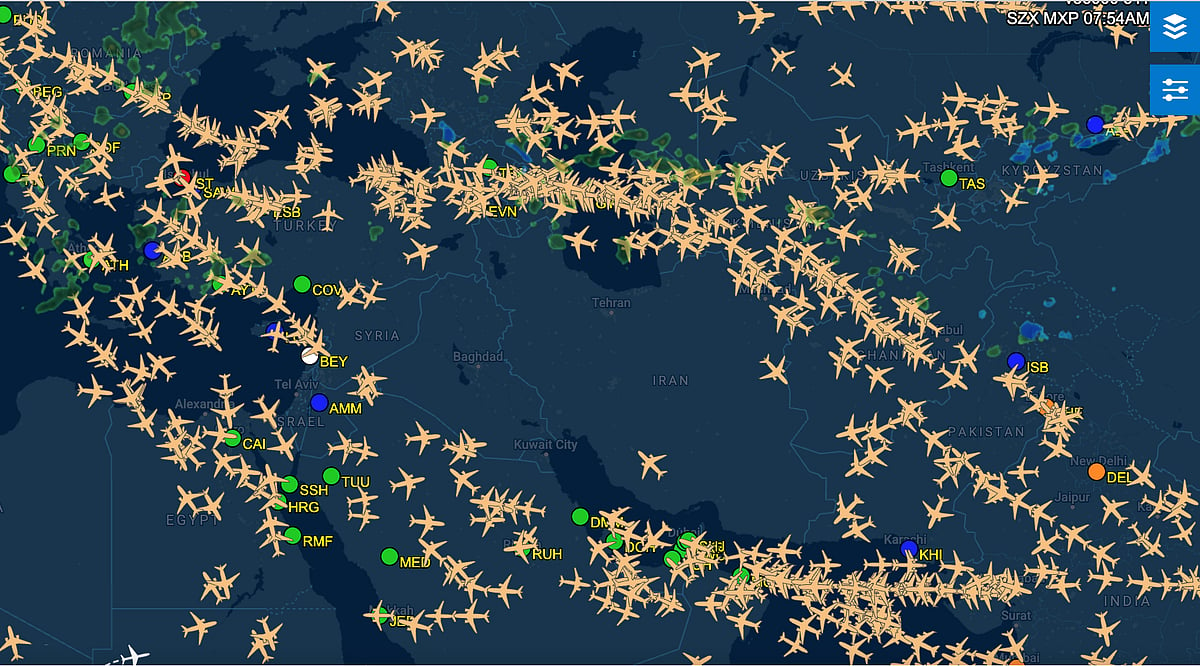
FlightAware data shows airlines rerouting flights around Iranian airspace and conflict-sensitive corridors near the Strait of Hormuz amid continuing regional tensions following the fragile US-Iran ceasefire.
Flightaware.com/live
Dubai: Three months after the war between the United States and Iran began with massive strikes on Iranian targets, the conflict appears to be entering a new and uncertain phase — one defined less by large-scale bombardment and more by brinkmanship, maritime pressure, sanctions and fragile diplomacy.
The latest signs of instability emerged this week after explosions were reported near Bandar Abbas and the Strait of Hormuz following Iranian claims involving a US tanker and IRGC naval activity. Around the same time, Kuwait said its air defences intercepted hostile missiles and drones as warning sirens sounded across the country, underlining how regional tensions continue to spill across the Gulf despite repeated ceasefire efforts.
The developments come nearly three months after the conflict erupted on February 28, when the US and Israel launched coordinated strikes on Iranian military and nuclear-linked sites, triggering the most serious direct confrontation between Washington and Tehran in decades.
While fears of an immediate regional war have eased since the early weeks of fighting, no comprehensive agreement has been reached, and the core disputes driving the conflict remain unresolved.
Instead, analysts say, the war has evolved into a prolonged contest involving naval pressure, economic sanctions, proxy attacks and negotiations repeatedly interrupted by military escalation.
The Strait of Hormuz has emerged as the central fault line in the confrontation.
The narrow waterway, through which roughly a fifth of the world’s oil and gas supplies pass, has increasingly become both a military flashpoint and a bargaining tool as Iran and the US struggle over sanctions, maritime access and regional influence.
Iran war: Key dates and turning points
February 28, 2026 — War begins: The US and Israel launch major strikes on Iranian military and nuclear-linked targets, triggering the most serious direct confrontation between Washington and Tehran in decades.
March — Regional attacks widen: Iran-backed groups across the region intensify attacks, while missile and drone interceptions rise across Gulf states. Maritime tensions in the Strait of Hormuz begin escalating.
April 8 — Ceasefire announced: A temporary ceasefire framework is announced amid fears of a wider regional war, though both sides continue accusing each other of violations.
April 11–12 — Islamabad talks: Senior US and Iranian officials hold indirect talks in Islamabad, with Pakistan and Oman playing mediation roles. No breakthrough is reached after nearly 21 hours of negotiations.
April 13 — US naval pressure intensifies: The US begins expanded maritime enforcement operations near the Strait of Hormuz, increasing inspections and redirecting vessels amid fears of Iranian disruption.
April — UAE intercepts missiles and drones: The UAE reports intercepting multiple ballistic missiles and drones following renewed regional attacks despite the ceasefire, highlighting continuing instability across the Gulf.
April — Fujairah tanker attack raises alarm: A tanker incident near Fujairah intensifies fears over maritime security and the vulnerability of energy shipping routes linked to the Strait of Hormuz crisis.
May — Barakah nuclear plant targeted: The UAE condemns a drone strike near the Barakah Nuclear Energy Plant in Al Dhafra, describing it as a terrorist attack on a peaceful civilian facility and warning against threats to regional energy infrastructure.
April–May — Hormuz becomes central flashpoint: Shipping traffic through the Strait of Hormuz drops sharply as insurers, shipping companies and governments warn of mounting security risks. Discussions emerge over possible transit controls and maritime oversight mechanisms.
May — Ceasefire proposals multiply: Iran and the US exchange multiple draft proposals involving sanctions relief, Hormuz access, uranium stockpiles and phased negotiations, but key disputes remain unresolved.
Late May — Conflict shifts toward pressure tactics: While large-scale strikes become less frequent, tensions increasingly revolve around sanctions, naval manoeuvres, proxy attacks and diplomatic brinkmanship.
This week — Bandar Abbas tensions and Kuwait interceptions: Explosions are reported near Bandar Abbas and the Strait of Hormuz following Iranian claims involving a US tanker and IRGC naval activity. Kuwait says its air defences intercepted hostile missiles and drones as warning sirens sounded across the country, highlighting how fragile the regional situation remains nearly three months into the conflict.
Shipping disruptions, tanker rerouting and fears of attacks on commercial vessels have repeatedly shaken energy markets and raised concerns among Gulf states dependent on stable maritime trade.
Recent reports that Tehran explored mechanisms for greater oversight of ship transit through Hormuz further intensified tensions, prompting warnings from Washington that “nobody is going to control it”.
US President Donald Trump escalated the rhetoric further this week by threatening action against Oman if it cooperated with Iran over Hormuz management.
“Oman will behave just like everybody else or we’ll have to blow ’em up,” Trump said during a White House Cabinet meeting.
The remarks drew attention because Oman has traditionally served as one of the key mediators between Washington and Tehran during periods of regional crisis.
Diplomatic efforts have continued in parallel with the military tensions.
Major obstacles remain
Over the past three months, mediators including Oman and Pakistan have facilitated multiple rounds of indirect negotiations between US and Iranian officials, including talks in Islamabad in April that stretched nearly 21 hours without producing a breakthrough.
Several ceasefire frameworks and draft proposals have reportedly been exchanged, covering issues such as sanctions relief, uranium stockpiles, Hormuz shipping access and phased negotiations.
But major obstacles remain.
Michael Koplow of the Israel Policy Forum previously warned that phased diplomacy could allow leaders to “claim victory while leaving the core issues unsolved” — a risk analysts say is becoming increasingly visible as negotiations drag on without a comprehensive settlement.
Washington continues insisting that Iran surrender or neutralise its enriched uranium stockpile before broader sanctions relief can be considered, while Tehran has repeatedly rejected those demands and accused the US of attempting to dictate terms after military pressure.
The rhetoric from both sides suggests deep mistrust persists despite growing speculation that some form of interim arrangement could eventually emerge.
Iran’s new Supreme Leader this week repeated calls against the United States and Israel, signalling that the ideological dimension of the confrontation remains deeply entrenched even as negotiations continue behind the scenes.
Targeted operations
Military activity has also shifted rather than disappeared.
Instead of the large opening waves of strikes seen earlier in the war, the conflict is increasingly characterised by targeted operations, naval confrontations, cyber activity and pressure through regional allies and proxy groups.
In Lebanon, Hezbollah says it continues attacks on Israeli positions, while Israel has carried out renewed warnings and operations in parts of southern Lebanon. Gaza has also remained volatile despite intermittent ceasefire arrangements.
Analysts say the result is a conflict that now resembles a frozen but highly combustible standoff rather than a conventional war nearing resolution.
Mehran Kamrava, a professor of government at Georgetown University in Qatar, previously warned that the confrontation risked turning into a “frozen conflict” rather than moving toward a decisive resolution.
“For the time being, we might see a short-term frozen conflict, but this cannot continue for several months or years,” he told Al Jazeera in an earlier analysis.
Three months after the first strikes, neither Washington nor Tehran appears willing to fully step back — yet neither side has secured the decisive outcome it once appeared to seek.
That leaves the region facing an uncertain future in which diplomacy, deterrence and the threat of renewed escalation continue to exist side by side.

A Senior Associate Editor with more than 30 years in the media, Stephen N.R. curates, edits and publishes impactful stories for Gulf News — both in print and online — focusing on Middle East politics, student issues and explainers on global topics. Stephen has spent most of his career in journalism, working behind the scenes — shaping headlines, editing copy and putting together newspaper pages with precision. For the past many years, he has brought that same dedication to the Gulf News digital team, where he curates stories, crafts explainers and helps keep both the web and print editions sharp and engaging.
Sign up for the Daily Briefing
Get the latest news and updates straight to your inbox
Network Links
GN StoreAbout Gulf NewsTerms & ConditionsReach by GNSitemapContact usPrivacy PolicyGN FocusHave your sayWork with usAdvertise with usGulf News epaperPrinting Services
Download our app
© Al Nisr Publishing LLC 2026. All rights reserved.