Inside Kobani: Kurdish civilians endure fight

2,000 out of 50,000 people remain, as some sleep in cars and others makeshift tents

Last updated:
2 MIN READ
1.1420648-1372706042
AP Photo/Jake Simkin

Kobani:  One of the few signs of life in this northern Syria border town is the old bakery, revived by Kurdish fighters battling Daesh.

Closed down for some 20 years, the production line now bakes two tons of doughy bread every day to energize the fighters and feed the spatter of civilians left behind.

“We came and fixed up (the bakery) for use in these difficult times,” said Fathi Misiro, a fighter with the People’s Protection Units, or YPG, who works in the bakery. “Ten days ago...it was worse here. We’ve been helping people and sending bread to them daily.”

An exclusive report shot by a video journalist inside Kobani late last month offered a rare, in-depth glimpse of the destruction that more than two months of fighting has inflicted on the Kurdish town in northern Syria by the Turkish border.

Outside the bakery, children playfully jump in and out of foxholes - barely fazed by the thunderous explosions nearby. Kobani as it was has been virtually erased. Rubble is all that remains of people’s homes and their memories. Shops are gutted. Schools are flattened.

Kurdish fighters backed by small numbers of Iraqi peshmerga forces and Syrian rebels are locked in what they see as an existential battle against Daesh, which swept into their town in mid-September. The advance was part of a summer blitz after Daesh overran large parts of Syria and neighbouring Iraq.

The YPG, an armed secular faction, is at the forefront of the struggle to save Kobani.

Helped by more than 270 airstrikes from a US-led coalition and an American airdrop of weapons, the Kurds have succeeded in halting the militants’ advance and believe that a corner has been turned.

But the battle comes at a heavy price for the town’s remaining residents. While most managed to flee across the nearby border with Turkey, some 2,000 Kurdish civilians opted to stay with the hope that fighting will soon subside. It is a small fraction of the population of 50,000 that once filled these streets.

A rain of mortars

They sleep in their cars or makeshift tents on the outskirts of the town, where barbed wire and land mines mark the Turkish border. Militant-fired mortars rain down on them regularly.

Some farmers escaped with their machinery and livestock. Others lost everything.

“My sheep were taken. I lost my cow, for God’s sake, my hens, my bedding, our sacks of wheat were stolen,” one woman said, expressing gratitude for the bread the YPG fighters are providing.

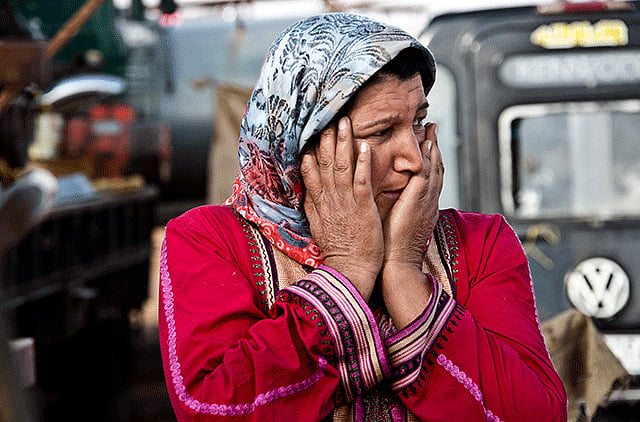
Then, there are those who lost loved ones as the militants moved in. Another woman named Parvin had to carry her two injured daughters to safety after they were hit by mortar fire. Her 7-year-old was then sent to Turkey and died there.

“We brought her body back and buried her here in Kobani,” said Parvin, her heartache written on her face. She asked to be identified only by her first name.

In this Saturday, Nov. 22, 2014 photo, children by the fence line with Turkey in Kobani, Syria. Here, Kurdish fighters backed by small numbers of Iraqi peshmerga forces and Syrian rebels, are locked in what they see as an existential battle against the Islamic State group, who swept into their town in mid-September as part of a summer blitz after the Islamic State group overran large parts of Syria and neighboUring Iraq. But the battle comes with an onerous price for the town’s residents. While most managed to flee across the nearby border with Turkey, some 2,000 Kurdish civilians have opted to stay with the hope that fighting will soon subside -- a shocking contrast from the population of 50,000 that once filled these streets.
In this Saturday, Nov. 22, 2014 photo, children play in the buffer zone near the Turkish border in Kobani, Syria. Here, Kurdish fighters backed by small numbers of Iraqi peshmerga forces and Syrian rebels, are locked in what they see as an existential battle against the Islamic State group, who swept into their town in mid-September as part of a summer blitz after the Islamic State group overran large parts of Syria and neighboring Iraq. But the battle comes with an onerous price for the town’s residents. While most managed to flee across the nearby border with Turkey, some 2,000 Kurdish civilians have opted to stay with the hope that fighting will soon subside _ a shocking contrast from the population of 50,000 that once filled these streets.
In this Saturday, Nov. 22, 2014 photo, a girl looks into the camera by the fence line with Turkey in Kobani, Syria.
In this Saturday, Nov. 22, 2014 photo, a woman has her clothes to dry by the buffer zone in Kobani, Syria. Here, Kurdish fighters backed by small numbers of Iraqi peshmerga forces and Syrian rebels, are locked in what they see as an existential battle against the Islamic State group, who swept into their town in mid-September as part of a summer blitz after the Islamic State group overran large parts of Syria and neighboring Iraq. But the battle comes with an onerous price for the town’s residents. While most managed to flee across the nearby border with Turkey, some 2,000 Kurdish civilians have opted to stay with the hope that fighting will soon subside _ a shocking contrast from the population of 50,000 that once filled these streets.
In this Wednesday, Nov. 19, 2014 photo, a man works in a recently restored bakery to make bread for the coalition forces and the civilians stuck in Kobani, Syria. The chief baker has a record that there is 3,600+ civilians that need bread daily. One of the few signs of life in this northern Syria border town is the old bakery, brought back online by Kurdish fighters battling the Islamic State group. Closed down for some 20 years, men with the People’s Protection Units now work the production line, baking two tons of doughy Arabic bread every day to energize the fighters and feed the spatter of civilians left behind.
In this Saturday, Nov. 22, 2014 photo, bread is distributed by the Kurdish People’s Protection Units (YPG) in Kobani, Syria. The chief baker has a record that there is 3,600+ civilians that need bread daily. One of the few signs of life in this northern Syria border town is the old bakery, brought back online by Kurdish fighters battling the Islamic State group. Closed down for some 20 years, men with the People’s Protection Units now work the production line, baking two tons of doughy Arabic bread every day to energise the fighters and feed the spatter of civilians left behind
In this Saturday, Nov. 22, 2014 photo, smoke rises from fighting in Kobani, Syria, as seen from the buffer zone near the Turkish border. Kurdish fighters backed by small numbers of Iraqi peshmerga forces and Syrian rebels, are locked in what they see as an existential battle against the Islamic State group, who swept into their town in mid-September as part of a summer blitz after the Islamic State group overran large parts of Syria and neighboring Iraq. But the battle comes with an onerous price for the town’s residents. While most managed to flee across the nearby border with Turkey, some 2,000 Kurdish civilians have opted to stay with the hope that fighting will soon subside _ a shocking contrast from the population of 50,000 that once filled these streets.
In this Saturday, Nov. 22, 2014 photo, bread is distributed by the Kurdish People’s Protection Units (YPG) in Kobani, Syria. The chief baker has a record that there is 3,600+ civilians that need bread daily. One of the few signs of life in this northern Syria border town is the old bakery, brought back online by Kurdish fighters battling the Islamic State group.
In this Wednesday, Nov. 19, 2014 photo, Kurdish People's Protection Units (YPG) soldiers walk near the town entrance circle heading to their strongholds in Kobani, Syria. Here, Kurdish fighters backed by small numbers of Iraqi peshmerga forces and Syrian rebels, are battling what they see as an existential battle against the militants who swept into their town in mid-September as part of a summer blitz that saw the group seize large chunks of territory in Syria and neighboring Iraq.

Sign up for the Daily Briefing

Get the latest news and updates straight to your inbox