USS Tripoli enters the Singapore Straits, amid the US- Israeli conflict with Iran, as seen from Singapore (Photo/ Reuters)
How US Marines could reopen the Strait of Hormuz — and break the blockade
Marines: Fastest way to reopen the world’s most critical oil chokepoint isn’t ships?
Last updated:
4 MIN READ
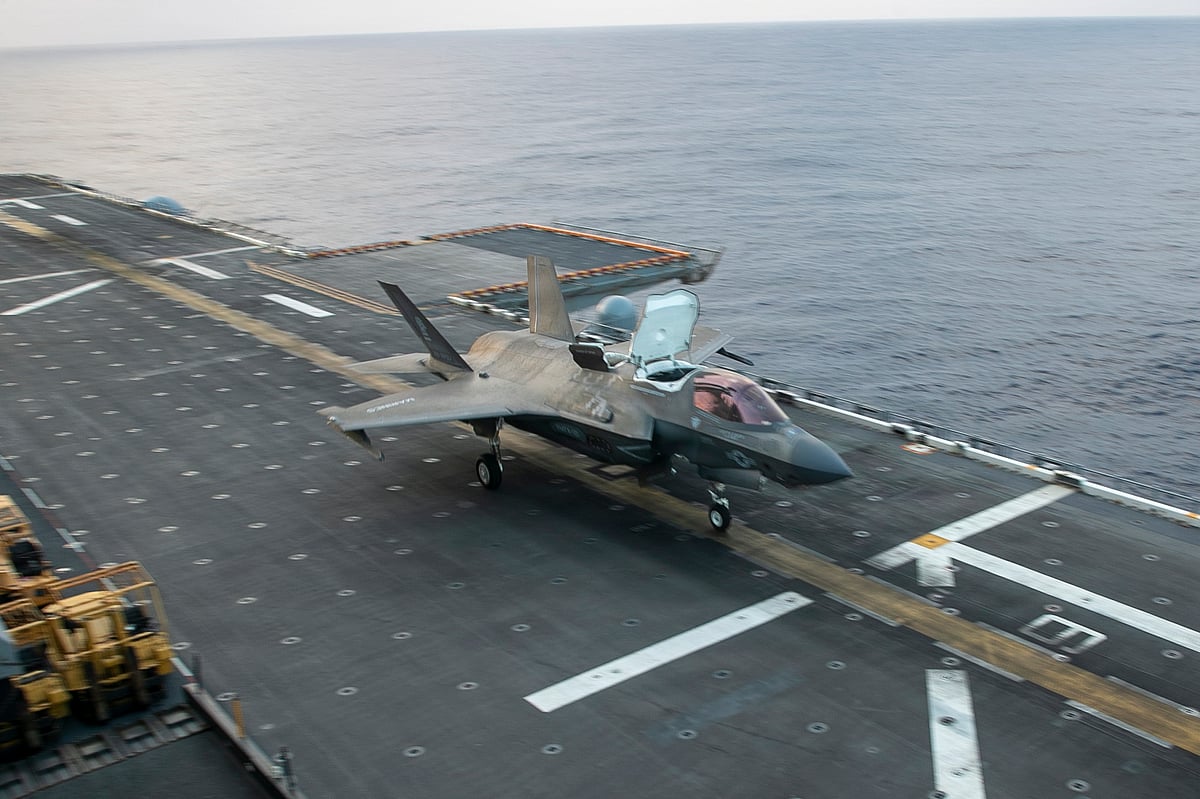
An F-35B launches from a ship. The deployment of the USS Tripoli (LHA 7) and the 31st MEU forms part of the "Peace Through Strength," bringing 2,200 elite Marines and F-35B stealth power to the doorstep of the IRGC.
X | @USMC
The Strait of Hormuz is not just an oil tanker passage. It’s a key waterway in global trade.
The Islamic Revolutionary Guard Corps (IRGC) uses a brutally simple playbook here: squeeze the world economy through this narrow gate — and control the gate.
At just 39 km wide at its narrowest, shipping is funneled into two tight lanes, each about 2 miles across.
Giant tankers laden with millions of barrels of crude have virtually no room to manoeuvre — rendering them exposed and easy targets the moment they enter this gate.
Enter the Marines
How to open Hormuz? Currently, the IRGC dominates key islands in and around Hormuz — Larak, Qeshm, and Abu Musa — effectively turning them into armed fortresses.
It forms part of IRGC’s layered “area denial” strategy. Amid a near-paralysis, reopening the strait where nearly 20% of global oil flows poses a tough challenge.
An F-35B launches from a ship. The deployment of the USS Tripoli (LHA 7) and the 31st MEU forms part of the "Peace Through Strength," bringing 2,200 elite Marines and F-35B stealth power to the doorstep of the IRGC.
Ground and coast operations
The risk-laden ground and coast operations will most likely fall on the shoulders of the US Marine Corps.
A US Navy warship carrying Marines is reportedly now off to the area after crossing the Malacca Strait off Singapore, CNN reported, citing maritime tracking data.
The Okinawa-based 31st US Marine Expeditionary Unit (MEU) — a rapid-response force of 2,200 personnel, is now en route to the Central Command theatre, following a reported deployment order from the Pentagon.
The Ground Combat Element (GCE) of a Marine Expeditionary Unit is a reinforced infantry battalion. It includes reconnaissance, engineers, armoured vehicles, artillery, and "other" combat capabilities.
It is led by the amphibious assault ship USS Tripoli (departed Okinawa, Japan on March 11), based on AIS tracking data.
Once in place, the Marines are not doing it alone — it would be a joint fight led by the US Navy, with Marines playing a fast, surgical, and highly strategic role.
Possible role of the Marines in Hormuz
Their key role: controlling key terrain, neutralising coastal threats, and enabling naval forces to safely clear and secure the waterway.
Realistically, here’s how the US Marines would see action:
#1. Seizing, securing key coastal terrain
The narrow geography of Hormuz means whoever controls the coastline controls the fight. Marines — especially expeditionary units — could:
Conduct amphibious or heliborne assaults to seize Iranian missile and radar sites along the coast
Capture small but strategic islands used for surveillance or anti-ship weapons
Establish forward positions to deny Iran the ability to target shipping lanes
These operations would likely involve units like Marine Expeditionary Units (MEUs), trained for rapid deployment and coastal warfare.
US Marines emplace sonar buoys as part of "Exercise Dynamic Manta 26", a Nato-led exercise aimed to provide challenging warfare training to enhance proficiency in anti-submarine and anti-surface warfare disciplines.
#2. Destroying anti-ship missile threats
Iran’s primary leverage in Hormuz comes from land-based IRGC anti-ship missiles.
Marines can:
Deploy long-range precision fires (e.g., HIMARS) from captured or allied territory
Conduct raids to destroy mobile missile launchers
Use drones and forward observers to locate and target hidden systems
This reduces the threat envelope so Navy ships and commercial vessels can pass safely.
Marines with the 2nd Marine Division take part in a military exercise designed to enhance mobility and integration between the US Marine Corps and the US Navy.
#3. Support Mine Countermeasure (MCM) operations
One of the biggest threats in Hormuz is naval mining.
While the US Navy handles mine-clearing, Marines help by:
Securing nearby coastlines to prevent further mine-laying
Establishing staging areas for mine countermeasure ships and helicopters
Providing force protection for vulnerable clearing operations
Without Marines locking down the shore, mine-clearing becomes far more dangerous.
The US Marines Logistics Combat Element of a Marine Expeditionary Unit, which provides transport, medical, dental, ammunition, maintenance, and other critical service support.
#4. Expeditionary Advanced Base Operations (EABO)
This is where Marines are evolving the most.
Under EABO doctrine, they would:
Set up small, mobile bases across islands and coastlines
Deploy anti-ship missiles to create “counter-denial zones”
Use sensors to track Iranian naval and drone movements
In effect, Marines would flip the script — denying Iran the ability to deny the strait.
#5. Special operations and raids
Marine Raiders (MARSOC) could:
Conduct covert raids on high-value targets (missile depots, drone hubs)
Disrupt command-and-control networks
Coordinate with allied and proxy forces in the region
These actions would degrade Iran’s ability to sustain a blockade.
The Strait of Hormuz: US Marines could be sent to the area to degrade Iran’s ability to sustain a blockade.
#6. Protecting commercial shipping
Once the immediate threat is reduced, Marines may:
Deploy aboard vessels or escort ships for security
Secure critical ports and oil terminals in nearby allied states
Assist in humanitarian or evacuation missions if the conflict spills over
'Cleaning' Hormuz Strait
Marines don’t “clear” necessarily the strait — they make it possible to clear and keep open.
By removing coastal threats, seizing key terrain, and supporting naval dominance, they enable the broader joint force to restore freedom of navigation.
In a Hormuz clearing scenario, the decisive advantage comes from integration: Marines on the shore, the Navy at sea, and airpower overhead — all working to dismantle IRGC’s layered denial strategy and free up one of the world’s most critical arteries.
A Marine Corps F-35C Lightning II, attached to Marine Fighter Attack Squadron (VMFA) 314, launches from the flight deck of the aircraft carrier USS Abraham Lincoln (CVN 72) in support of Operation Epic Fury.
Sign up for the Daily Briefing
Get the latest news and updates straight to your inbox
Network Links
GN StoreAbout Gulf NewsTerms & ConditionsReach by GNSitemapContact usPrivacy PolicyGN FocusHave your sayWork with usAdvertise with usGulf News epaperPrinting Services
Download our app
© Al Nisr Publishing LLC 2026. All rights reserved.