Hezbollah members hold flags marking Resistance and Liberation Day, in Kfar Kila near the border with Israel, southern Lebanon.
How Iran war revived Hezbollah, derailed Lebanon’s disarmament push
Push to curb terror group stalled as conflict reshaped the battlefield
Last updated:
4 MIN READ
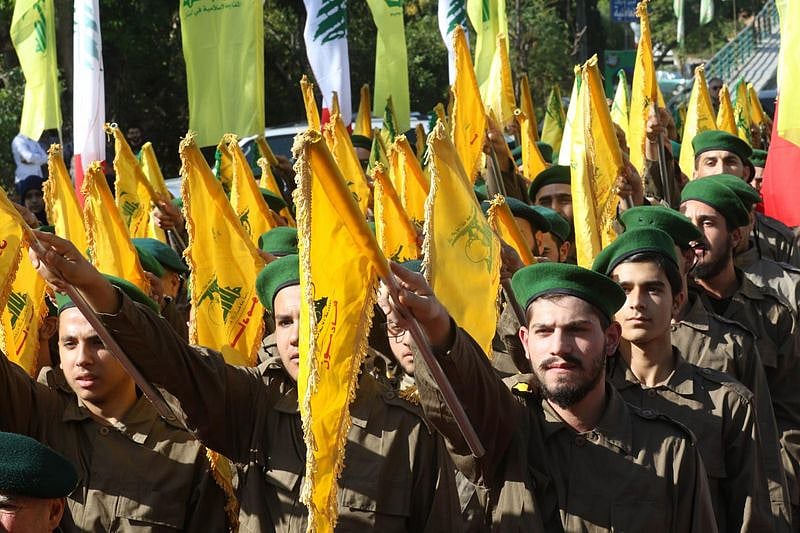
Members of Hezbollah. Hezbollah’s return to active fighting following the outbreak of war between Iran, Israel and the United States has complicated Lebanon’s plans to curb the group’s military power and reassert state authority.
AFP
Dubai: Earlier this year, Lebanon’s leaders appeared closer than they had been in decades to achieving one of the country’s most elusive goals: Disarming Hezbollah, the powerful Iran-backed militia that has long operated as a state within a state.
According to a report by the The New York Times, Hezbollah’s return to active fighting following the outbreak of war between Iran, Israel and the United States has complicated Lebanon’s plans to curb the group’s military power and reassert state authority.
The setback highlights a dilemma that has haunted Lebanon for years: How to deal with an armed movement that is simultaneously a political party, a military force and one of Iran’s most important regional allies.
A rare opening
Following years of conflict that weakened Iran’s regional network, including Hezbollah, Lebanese officials and their Western backers believed a rare window had opened.
A US-backed ceasefire in late 2024 envisioned Hezbollah gradually surrendering weapons, particularly in southern Lebanon near the Israeli border, in exchange for an end to Israeli military operations.
Momentum appeared to build after a new Lebanese government took office in 2025, pledging to prioritise the issue.
Prime Minister Nawaf Salam directed the military to prepare a roadmap for dismantling Hezbollah’s arsenal, while the Lebanese army reportedly removed thousands of rockets and missiles from areas south of the Litani River.
For the first time in years, disarmament no longer appeared impossible.
Hezbollah explained
Hezbollah: How the group emerged and became a regional force
Founded: 1982
Meaning: Hezbollah translates to “Party of God” in Arabic.
Origins: The group was formed during the Israeli invasion of Lebanon in 1982, with support from Iran’s Islamic Revolutionary Guard Corps (IRGC).
Base of support: Primarily Lebanon’s Shiite Muslim community.
Key objectives:
Resist Israeli military presence in Lebanon
Expand Iran’s regional influence
Maintain an armed “resistance” force independent of the Lebanese state
Political role: Hezbollah is both a political party and an armed organisation. It holds seats in Lebanon’s parliament and has been part of coalition governments.
Military strength: The group is believed to possess one of the largest non-state arsenals in the world, including rockets, missiles, drones and anti-tank weapons.
Regional footprint: Beyond Lebanon, Hezbollah militants have operated in Syria and have supported Iran-backed groups across the Middle East.
Terrorist designation: Hezbollah is listed as a terrorist organisation by the UAE, the GCC, the United States, the United Kingdom and several other countries.
Why it matters: Hezbollah’s military power has long challenged the authority of the Lebanese state and made it a central player in regional conflicts involving Israel and Iran.
Iran war changes the equation
That optimism faded after Israel and the United States launched military operations against Iran in late February.
Within days, Hezbollah resumed attacks on Israel in support of Tehran, demonstrating that despite years of pressure and conflict, it still possessed significant military capabilities.
Israel responded with intensified operations in southern Lebanon, while Hezbollah launched rockets, anti-tank missiles and drone attacks.
The renewed fighting effectively froze efforts to persuade the group to disarm.
Analysts told The New York Times that Hezbollah is unlikely to relinquish its weapons while Iran retains influence across the region and continues to view the group as a critical part of its deterrence strategy.
“Lebanon will have to wait for change in Tehran before it can turn a page regarding Hezbollah’s defiance of the Lebanese national interest,” Lina Khatib, a visiting scholar with Harvard Kennedy School’s Middle East Initiative, told The New York Times.
“It will be tough, but it is existential for Lebanon. Our fundamental effort is to get there without a civil war.”
Why Lebanon is reluctant
Lebanon’s government faces enormous political and security risks in confronting Hezbollah directly.
The group remains deeply rooted within parts of Lebanon’s Shiite community and is widely regarded as more powerful than the country’s own armed forces.
Many Lebanese also fear that any attempt to forcibly seize Hezbollah’s weapons could trigger internal conflict and revive memories of the country’s devastating 15-year civil war.
While the government has declared Hezbollah’s military operations illegal, officials have largely avoided direct confrontation.
Experts say that balancing Western pressure for disarmament against fears of domestic instability remains one of the country’s biggest challenges.
What comes next?
The issue remains central to US-mediated talks involving Lebanon and Israel.
Washington has repeatedly called for stronger action against Hezbollah, while some analysts have proposed international mechanisms to oversee a gradual disarmament process.
But with fighting continuing, parts of southern Lebanon still under Israeli control, and Hezbollah showing little willingness to surrender its arsenal, the prospects for a breakthrough appear increasingly remote.
“Lebanon is facing a moment of truth,” said Heiko Wimmen of International Crisis Group. “Whether it will defer or delay resolving the question of disarmament will define what’s to come next for the country.
For now, the opportunity that briefly emerged after years of regional upheaval appears to have been overtaken by another war — one that has once again placed Hezbollah at the centre of Middle East tensions.
Sign up for the Daily Briefing
Get the latest news and updates straight to your inbox
Network Links
GN StoreAbout Gulf NewsTerms & ConditionsReach by GNSitemapContact usPrivacy PolicyGN FocusHave your sayWork with usAdvertise with usGulf News epaperPrinting Services
Download our app
© Al Nisr Publishing LLC 2026. All rights reserved.