Beirut: The military operation against Syrian rebels led to lifting the siege of rebel-held parts of east Aleppo and threatened to overrun western parts of the city, which are still held by the Syrian government. It spread panic among pro-regime circles and surged the morale of the Syrian Opposition.
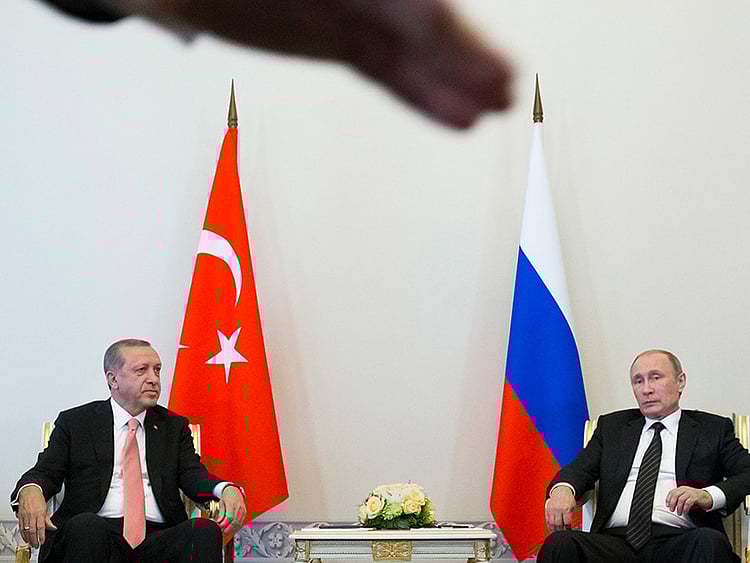
Briefly it signalled an eminent collapse of everything Russian President Vladimir Putin has been working to achieve since his warplanes joined the Syria War last September. A high-profile Turkish-Russian summit took place in St Petersburg last Tuesday, however, shifting battlefield dynamics in his favour, followed by a visit to Ankara by Iranian foreign minister Javad Zarif.
Both meetings, described as warm and productive, were about Aleppo. If Putin gets his way, then this will certainly affect the future of Aleppo and perhaps that of the entire Syria War.
The rebel counter-offensive took both the Syrians and Russians off-guard and gave a tremendous moral boost to the opposition fighters. Government troops, originally in shock and awe, are now back on the defensive, with strong support from Hezbollah and the Russian Air Force, trying to re-take the Artillery School of Aleppo, which was overrun by the Syrian opposition on August 6.
State-run media claimed that over 150,000 fighters participated in the counter-offensive, with seven major back-to-back attacks in one single night, while opposition sources put the number at just 7,000. The initial response was to heavily bomb the city of Idlib in northwestern Syria, where the families of Syrian fighters are housed.
The hope was for the rebels to throw down their guns and rush back to Idlib to save their families. Then came the Erdogan-Putin summit, followed by a high-profile visit by the Iranian minister to Ankara, where he was given unprecedented homage — treated more like a head of state than a foreign minister.
Zarif exchanged niceties with his Turkish counterpart, Mevlut Cavusoglu, and the two men pledged to work together, saying that they saw things eye-to-eye on Syria, spreading panic in Syrian Opposition circles. It was noteworthy that Zarif was the first regional foreign minister to visit Turkey after the failed coup attempt in mid-July.
The Turks had expected such a visit from his Saudi counterpart Adel Al Jubeir, but Iranian diplomacy took the initiative first, probably at the advice of the Russians, winning the appreciation of Turkish leaders. Additionally both Iranian and Russian state media have been surprisingly silent about Erdogan’s purge of officers, journalists, politicians, and academics, which was music to the ears of Ankara, unlike American and European media, which have accused him of authoritarianism and showing dictatorial tendencies.
Clearly from the warmth of both meetings, Erdogan is strategically re-positioning himself right into the Russian orbit, feeling abandoned and betrayed by the Americans, especially after they refused to extradite his archenemy Fethullah Gulen from the US.
There are reports that point to Russian intelligence services helping Erdogan abort the coup attempt last July, topped with a telephone call from President Putin, congratulating Erdogan for suppressing his opponents. According to sources in Damascus and Moscow, at their summit last week, the two leaders agreed to work together to bring an end to the Syria War.
Erdogan pledged to close his border with Syria by late August, preventing the influx of fighters and their return to Turkey, and promised to expel fighters from Chechnya and the Caucasus on Turkish soil, in addition to providing detailed intelligence on their names, backgrounds, and whereabouts.
Reciprocating, Putin promised to use his influence to prevent the emergence of a Kurdish state on the Syrian-Turkish border, and to abandon Kurdish proxies in the Syrian battlefield, who have been bankrolled and armed by the Russians since September. He also agreed to abandon Russia’s Kurdish allies in the upcoming round of talks in Geneva, which are now tentatively scheduled for late August.
Abortion of a Kurdish project was vital for Erdogan, and Putin promised to deliver if Erdogan looked the other way as the Syrian Army took Aleppo and ditched his proxies in the Syrian battlefield, namely, Jaish Al Fatah and Ahrar Al Sham, which are heavily present in the Syrian north and played a vital role in the Aleppo counter-offensive.
In testimony to just how far the Russian-Turkish understanding is going, a Russian aircraft cruiser, Admiral Kuzuestsov, arrived at the Russian military base in Hmaymeen on the Syrian coast, unloading 40 Russian warplanes, in addition to the 35 ones already in operation in Syrian skies. They will be used in the upcoming operation to repel opposition advances on Aleppo, with silent approval seemingly, from President Erdogan.
Additionally three military airbases in Syria — namely, Mezzeh in Damascus, Kweires in the north, and T4 in Palmyra, are being rebuilt and upgraded by the Russians, also in preparation for an upcoming surge for Aleppo. Interestingly, state-run media in Damascus has not blamed the Turks for the counter-offensive in Aleppo, giving Erdogan leeway to manoeuvre after his meeting with Putin.
The accusations are fired against Saudi Arabia and Qatar but not a word was said against Turkey. Everything was blamed on Shaikh Abdullah Mahaysni, the Saudi cleric who is leading Syrian Islamists in the Aleppo battles. After the siege was lifted he appeared in an online video, telling his supporters that not even 20 per cent of their manpower was used in breaking the blockade, promising, “The upcoming days will be great.”
Sign up for the Daily Briefing
Get the latest news and updates straight to your inbox
Network Links
GN StoreDownload our app
© Al Nisr Publishing LLC 2026. All rights reserved.