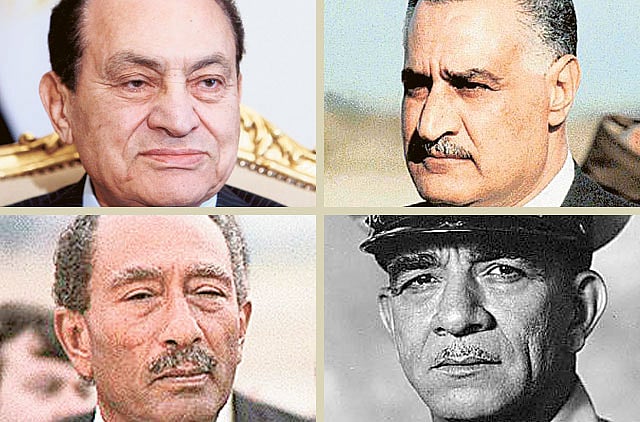
Mohammad Najeeb
Leader of a group of Egyptian army officers who overthrew the monarchy in Egypt in 1952. He became the country's first president in June 1953. The ruling group, calling themselves the Free Officers, removed Najeeb from the post in November 1954 after a disagreement and put him under house arrest. In his memoirs, published in 1984, Najeeb attributed his dispute with his one-time comrades to his pro-reform drive that included restrictions on the military's powers. "The army left the barracks and spread within all civil departments and ministries, causing a big catastrophe from which Egypt is still suffering," he added in his memoirs, titled "I Was Egypt's President". Najeeb died in August 1984 in Cairo at the age of 82.
Jamal Abdul Nasser
An army officer who became Egypt's second president ruling from November 1954 to September 1970. He was a champion of Arab nationalism and called for revolutions in the third world against "colonialism and their agents in the ruling systems". He survived an assassination attempt in October 1954 in the Egyptian coastal city of Alexandria, which was blamed on the then Muslim Brotherhood. Nasser became a populist leader among Egyptians due to his policy to achieve social justice and the nationalisation of the Suez Canal in July 1956. He died of a heart attack in September 1970 at the age of 52.
Anwaral Sadat
Nasser's vice-president. He became his successor, ruling from September 1970 to October 1981. Al Sadat, an ex-army officer, gradually moved away from his predecessor's policy of socialism and close ties with the former Soviet Union. Having won a military victory over Israel in October 1973, Al Sadat shifted alliance to the US. In November 1977, Al Sadat caused a worldwide stir by travelling to Israel, a trip that cleared the way for a peace treaty he signed two years later with Tel Aviv. In 1978, he shared the Nobel Peace Prize with the then Israeli prime minister Menachem Begin. In the autumn of 1981, Al Sadat ordered that more than 1,830 opponents be detained. On October 6, 1981, he was assassinated by Muslim militants during a military parade in Cairo.
Hosni Mubarak
Al Sadat's vice-president and a former air force chief. He became Egypt's fourth president in October 1981, a post he held until February 2011 when he was forced to step down in a popular revolt.Mubarak started his rule by releasing opponents imprisoned by former rulers. But his critics accused him of pursuing economic and social policies, which benefited only the rich. Under Mubarak, Egypt's relations with the Arab world, strained after Al Sadat's peace treaty with Israel, remarkably improved. His supporters praise him for not plunging Egypt in regional wars. However, the opposition accuses him of allowing his family to meddle in state affairs. His younger son, Jamal, made a meteoric rise starting from the early 2000 inside the then ruling National Democratic Party, amid claims that he was being groomed to succeed his father.Mubarak, 84, and his two sons, Ala'a and Jamal, are being tried on charges of corruption and ordering the killing of peaceful protesters. A verdict in their cases is due on June 2.
Sign up for the Daily Briefing
Get the latest news and updates straight to your inbox
Network Links
GN StoreDownload our app
© Al Nisr Publishing LLC 2026. All rights reserved.