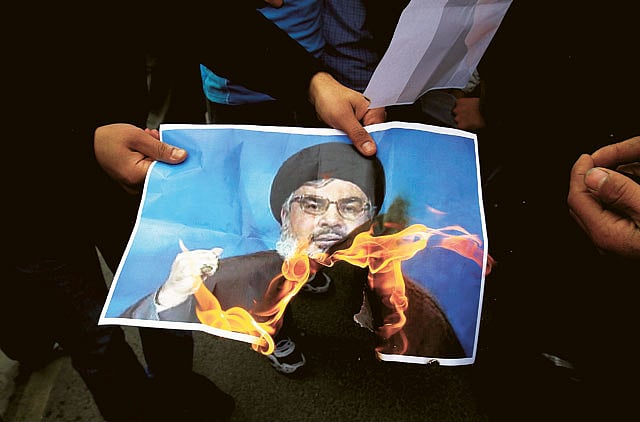
Beirut: Mazen, a carpenter who organises protests against President Bashar Al Assad in a suburb of Damascus, Syria, has torn down the posters of Hassan Nasrallah, the leader of Hezbollah, that once decorated his car and shop.
Like many Syrians, Mazen, 35, revered Nasrallah for his confrontational stance with Israel. He considered Hezbollah, the Lebanese group and political party, as an Arab champion of the dispossessed, not just for its Shiite Muslim base but for Sunnis like himself.
But now, with Hezbollah having stood by Al Assad during his deadly year-long crackdown on the uprising against his rule, Mazen sees Hezbollah as a sectarian party that supports Al Assad because his opponents are mainly Sunnis.
"Now, I hate Hezbollah," he said.
"Nasrallah should stand with the people's revolution if he believes in God."
Behind the scenes, Nasrallah personally tried and failed to start a reconciliation process in Syria early in the uprising and is now renewing those efforts, said Ali Barakeh, a Hamas official involved in the talks.
"He refuses the killing for both sides," said Barakeh, the Beirut representative for Hamas.
Barakeh said Nasrallah visited Damascus last April and briefly persuaded Assad to try to reach a political solution, with Hezbollah and Hamas acting as mediators.
But as Hamas began reaching out to fellow Sunni Muslims in the opposition, the plan was scuttled by the Syrian government.
Fears of backlash
Hezbollah rarely allows official interviews and has refused them for months. But supporters and current and former party activists suggest that the situation is fuelling fears of an anti-Shiite backlash and is testing loyalists who must explain the party's position to others, and to themselves.
Nasrallah is tempering his position because he wants to avoid asking supporters to endure another war, said a former student activist who spends hours defending the party on Facebook, arguing, for example, that rogue forces, not Al Assad, are responsible for the "mistakes."
Nasrallah "doesn't want supporters to suffer," said the woman, who works at a Hezbollah foundation, adding that some still feel "broken inside" from the 2006 war with Israel and "don't want more pressure."
To a young, college-educated health care worker who is a lifelong supporter of Hezbollah, the party's support of Al Assad keeps faith with the most important principle of all: opposing Israel.
"This revolution is not made in Syria," she told friends at a seaside cafe in Sidon, Lebanon, after shopping at a shiny new mall. "The real target is Lebanon and the resistance."
Echoing the party line, she said the United States and its Arab allies fomented Syria's revolt to punish Hezbollah for fighting the Israelis in 2006. But that argument has frayed. Hamas, unable to disown Syria's Sunni revolutionaries, declared itself neutral, angering Al Assad and leading it to leave Damascus. Some Hamas leaders from Gaza went further, praising the Syrian revolution to crowds that shout, "No, no, Hezbollah."
Hatred
Deprived of Hamas' political cover, Hezbollah has been accused of sectarian hatred, and has been its target as well.
Syrian rebels have burned the Hezbollah flag, claimed that its snipers are killing civilians in Syria, and named their brigades after historic warriors who defeated Shiites in Islam's early schismatic battles.
Early on, some analysts thought that if a Sunni government would arise in Damascus it might support Hezbollah against Israel. But now, says Michael Wahid Hanna of the Century Foundation, Hezbollah may have missed a chance to hedge its bets.
— New York Times News Service
Sign up for the Daily Briefing
Get the latest news and updates straight to your inbox
Network Links
GN StoreDownload our app
© Al Nisr Publishing LLC 2026. All rights reserved.