Trump warns IRGC to surrender or face certain death: What to know about Iran’s elite military force
From foreign proxy wars to domestic crackdowns, IRGC is backbone of security system
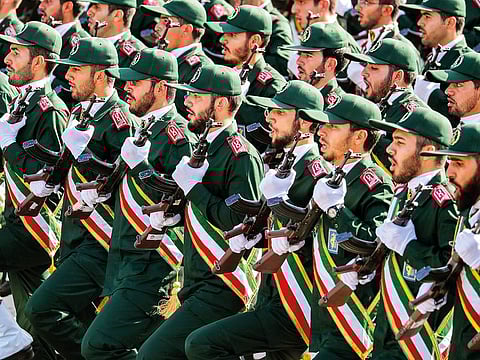
Dubai: As US President Donald Trump has announced what he described as a “major” and “ongoing” military operation against Iran, he issued a direct warning to the country’s most powerful security institution — the Islamic Revolutionary Guard Corps (IRGC).
“To the members of the Islamic Revolutionary Guard, the armed forces, and all of the police, I say tonight that you must lay down your weapons and have complete immunity or, in the alternative, face certain death,” Trump said in his address on Friday night.
Meanwhile, Reuters reported that Gen. Mohammad Pakpour, the IRGC chief, was killed in Israeli strikes, citing three sources familiar with the matter. Iranian officials have not yet publicly confirmed the report, and details remain unclear.
The IRGC is not just another military branch. It is the backbone of Iran’s ruling system and answers directly to Supreme Leader Ayatollah Ali Khamenei.
As Israel and the United States strike Iranian military targets — and as questions swirl about Iran’s leadership and decision-making — understanding the IRGC is key to understanding how Tehran may respond.
What is the IRGC?
The Islamic Revolutionary Guard Corps was created in 1979 following Iran’s Islamic Revolution.
When the shah was overthrown, revolutionary leaders sought to build a force loyal not to the state alone, but to the Islamic system itself. Various paramilitary groups that helped topple the monarchy merged into what became the IRGC.
Unlike Iran’s regular army, which is tasked with defending the country’s borders, the IRGC exists to protect the Islamic Republic and its clerical leadership.
Over time, it became the most powerful branch of Iran’s military establishment.
Today, the IRGC is estimated to comprise between 150,000 and 190,000 personnel. It operates its own ground forces, navy, aerospace force, intelligence units, and cyber capabilities — independent of the conventional armed forces.
It also wields significant economic influence, with stakes in construction, energy, telecommunications and other major sectors of Iran’s economy.
What role does the IRGC play in Iran’s power structure?
As outlined in Iran’s layered political system, ultimate authority rests with the Supreme Leader — and the IRGC answers directly to him.
The corps plays a central role in:
Protecting the regime from internal dissent
Projecting Iranian influence abroad
Overseeing missile development and strategic weapons
Coordinating national security decisions through the Supreme National Security Council
In times of crisis, such as the current escalation with Israel and the United States, decision-making narrows to a small circle that includes the Supreme Leader, senior IRGC commanders and top security officials.
The IRGC has also been instrumental in suppressing domestic protests, including mass demonstrations that erupted over economic grievances in recent months.
What Is the Quds Force?
The Quds Force is the IRGC’s elite external operations arm.
It is responsible for foreign missions and regional alliances. Over the decades, it has cultivated and supported a network of allied non-state actors across the Middle East.
These include:
Hezbollah in Lebanon
Hamas in Gaza
The Houthis in Yemen
Various militia groups in Iraq and Syria
The Quds Force has played a key role in expanding Iran’s regional influence, often operating through proxy forces rather than direct confrontation.
What Is the Basij?
The Basij is another IRGC-affiliated branch focused on domestic enforcement.
Its name means “mobilisation” in Farsi. It is a volunteer force drawn largely from conservative and lower-income segments of society.
The Basij operates as a street-level enforcement body, assisting in:
Policing protests
Enforcing Islamic codes of conduct
Supporting regime security during unrest
During previous waves of demonstrations, the Basij has been deployed to quell protests and maintain order.
Why is the IRGC central to the current conflict?
Trump’s warning directly to IRGC members underscores how central the corps is to Iran’s defence and political system.
US officials have said the current campaign aims to degrade Iran’s missile capabilities and military infrastructure — much of which falls under IRGC control.
Iran has already retaliated with missile launches across the region, and analysts say further escalation could involve IRGC-linked forces or allied groups.
Because the IRGC sits at the intersection of military power, political loyalty and economic influence, any attempt to weaken the regime inevitably runs through it.
Whether the current strikes shift that balance — or entrench the corps further — remains uncertain.


