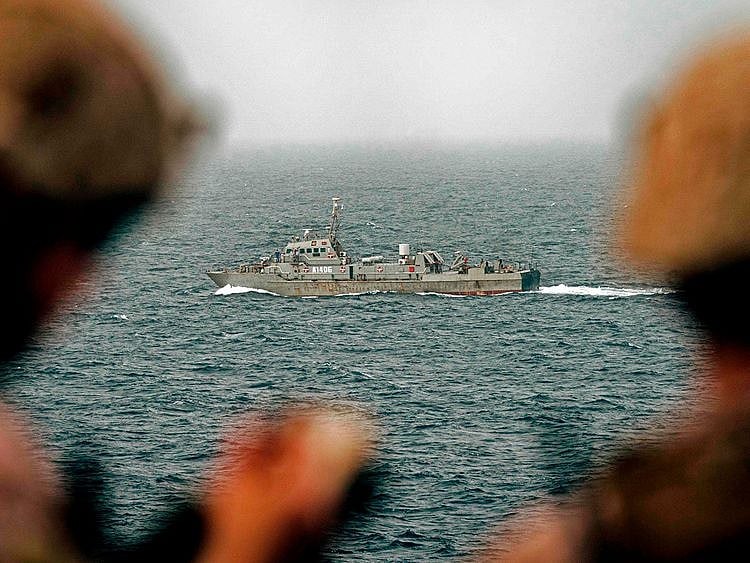
Last month Iran proposed a law that stated the financial gains from the strait should be paid in the local rial currency.
Dubai: In defiance of international pressure and growing condemnation from Gulf states, Iran’s Revolutionary Guard has declared that the Strait of Hormuz is no longer merely a narrow maritime passage but part of a vastly expanded “strategic operational zone” stretching hundreds of kilometres across the Gulf.
The comments came as tensions deepened over Iran’s continued restrictions in the vital waterway and Kuwait revealed it had foiled an alleged infiltration attempt by four members of Iran’s Islamic Revolutionary Guard Corps (IRGC).
According to Iran’s Tasnim news agency, quoted by Al Jazeera, Mohammad Akbarzadeh, deputy political chief of the IRGC Navy, said Tehran’s military view of the Strait of Hormuz had fundamentally changed.
“The Strait of Hormuz was considered a limited area around islands like Hormuz when defined, but today this perspective has changed,” Akbarzadeh said.
What is IRGC?
The Islamic Revolutionary Guard Corps, established after Iran’s 1979 revolution, is regarded as the country’s most powerful military and ideological force and operates separately from the regular army.
With an estimated strength of more than 190,000 personnel across its naval, aerospace, ground and intelligence branches, the IRGC plays a central role in Iran’s regional military operations and security strategy.
Its naval wing has frequently been accused by Gulf and Western governments of harassing commercial shipping, seizing vessels and supporting covert maritime operations across the region.
He claimed the operational zone had expanded from just 32-48km (20-30 miles) to 320-480km (200-300 miles), stretching from Jask and Sirri Island to areas beyond Qeshm Island and Greater Tunb, forming what he described as a “complete arc”.
International law guarantees freedom of transit passage through strategic waterways like Hormuz, where nearly a fifth of global oil trade passes daily.
The remarks are likely to alarm the regional states and global shipping operators already grappling with severe disruption in one of the world’s most critical energy chokepoints.
The Strait of Hormuz handles roughly a fifth of global oil shipments, and international maritime law guarantees freedom of transit passage through such waterways. Iran’s repeated attempts to impose conditions or restrictions on movement through the strait have triggered widespread criticism from Western and Gulf governments.
Qatar warning
Qatari Prime Minister Sheikh Mohammed bin Abdulrahman bin Jassim Al Thani warned on Tuesday that the waterway was being turned into a geopolitical weapon.
Speaking alongside Turkish Foreign Minister Hakan Fidan, Sheikh Mohammed said the Middle East crisis and the Strait of Hormuz standoff were having severe repercussions on Gulf states, especially economically.
“Iran should not use this strait as a weapon to pressure or to blackmail the Gulf countries,” he said.
A spokesperson for the Iranian government meanwhile said Tehran was still “holding the trigger” despite pursuing negotiations.
“We fought the world’s greatest military power for 40 days, and we are still holding the trigger and waiting for a negotiated settlement,” government spokesperson Fatemeh Mohajerani was quoted as saying by ISNA news agency.
Kuwait foils IRGC infiltration bid
The rhetoric came as Kuwait announced that authorities had thwarted what it described as a hostile infiltration operation involving members of Iran’s Revolutionary Guards.
According to Kuwait’s interior ministry, four men arrested earlier this month after attempting to enter the country by sea confessed to belonging to the IRGC. The group included two navy colonels, a captain and a lieutenant commander.
The suspects allegedly attempted to infiltrate Kuwait’s Bubiyan Island aboard a fishing boat “specially chartered to carry out hostile actions against Kuwait”, the ministry said in a statement carried by state news agency Kuna.

A Senior Associate Editor with more than 30 years in the media, Stephen N.R. curates, edits and publishes impactful stories for Gulf News — both in print and online — focusing on Middle East politics, student issues and explainers on global topics. Stephen has spent most of his career in journalism, working behind the scenes — shaping headlines, editing copy and putting together newspaper pages with precision. For the past many years, he has brought that same dedication to the Gulf News digital team, where he curates stories, crafts explainers and helps keep both the web and print editions sharp and engaging.
Sign up for the Daily Briefing
Get the latest news and updates straight to your inbox
Network Links
GN StoreAbout Gulf NewsTerms & ConditionsReach by GNSitemapContact usPrivacy PolicyGN FocusHave your sayWork with usAdvertise with usGulf News epaperPrinting Services
Download our app
© Al Nisr Publishing LLC 2026. All rights reserved.