Oman urges humanitarian initiative to free trapped ships in disrupted Strait of Hormuz
Maritime bodies warn prolonged closure risks humanitarian and economic fallout
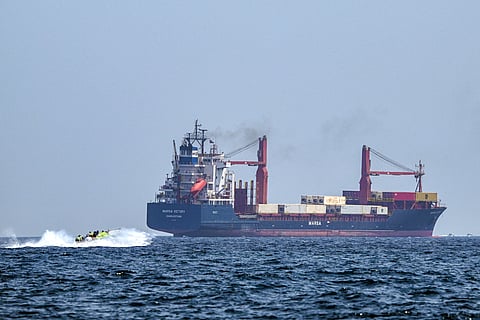
Oman Foreign Minister Badr Albusaidi said there is an “urgent need” to free commercial vessels stranded along the Strait of Hormuz after talks with Arsenio Dominguez, head of the International Maritime Organisation (IMO).
“We focused on the maritime challenge in the Strait of Hormuz, the importance of adherence to international law, and respect for the sovereignty of territorial waters. There is an urgent need to advance a humanitarian initiative to free ships in the Gulf, in safety and in cooperation with the littoral states,” Albusaidi wrote in a social media post.


Get updated faster and for FREE: Download the Gulf News app now - simply click here.
Control
The appeal comes as Iran moves to assert greater control over traffic through the strait, which has been effectively constrained for weeks amid conflict involving the United States and Israel.
More than 20,000 seafarers remain stranded at sea and over 2,000 commercial vessels are caught in a web of risks and restrictions to navigation, according to the United Nations
The narrow waterway, shared by Iran and Oman, is one of the world’s most vital shipping corridors, carrying a large share of global oil exports from Gulf producers such as Saudi Arabia and Kuwait to international markets.
Oman has long positioned itself as a neutral broker in regional tensions, previously helping mediate ceasefire talks and urging all parties to respect international maritime law and territorial sovereignty as the crisis drags on.
In his comments after the IMO meeting, Foreign Minister Badr Al-Busaidi stressed that maritime safety and freedom of navigation are essential for global trade and called on littoral states to cooperate on a safe mechanism to clear the backlog of vessels.


