Oman now matters more to India as Hormuz disrupts ships
New CEPA gives Indian exporters wider access to gateway that sits outside Strait of Hormuz
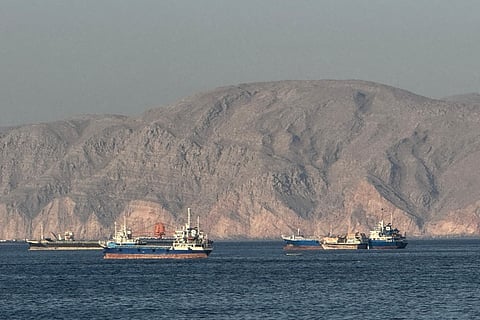
Dubai: The India-Oman Comprehensive Economic Partnership Agreement (CEPA) came into force on Monday, opening duty-free access for most Indian exports to Oman and deepening economic ties between the two countries.
Get updated faster and for FREE: Download the Gulf News app now - simply click here.
At first glance, the agreement is a trade pact focused on reducing tariffs and boosting commerce. Its strategic importance, though, has grown amid disruptions around the Strait of Hormuz, one of the world's most important shipping routes.
For India, the deal strengthens ties with a Gulf partner whose ports can remain accessible even when traffic through Hormuz is disrupted.
Why Hormuz matters
The Strait of Hormuz handles around 20 per cent of global daily oil consumption and roughly a quarter of global seaborne oil trade. Any disruption in the narrow waterway can affect energy supplies, freight costs and trade flows across major economies.
Recent tensions in the Gulf have underscored those risks. India's imports from major Gulf economies fell from about $15 billion in April 2025 to $9.8 billion in April 2026, while exports to the region dropped from $4.4 billion to $2.7 billion.
Oman's advantage
Unlike many Gulf countries, much of Oman's coastline lies outside the Strait of Hormuz, facing directly onto the Arabian Sea and the Gulf of Oman.
Major ports such as Salalah and Duqm remain accessible even when shipping traffic through the Strait faces disruption. This allows Oman to continue functioning as a trade and energy gateway during periods of regional instability.
The recent trade data highlights that advantage. While India's trade with several Gulf economies weakened, imports from Oman surged 246.4 per cent from $430 million to nearly $1.5 billion in April 2026, driven by higher purchases of crude oil and urea. India's exports to Oman fell by only 10.3 per cent during the same period.
What CEPA delivers
Under the agreement, Oman is granting duty-free access on 98.08 per cent of its tariff lines, covering 99.38 per cent of India's exports to the country. Before the CEPA, only 15.3 per cent of Indian exports enjoyed zero-duty access.
The benefits extend across labour-intensive sectors including textiles, leather, footwear, gems and jewellery, engineering products, pharmaceuticals, medical devices, furniture, plastics and agricultural goods.
Announcing the implementation of the agreement, Union Commerce and Industry Minister Piyush Goyal described it as "a defining milestone" in Prime Minister Narendra Modi's mission to create "global pathways to prosperity" for students, artisans, women, farmers, fishermen and MSMEs by opening new markets, boosting exports, attracting investments and accelerating job creation.
No import duties
Indian exports to Oman were valued at about $3.64 billion in fiscal 2026, led by refined petroleum products, calcined alumina, iron and steel products, machinery and rice. According to Goyal, the elimination of Omani import duties will make a wide range of Indian products more competitive in the market.
"Sectors dominated by small businesses such as iron and steel, textiles, leather, auto components and industrial equipment, could see large international orders after the agreement," he said.
He also pointed to potential employment gains from higher exports. "Increased textiles exports to Oman will boost production and create jobs across major clusters such as Tirupur, Surat, Ludhiana, Panipat, Coimbatore, Karur, Moradabad, Jaipur, and Ahmedabad. Artisans and weavers across India will also gain from higher international demand for their products," Goyal said.
Beyond goods trade
The CEPA also includes commitments on services, investment and professional mobility.
Indian professionals, including business visitors, contractual service suppliers, independent professionals and intra-corporate transferees, will benefit from easier entry and stay provisions. Oman has also committed to allowing 100 per cent foreign direct investment by Indian companies in key services sectors.
The agreement further provides faster marketing approvals for pharmaceutical products already cleared by regulators such as the US Food and Drug Administration, the European Medicines Agency and the UK's Medicines and Healthcare Products Regulatory Agency.
What Oman gets
India has agreed to liberalise tariffs on 77.79 per cent of its tariff lines, covering 94.81 per cent of imports from Oman by value.
The biggest gains are expected in sectors where Oman is already a major supplier to India, including crude oil, liquefied natural gas, fertilisers, methanol and ammonia. India imported $7.2 billion worth of goods from Oman in fiscal 2026.
The agreement also provides preferential access for products such as dates, frankincense, Gum Arabic, petrochemicals and marble blocks. Sensitive Indian sectors including dairy, tea, coffee, tobacco, jewellery and certain labour-intensive products have been kept outside tariff concessions.
More than trade
Trade agreements are often assessed by the tariffs they remove and the exports they generate. The India-Oman CEPA arrives with another dimension.
As businesses and governments reassess supply chains exposed to the Strait of Hormuz, the agreement strengthens India's commercial links with a Gulf country whose geographic position offers access to trade routes beyond the region's most critical maritime chokepoint.