A person points at a page on the Marinetraffic website that shows commercial boats traffic on the edge of the Strait of Hormuz near the Iranian coast, in Paris on March 4, 2026.
Defying maritime law, Iran imposes new shipping rules in Strait of Hormuz
Tehran turning wartime leverage into long-term control over a vital global waterway
Last updated:
4 MIN READ
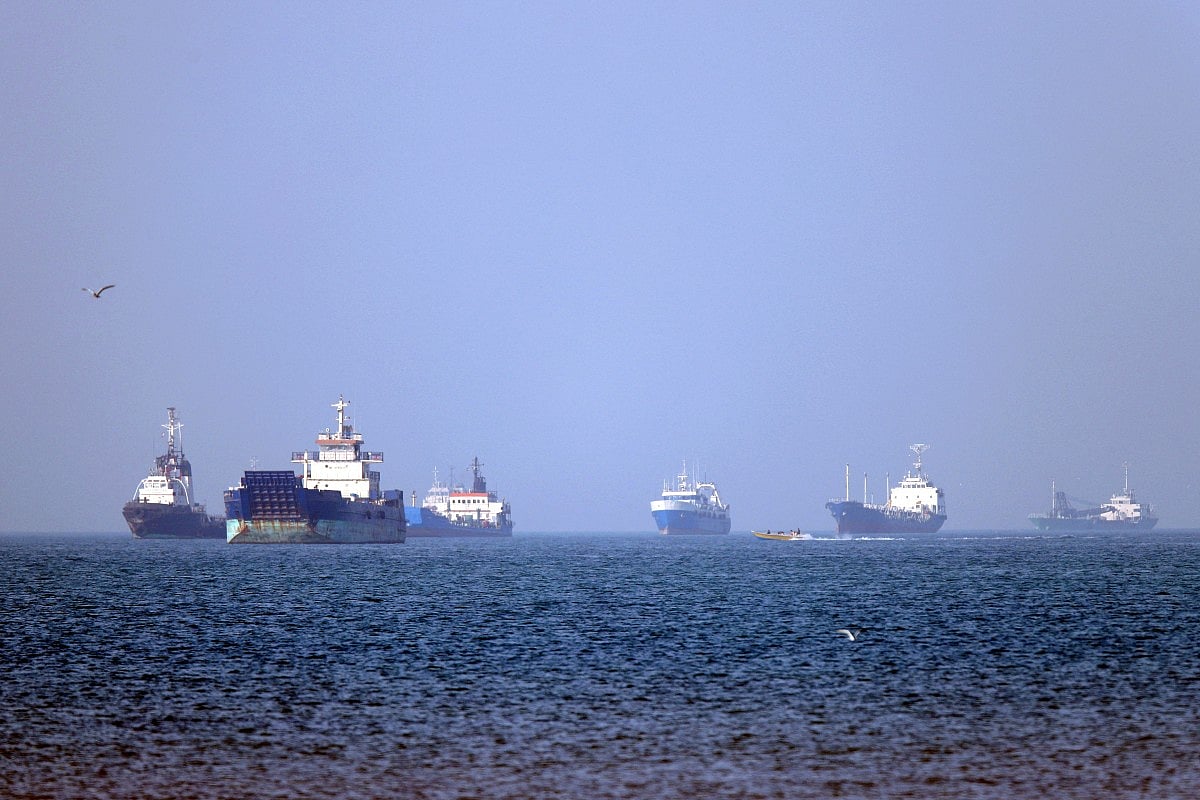
Vessels are pictured anchored in the Strait of Hormuz off Bandar Abbas in southern Iran. Analysts warn that even if the war subsides, Tehran may seek to preserve some form of strategic control over the passage.
AFP
Dubai: Defying international law governing global waterways, Iran is trying to force shippers to comply with a new protocol for transiting the Strait of Hormuz — or risk attack.
According to a document seen by CNN, Tehran has introduced new rules for vessels seeking passage through the strategic waterway, pressing ahead with efforts to formalise control over Hormuz despite repeated US and regional warnings.
The document, titled “Vessel Information Declaration,” was issued by Iran’s newly created Persian Gulf Strait Authority (PGSA). It requires vessels transiting Hormuz to submit detailed information, including ownership, crew nationalities, cargo details and voyage plans, before entering the waterway.
The move marks a dramatic shift in one of the world’s most important shipping corridors.
Before the US-Israeli military campaign against Iran began in late February, vessels of all nationalities freely crossed the strait. But since the conflict erupted, Iran has repeatedly threatened to target ships passing through Hormuz without approval from the Islamic Revolutionary Guard Corps (IRGC) navy.
Maritime analysts say Tehran now appears to be transforming wartime leverage into an attempt at long-term strategic control.
Disruption
The Strait of Hormuz carries around one-fifth of global oil and liquefied natural gas supplies, making it one of the most critical chokepoints in the global economy. The disruption has already sent energy prices sharply higher, with US gasoline prices rising above $4.50 a gallon for the first time in four years.
Shipping traffic has collapsed.
Only 40 vessels crossed the strait during the week ending May 3, according to Lloyd’s List, compared with a pre-war average of around 120 crossings a day. Marine tracking data on Thursday showed almost no tanker or freight traffic moving through the corridor.
The deeper concern for Western governments and shipping firms is not merely the disruption itself, but Iran’s apparent effort to normalize authority over an international waterway.
Under the United Nations Convention on the Law of the Sea (UNCLOS), international straits used for global navigation are governed by the principle of “transit passage,” allowing ships of all nations to move continuously and freely without requiring permission from coastal states.
Legal experts say no country can unilaterally convert such waterways into a permission-based corridor or impose selective restrictions on civilian shipping.
Challenging the framework
Iran’s new procedures appear to challenge that framework directly.
The PGSA documents warn that incomplete or inaccurate information could lead to “consequences” for vessels seeking passage.
Shipping companies also fear complying with the Iranian process could expose them to US sanctions — especially if transit payments are involved.
According to maritime risk consultancy Marisks, Iran is already demanding what it calls “toll fees” from some vessels in exchange for safe passage through Hormuz. Analysts say those payments may reach as high as $2 million per ship.
What international law says
International straits used for global navigation are protected under the UN Convention on the Law of the Sea (UNCLOS).
Ships of all nations have the right of “transit passage” through such waterways without requiring permission from coastal states.
Coastal countries cannot normally suspend or selectively block civilian passage through international straits.
Hormuz is considered one of the world’s most critical global shipping chokepoints.
Maritime experts say no country can legally convert an international waterway into a unilateral toll corridor.
Any attempt to impose mandatory permissions or transit fees risks violating established freedom of navigation principles.
The US Treasury Department has warned that payments to Iran or the IRGC linked to Hormuz transit would not be authorized for American entities.
Iran’s leadership has increasingly framed control of Hormuz as a strategic wartime gain. Statements attributed to Supreme Leader Mojtaba Khamenei have called for new “management” mechanisms for the waterway and a reduced foreign military presence in the Gulf.
Richard Meade of Lloyd’s Intelligence told CNN the new system appeared designed to “formalize” Iranian authority over transits through the strait.
Analysts warn that even if the war subsides, Tehran may seek to preserve some form of strategic control over the passage.
Caught in the middle
Matt Wright of marine intelligence firm Kpler said prolonged Iranian dominance over Hormuz would keep shipping flows well below normal levels, with major consequences for global oil and gas markets.
Caught in the middle are thousands of civilian sailors trapped in increasingly dangerous conditions.
Dimitris Maniatis, chief executive of maritime risk consultancy Marisks, told CNN that nearly 20,000 seafarers aboard close to 1,000 vessels remain stuck in the Gulf amid the confrontation.
“Mariners are not soldiers,” Maniatis said. “They are civilians who are piloting vessels, who are managing global trade.”
Washington has repeatedly insisted it will not accept permanent Iranian control over the strait. Yet the abrupt launch and suspension of the US naval escort mission known as “Project Freedom” has also highlighted the difficulty of restoring free navigation without risking wider escalation.
For now, the battle over Hormuz is increasingly becoming about more than wartime pressure. Analysts warn that if Iran succeeds in normalizing restrictions, permissions and transit fees in the strait, the consequences could reshape global shipping and energy markets long after the conflict itself ends.

A Senior Associate Editor with more than 30 years in the media, Stephen N.R. curates, edits and publishes impactful stories for Gulf News — both in print and online — focusing on Middle East politics, student issues and explainers on global topics. Stephen has spent most of his career in journalism, working behind the scenes — shaping headlines, editing copy and putting together newspaper pages with precision. For the past many years, he has brought that same dedication to the Gulf News digital team, where he curates stories, crafts explainers and helps keep both the web and print editions sharp and engaging.
Sign up for the Daily Briefing
Get the latest news and updates straight to your inbox
Network Links
GN StoreAbout Gulf NewsTerms & ConditionsReach by GNSitemapContact usPrivacy PolicyGN FocusHave your sayWork with usAdvertise with usGulf News epaperPrinting Services
Download our app
© Al Nisr Publishing LLC 2026. All rights reserved.