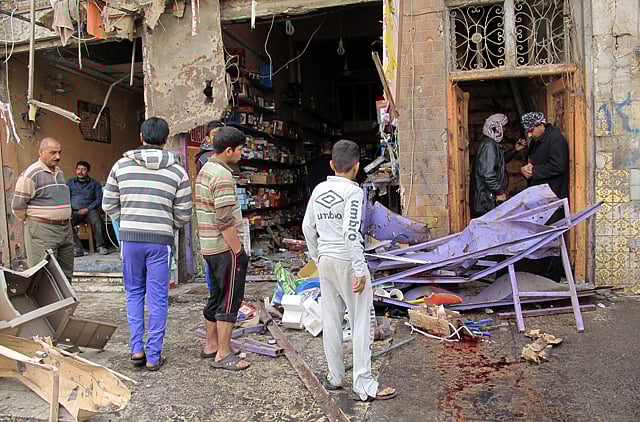
Baghdad: A wave of attacks in Baghdad Thursday killed at least 60 people and wounded nearly 150 as Iraq faced a political crisis, with its vice president accused of running death squads and the premier warning he could break off power-sharing.
The apparently coordinated blasts, which left nearly 150 people wounded, were the first major sign of violence in a crisis that has threatened the country's fragile political truce and heightened sectarian tensions just days after US forces completed their withdrawal from Iraq.
Rush hour
The attacks, the deadliest in more than four months, largely coincided with the morning rush hour, and security forces cordoned off bomb sites, AFP correspondents and officials said.
Iraqi helicopters could be heard hovering overhead at many of the blast sites and emergency response vehicles rushed to the scene of attacks, while tightened security at checkpoints worsened Baghdad's already choking traffic.
Earlier it was reported that an interior ministry official, speaking on condition of anonymity, said 27 people were killed and 133 people wounded in 11 apparently coordinated attacks.
Health ministry spokesman Ziad Tariq had put the toll at 31 killed and 143 wounded.
The attacks, the deadliest in more than two weeks, largely coincided with the morning rush hour, and security forces cordoned off bomb sites, AFP correspondents and officials said.
They struck in the Allawi, Bab Al Muatham and Karrada districts of central Baghdad, the Adhamiyah, Shuala and Shaab neighbourhoods in the north, Jadriyah in the east, Ghazaliyah in the west and Al Amil and Dura in the south, the officials said.
Loggerheads
The violence comes with Iraqi politicians at loggerheads over a warrant issued for the arrest of Vice President Tareq Al Hashemi, with Prime Minister Nuri Al Maliki demanding that Kurdish authorities hand over the Sunni Arab leader, who is holed up in their autonomous region. Hashemi denies the charges.
Maliki has also called for his Sunni deputy Saleh Al Mutlak, who belongs to the same Iraqiya bloc as Hashemi, to be sacked after he described the Shiite-led government as a "dictatorship".
Iraqiya, meanwhile, has boycotted parliament and the cabinet, and Maliki has threatened to replace their ministers in the year-old unity government.
Sign up for the Daily Briefing
Get the latest news and updates straight to your inbox
Network Links
GN StoreDownload our app
© Al Nisr Publishing LLC 2026. All rights reserved.