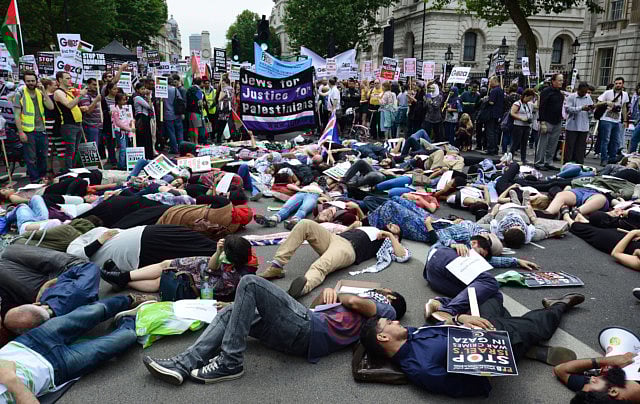
Dubai: Despite tens of thousands of protesters who gathered in London on Saturday to express solidarity with Palestinians under Israeli attack in Gaza, the BBC did not have a single mention of it on its website.
Estimates ranged from 50,000 to 100,000 participants, making the rally one of the largest in recent years in London. The sheer numbers of people brought central London to a virtual standstill all day, yet the story failed to grab the BBC’s attention.
The credibility of the news organisation comes under scrunity, given that the corporation’s integrity and quality reporting have been admired in the past. However, many observers believe that the state’s prevailing orthodoxy and pro-Israeli bias have managed to infiltrate the organisation’s editorial policy.
A report on electronic intifada highlighted that in 2012, Raffi Berg, the new Middle East Editor of BBC, sent internal emails guiding his staff to write more favourably about Israel during its assault on Gaza in November 2012 which killed nearly 200 Palestinians. The report also accuses Berg of instructiing writers to word stories in way that does not blame or “put undue emphasis” on Israel for attacks.
Journalists were instead told to write that rockets were aimed at “ending rocket fire from Gaza”. The editorial decision of BBC reflects a more prevalent and worrying trend of Western-media bias when reporting the conflict in Palestine. A media monitoring group, Palestine Centre, analysed CNN’s reportage of Israel’s eight-day attack on Gaza in November 2012. It revealed that a total of 45 Israeli officials were interviewed by CNN, compared with just 20 Palestinian officials.
An ongoing, but incomplete, analysis of this year’s violence by the Palestine Centre shows that this is happening once more. Between June 30 and July 9, CNN interviewed a total of 17 Israeli officials, but just one Palestinian official.
A 2003 study by Matt Viser published in the International Journal of Press Politics found that the New York Times personalised Israeli deaths, largely ignored Palestinian deaths, and relied heavily on Israeli sources.
A 2001 study by Seth Ackerman showed that National Public Radio covered 89 per cent of Israeli child deaths and only 20 per cent of Palestinian child deaths. Washington State University’s Susan Ross similarly studied New York Times editorial coverage of the Israel-Palestine conflict, finding that Israelis were presented as victims and Palestinians as aggressors.
Sign up for the Daily Briefing
Get the latest news and updates straight to your inbox
Network Links
GN StoreDownload our app
© Al Nisr Publishing LLC 2026. All rights reserved.