Khartoum: Armed security agents on Friday raided AFP’s Khartoum office and arrested a freelance photographer who had taken pictures of anti-regime protests, as Canada joined in criticism of the crackdown in Sudan.
Two agents from the National Intelligence and Security Service (NISS), one of them wielding a pistol, seized Talal Sa’ad, a local journalist who was working freelance with AFP, at about 1550 GMT.
They said they would take him to NISS offices in Bahri district to be released in two hours. But after that time his phone was disconnected.
The raid took place shortly after Sa’ad arrived at the AFP office with pictures he had taken of a protest in Khartoum’s twin city of Omdurman.
Witnesses there said police fired tear gas and rubber bullets to disperse hundreds of peaceful protesters on the 14th straight day of anti-regime demonstrations sparked by inflation.
Protesters had gathered in Hijra Square beside the mosque of the opposition Ummah party. Police said the crowd numbered in the thousands and one person was reported injured.
One witness said demonstrators carried Sudanese flags and banners reading “The people want the regime to fall,” a slogan used by protesters during the Arab Spring uprisings against regional strongmen over the past year.
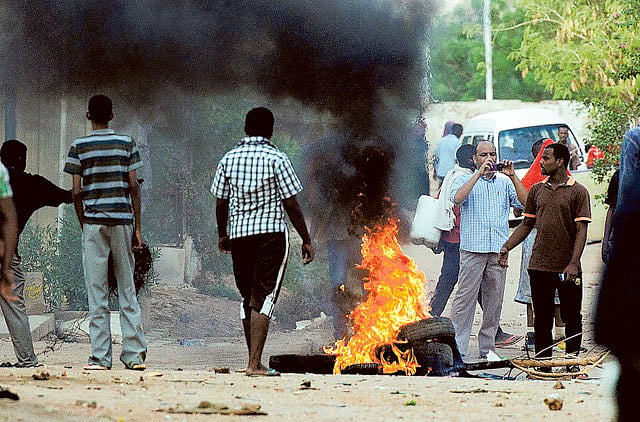
After the tear gassing and an unknown number of arrests, demonstrators burned tyres and threw stones at police before running for cover, the witness said.
Similar running battles between protesters and police took place in the Bahri district, where tear gas was also fired, the witness added.
Demonstrators planned major protests for Friday and Saturday, the 23rd anniversary of a coup by President Omar Al Bashir.
In the raid on AFP, one NISS officer slammed a magazine into his silver pistol, refused to let AFP’s staff correspondent make a telephone call and threatened to seize every computer in the bureau unless the pictures were deleted. AFP complied with the request.
Sa’ad is a Sudanese journalist with the local newspaper Al Tayar.
National Security agents last week held AFP correspondent Simon Martelli for more than 12 hours without charge after he talked to students and took pictures at the University of Khartoum, where protests sparked by inflation began two weeks ago.
A correspondent for international news wire Bloomberg, Salma Al Wardany, an Egyptian, was deported on Tuesday, after also being detained while trying to cover the country’s protest movement.
Amid increased international criticism of Sudan’s crackdown, Canada’s top diplomat said on Friday he was “concerned”.
“We condemn the arrests of bloggers, journalists and political activists that have taken place over the last week and call for their immediate release,” Foreign Affairs Minister John Baird said.
“We impress upon the government the importance of carrying out a genuine and inclusive reform process that addresses the true needs and interests of the Sudanese people.”
UN High Commissioner for Human Rights Navi Pillay on Thursday urged the government to avoid “heavy-handed suppression” of protests.
She called on Sudan “to immediately and unconditionally release those who have been detained for merely exercising their rights to freedom of assembly and expression.
“Reports of ill treatment in detention are very worrying and must be investigated promptly.”
Britain and the United States have also sought the immediate release of those detained for peaceful protest.
Human rights groups say scores of people have been detained.
After Al Bashir announced austerity measures, including tax hikes and an end to cheap fuel, the protests spread to include a cross-section of people in numerous locations throughout the capital and other parts of Sudan.
Demonstrators, typically in groups of 100 to 200, have burned tyres, thrown stones and blocked roads in a call for regime change which has almost universally been met by police tear gas.
Al Bashir has played down the demonstrations as small-scale and not comparable to the Arab Spring uprisings in Egypt and elsewhere, maintaining that he himself remains popular.
Sign up for the Daily Briefing
Get the latest news and updates straight to your inbox
Network Links
GN StoreDownload our app
© Al Nisr Publishing LLC 2026. All rights reserved.