Look west after sunset on June 9: Venus, Jupiter stage a rare planetary meet-up visible to the naked eye
Last chance: Venus and Jupiter appear almost touching — why astronomers are excited
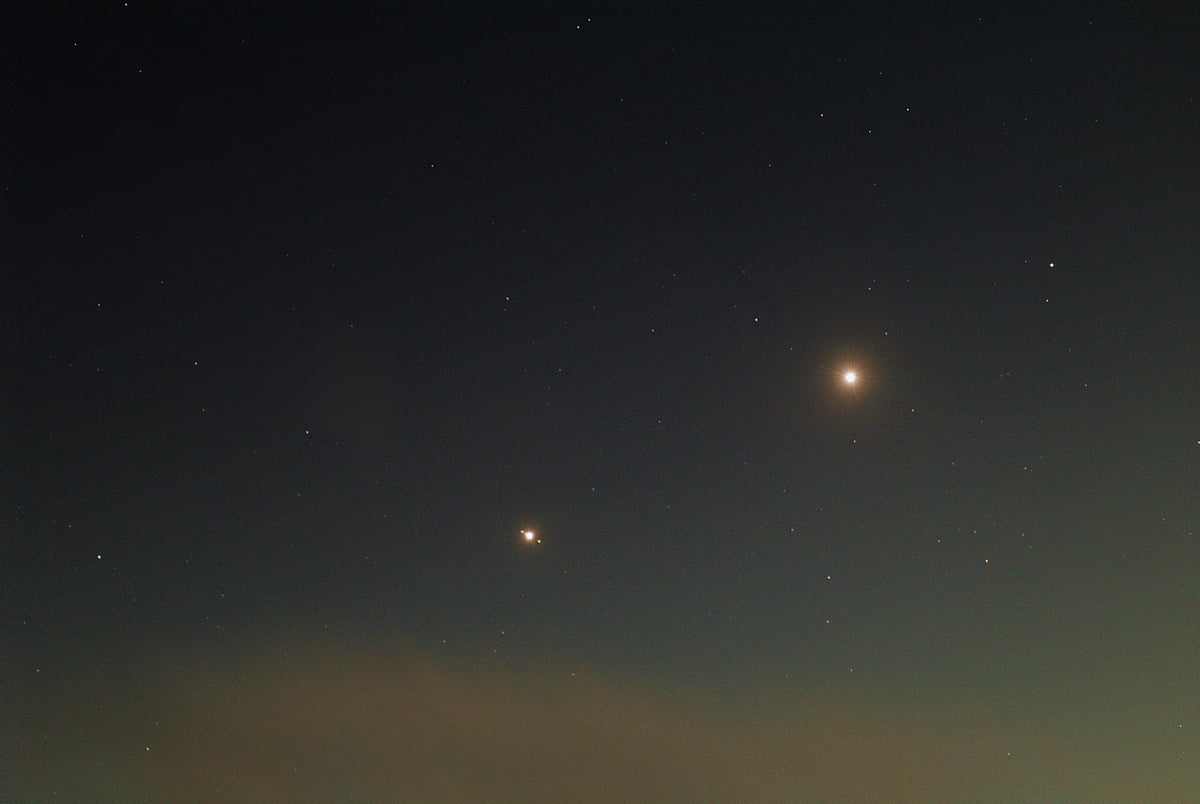
Skywatchers across much of the world, including the Middle East and the Northern Hemisphere, can look west after sunset on June 9 to see one of the year's most striking planetary sights: Venus and Jupiter appearing unusually close together in the evening sky.
The two planets will come within about 2 degrees of each other, close enough to fit within the same binocular field of view.
Conjunction
Astronomers call this a "conjunction" — an apparent close approach of two celestial bodies as seen from Earth.
This planetary conjunction is a "line-of-sight effect", rather than a physical close encounter, explains Nasa.
In reality, Venus and Jupiter maintain a vast physical distance of hundreds of millions of kilometers in space.
However, because they orbit along a similar plane, Earth's perspective creates an optical illusion that makes them look beautifully close together in the night sky — a phenomenon that peaks this year on Tuesday (June 9, 2026).
Such bright-planet conjunctions are among the easiest astronomical events for the general public to observe — without a need for telescopes.
Brightest planets converge
Venus, the brightest planet visible in the night sky, and Jupiter, the second-brightest, should be easy to spot without optical aid if skies are clear.
The pair will be visible low in the western sky for roughly two to two-and-a-half hours after sunset.
Conjunction: Venus and Jupiter appear "close" on June 9 because they travel along the same general path across the sky, known as the "ecliptic", the "route" followed by the sun, moon and planets.
When to look
Dates: June 8 and June 9, 2026 [this year's conjunction lasts through June 15, 2026, as per Nasa JPL]
Time: Begin looking shortly after sunset
Direction: Western sky
Duration: About 2–2.5 hours after sunset
Visibility: Naked-eye visible if skies are clear; binoculars can frame both planets together
Other objects to watch
Mercury: Look below Venus and Jupiter for Mercury, which is moving toward its greatest elongation from the sun on June 15, making it easier to see than usual.
Gemini constellation: The conjunction occurs near Gemini's twin stars, Pollux and Castor, which can often be seen even from suburban locations.
The crescent moon
On June 16, a thin crescent moon will appear roughly between Mercury and Jupiter. On June 17, the moon will sit near Venus.
Why it matters
This is the closest evening pairing of Venus and Jupiter visible from the Northern Hemisphere until late 2028.
The planets remain noticeably close for several nights before and after the conjunction, including June 6, 7, 10 and 11, when they are still within about 3 degrees of each other.
What happens next?
After the conjunction, Venus and Jupiter will gradually separate. Jupiter will drift lower toward the horizon and nearer to Mercury, while Venus will climb higher in the evening sky.
Later in June, Venus will pass near the constellation Leo and its brightest star, Regulus, setting up another notable sky pairing in early July.
Sign up for the Daily Briefing
Get the latest news and updates straight to your inbox
Network Links
GN StoreDownload our app
© Al Nisr Publishing LLC 2026. All rights reserved.