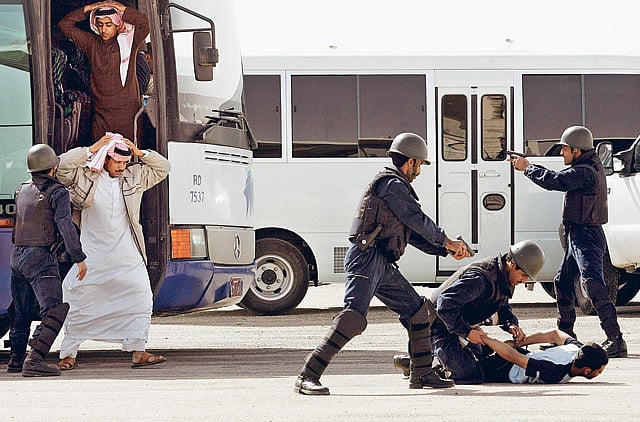
Riyadh: Saudi Arabia, which has long suffered from the presence of terrorists within its borders, says it has tightened its grip on hardline Muslim scholars who consider anyone who does not follow their ideology to be an infidel.
The kingdom said it had done this through measures such as giving the press more freedom, and intensifying the activities of the King Abdul Aziz Centre for National Dialogue.
The centre holds discussions throughout the year on issues which provoked political, intellectual and religious furore.
A number of Saudi analysts, writers and academics told Gulf News the transfer of more than 2,000 schoolteachers to administrative positions in the past two years was due to their attempts to teach students about Al Qaida.
Local Arabic daily Okaz, commonly believed to be the mouthpiece of the government, last Monday quoted Abdul Rahman Al Halaq, adviser to Prince Mohammad Bin Naif, assistant Interior Minister for Security Affairs as saying that the decision to remove these teachers from the classroom was clear proof that the kingdom was tightening its grip on people who spread devious thoughts.
"The teachers were deposed after they were found to be transforming their teaching mission into a mission to spread extremism," he was quoted as saying in the newspaper.
Dr Mohammad Al Zoulfah, a former member of the Shura Council (parliament) said the scholars who issued infidel fatwas (religious rulings) were distorting the image of Saudi Arabia internally and externally.
"They are not in fact highlighting the reformist path the kingdom is taking at present," he said.
"They are singing a different tune from that of the reformist flocks which have two wings: a liberal one and an Islamic one," he said.
Al Zoulfah said the kingdom was the cradle of tolerant Islam which accepted the other.
Reformist
Al Zoulfah said he recalled that King Abdullah Bin Abdul Aziz of Saudi Arabia had made a significant speech before the Shura Council in 2008 in which he said how extremists were obstructing the country's reformist trend.
He said the King had stressed the importance of respecting freedom, tolerance, rejection of sectarianism and openness towards the other.
"King Abdullah has always supported reforms and the balanced thought," Al Zoulfah said.
"He is determined that the kingdom would continue its reformist path and will not be hampered by the "weak and the reluctant".
Ali Abdul Rahman Al Attiyah, a Saudi social researcher, said the jihad in Afghanistan during the 1970s, the writings of Abu Mohammad Al Maqdasi and the tapes of Mohammad Al Masaari had shaped the thoughts of some of the religious-minded Saudi youth who had no organisation to belong to until Al Qaida was established.
The kingdom said it had adopted an integrated strategy which included dealing harshly with terrorists.
It had also adopted legal procedures to try terrorists in court, and to stop finances from reaching them.
Professor of political science Dr Naif Al Subeih said the kingdom's efforts to fight terrorism started by warning school and university students about the dangers of terrorist acts — which were against Islam.
He said a day had been dedicated in all schools to teach about the crimes committed by terrorists.
The kingdom had also initiated chairs in a number of universities to conduct research on terrorism.
Sign up for the Daily Briefing
Get the latest news and updates straight to your inbox
Network Links
GN StoreDownload our app
© Al Nisr Publishing LLC 2026. All rights reserved.