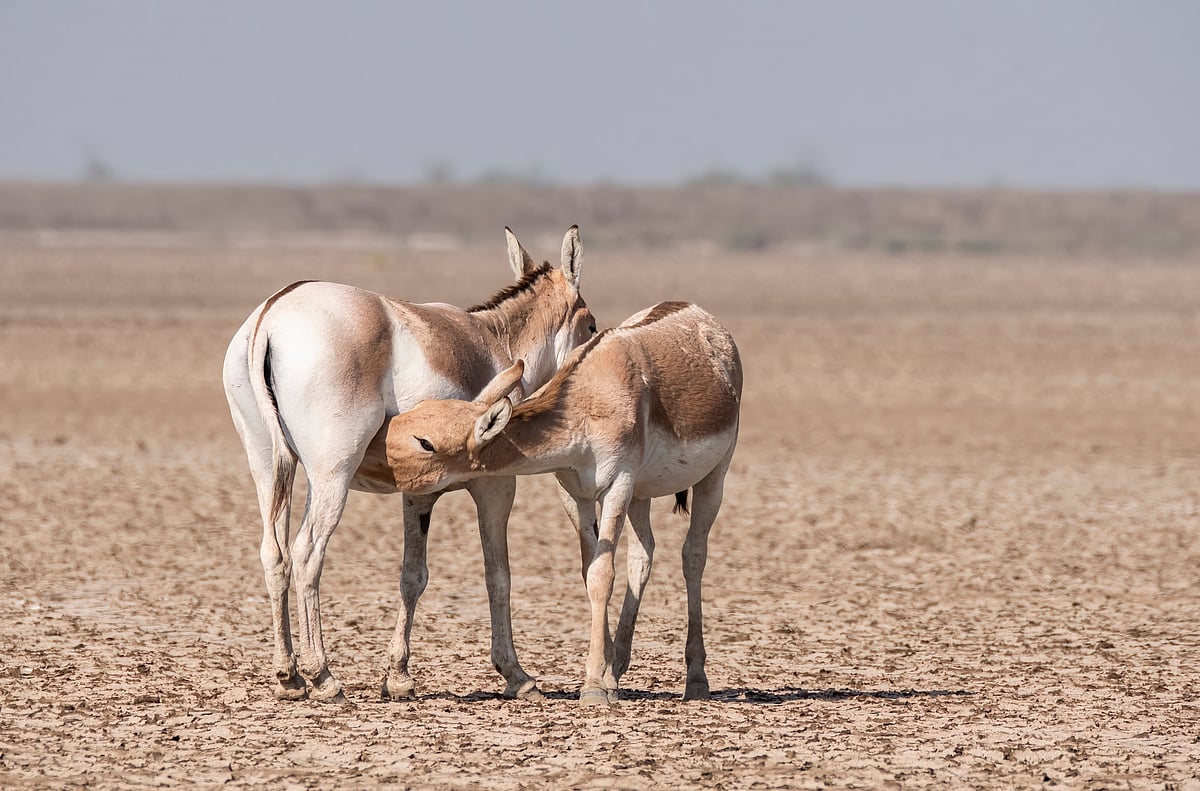
A pair of onagers in a grassland
Marking a significant milestone for wildlife conservation in the country, Saudi Arabia has recorded the first onager birth on its soil in more than a century at the Prince Mohammed bin Salman Royal Reserve.
The male foal, born in June 2025 as part of an Arabian rewilding programme, has successfully survived its critical first year. The reserve expects two more births this winter and is expanding its breeding efforts to increase genetic diversity.
Why is the onager birth so important?
This is the first onager born on Saudi soil in more than a century.
Following the disappearance of local onager populations from the Arabian Peninsula in the early 1900s, there were no wild breeding herds left in Saudi Arabia capable of producing offspring.
In 2024, as part of a conservation effort at the Prince Mohammed bin Salman Royal Reserve, Persian onagers from conservation populations outside Saudi Arabia were reintroduced to establish a new breeding herd.
In June 2025, that effort resulted in the birth of the male foal. The reserve only announced the birth after the foal successfully survived its first year, which is considered a critical period where survival rates can be 50% per cent.
The milestone goes beyond the birth of a single foal. It signals that a new population has been successfully re-established and is reproducing, a key step towards creating a self-sustaining wild population. The reserve is also expecting additional births as the herd continues to grow.
What are onagers?
The onager, also known as the Asiatic wild ass or hemione, is one of Asia's most remarkable yet little-known wild animals. Once roaming widely across deserts, grasslands, savannahs and open plains, the species now survives in scattered populations across Central Asia, the Middle East and South Asia, as well as in tightly managed captive breeding programmes around the world.
Are onagers just wild donkeys?
A frequent question among the public is whether onagers are simply wild donkeys. The short answer is no.
While onagers and domestic donkeys belong to the same horse family, Equidae, and share several physical traits, they are distinct species.
In appearance, onagers are often described as looking like a cross between a horse and a donkey. They have sturdy, horse-like legs, an upright mane and a donkey-like tail. They are also generally larger, taller and faster than the average domestic donkey, while retaining a slimmer, more horse-like build.
Their origins are different as well. Today's domestic donkey is descended from the African wild ass and has lived alongside humans for thousands of years. The onager, by contrast, remains entirely wild. It also has a different chromosome count, reflecting a separate evolutionary history despite its close relationship with the donkey.
Fast facts about the onager
Onagers are exceptionally fast and can reach speeds of around 70 km/h (43 mph), making them among the fastest hoofed animals in their habitats.
They are social animals and often form small groups, although their social structure can vary depending on the season and the environment.
Their coat changes with the seasons, ranging from reddish-brown in summer to a sandy yellowish-brown in winter.
In the wild, onagers generally live up to 14 years, although individuals in captivity can reach 26 years of age.
Onagers are herbivores, feeding on grasses, herbs, leaves and fruits. In arid environments, they also browse on shrubs, trees and saline vegetation.
They are highly adapted to desert life. Unlike domestic horses, which can drink more than 45 litres of water a day, onagers can survive on five litres or less. They obtain much of the moisture they need from desert plants and can tolerate highly saline or brackish water when fresh water is scarce.
Sign up for the Daily Briefing
Get the latest news and updates straight to your inbox
Network Links
GN StoreAbout Gulf NewsTerms & ConditionsReach by GNSitemapContact usPrivacy PolicyGN FocusHave your sayWork with usAdvertise with usGulf News epaperPrinting Services
Download our app
© Al Nisr Publishing LLC 2026. All rights reserved.