King Abdullah of Saudi Arabia laid to rest in Riyadh

Pictures: Leaders join funeral prayers as Saudi monarch is laid to rest

Last updated:
2 MIN READ
1.1445738-1416568170
AFP
AFP

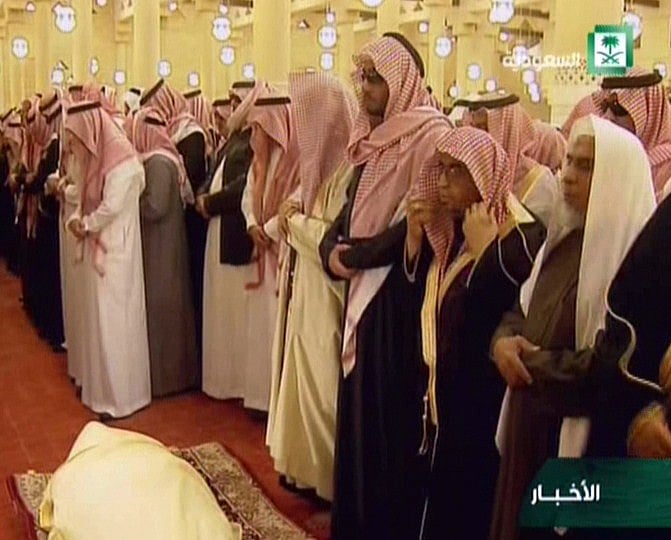
RIYADH: Saudi King Abdullah was laid to rest on Friday after prayers attended by foreign leaders gathered in a cavernous mosque in the capital.

Turkish President Recep Tayyip Erdogan and Pakistani Prime Minister Nawaz Sharif joined Gulf leaders for the funeral prayer at the Imam Turki Bin Abdullah mosque in Riyadh, television pictures showed.

Simple burial in unmarked grave

King Abdullah, one of the richest men in the history of the world, was carried in a simple white shroud to an unmarked grave on Friday in a Riyadh cemetery where many of his commoner subjects rest, in keeping with ascetic traditions.

There was no official mourning period in Saudi Arabia and flags around the kingdom all flew at full staff.

Despite his apparent popularity among his subjects, there were no spontaneous gatherings on city streets to mark his passing.

Government offices, closed for the Middle East's normal Friday-Saturday weekend, will open as usual on Sunday.

While the afternoon prayer that preceded Abdullah's burial took place before ranks of Muslim leaders, Saudi princes, powerful clerics and billionaire Arab businessmen, his body was transported to the mosque in a city ambulance.

It was borne through the crowds on a carpet on a simple stretcher, laid in front of the faithful at prayer and then carried by Abdullah's male relatives to the graveyard, where it was laid in the ground with no ceremony.

It was a change for the king who, during his lifetime, travelled in the luxury one might expect of the monarch of the world's leading oil exporter.

A 2006 US diplomatic cable noted that he personally asked a US envoy for his Boeing 747 to be outfitted with all the same security systems as the Air Force One of his friend, then-President George W. Bush.

Frugal

Abdullah lived frugally, choosing to holiday in a desert camp instead of brash Mediterranean palaces. He was also known for curbing some of his family's excesses once in power, ordering princes to pay their phone bills and book seats on the national airline in advance.

In Wahhabism's austere reading of Islam, elaborate shrines contradict the ideal of egalitarianism that should unite all Muslims.

Abdullah's predecessors and other half brothers have also been interred in unmarked graves in the Al Aoud cemetery where he was buried on Friday, as well as in other simple graveyards in the kingdom's other cities.

The Al Saud family has also always striven to distinguish itself from European monarchies, preferring to hark to the tribal roots of its leadership in which ordinary Saudis theoretically remain able to petition kings.

Nevertheless, there is no shortage of monuments to Abdullah in Saudi Arabia: his name adorns a giant university in Jeddah, a scholarship fund, a "medical city" hospital complex in Mecca, the state renewable energy agency and a boulevard in Riyadh recently given a lavish upgrade.

Abdullah and his successor Salman style themselves as both king and Custodian of the Two Holy Mosques - a clear indication of how they view the importance of their religious credentials in underpinning their legitimacy.

A handout picture released by the Saudi Press Agency (SPA) shows foreign leaders, Saudi officials and visiting dignitaries at the funeral of King Adullah bin Abdul Aziz in the capital Riyadh on January 23, 2015.
The body of Saudi Arabia's King Abdullah is carried during his funeral at Imam Turki Bin Abdullah Grand Mosque in Riyadh January 23, 2015, in this handout photo provided by Saudi Press Agency. King Abdullah, who died early on Friday after a short illness, was buried in an unmarked grave in keeping with local religious traditions.
The body of Saudi King Abdullah is carried during his funeral at Imam Turki Bin Abdullah Grand Mosque in Riyadh January 23, 2015, in this handout photo provided by Saudi Press Agency.
The body of Saudi King Abdullah is carried during his funeral at Imam Turki Bin Abdullah Grand Mosque in Riyadh January 23, 2015, in this handout photo provided by Saudi Press Agency. Saudi King Salman pledged on Friday to maintain existing energy and foreign policies then quickly moved to appoint younger men as his heirs, settling the succession for years to come by naming a deputy crown prince from his dynasty's next generation.
An image grab taken from Saudi state TV on January 23, 2015 shows Saudi mourners carrying the body of their late King Abdullah Bin Abdul Aziz during his funeral procession at Imam Turki Bin Abdullah Grand Mosque in Riyadh.
The body of Saudi King Abdullah is carried during his funeral at Imam Turki Bin Abdullah Grand Mosque in Riyadh January 23, 2015, in this handout photo provided by Saudi Press Agency. Saudi King Salman pledged on Friday to maintain existing energy and foreign policies then quickly moved to appoint younger men as his heirs, settling the succession for years to come by naming a deputy crown prince from his dynasty's next generation. King Abdullah, who died early on Friday after a short illness, was buried in an unmarked grave in keeping with local religious traditions.
A handout picture released by the Saudi Press Agency (SPA) shows Prince Majed bin Abdullah bin Abdul Aziz (L) welcoming Turkish President Recep Tayyip Erdogan upon his arrival in the Saudi capital Riyadh to attend the funeral of King Abdullah on January 23, 2015. Saudi Arabia's elderly King Abdullah died early in the morning and was replaced by his half-brother Salman as ruler of the world's top oil exporter and the spiritual home of Islam.
On behalf of President His Highness Shaikh Khalifa Bin Zayed Al Nahyan, His Highness Dr Shaikh Sultan Bin Mohammad Al Qasimi, Supreme Council Member and Ruler of Sharjah, joined the procession of the late Saudi Arabia’s King Abdullah to his final resting place on Friday afternoon. Dr Shaikh Sultan was joined by His Highness Shaikh Humaid Bin Rashid Al Nuaimi, Supreme Council Member and Ruler of Ajman, His Highness Shaikh Saud Bin Saqr Al Qasimi, Supreme Council Member and Ruler of Ras Al Khaimah, Shaikh Sultan Bin Mohammad Bin Sultan Al Qasimi, Crown Prince and Deputy Ruler of Sharjah, Shaikh Ammar Bin Humaid Al Nuaimi, Crown Prince of Ajman, Shaikh Nahyan Bin Mubarak Al Nahyan, Minister of Culture, Youth and Community Development, and a number of other shaikhs.
Qatar's Emir Shaikh Tamim bin Hamad Al Thani (2nd R) arrives to take part in the funeral of Saudi King Abdullah bin Abdulaziz in Riyadh January 23, 2015.
Oman's Deputy Prime Minister Fahd bin Mahmoud al-Said (centre) arrives to take part in the funeral of Saudi King Abdullah bin Abdulaziz in Riyadh January 23, 2015.
A handout picture released by the Saudi Press Agency (SPA) shows an unidentified Saudi official (R) welcoming Pakistan's Prime Minister Nawaz Sharif (L) upon his arrival in Riyadh to attend the funeral of King Abdullah on January 23, 2015.

Sign up for the Daily Briefing

Get the latest news and updates straight to your inbox