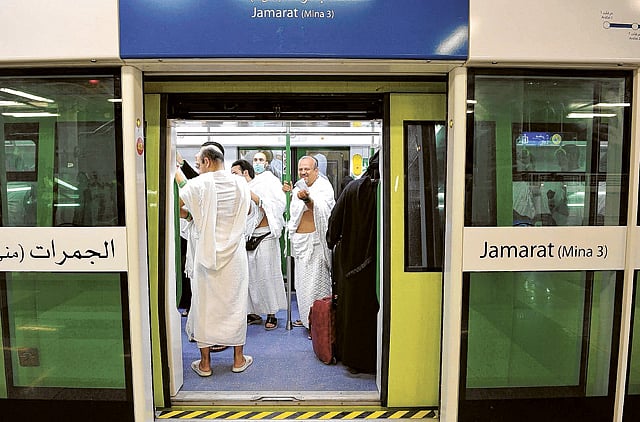
Dubai: For the first time this year, pilgrims on Haj travelled between Makkah's holy sites by train.
The Mashair Railway, dubbed the ‘Makkah Metro' will greatly reduce the carbon emissions of the three million Muslims who make the pilgrimage each year.
However, a bit more signage and environmental awareness would be welcome said some pilgrims Gulf News spoke to.
While bins are provided and street cleaners are plenty, the sheer number of people at one time can leave some areas unattended to and littered, they said.
According to environmental website Green Prophet, it is estimated that 100 million plastic bottles are left behind every year after the Haj season. Food packaging is also a big issue as well as the carbon emissions of travellers.
The new train is expected to reduce traffic by approximately 30,000 cars — a step towards reducing congestion and cutting noxious emissions from vehicles.
Ideal place to educate
Omar Habbouche, 27, from Australia performed Haj in 2005, and Umra in 2008. At the time he was not as well educated about CO2 emissions as he is today, he said.
"[Haj] would be an ideal place to educate people, particularly regarding the environment which directly relates to our faith. It is part of our faith to look after ourselves, our friends, family, fellow man, animals and yes, the environment too," he said.
The high speed train will only be operating at a third of its full capacity this year so only 130,000 passengers will be able to use it. Only pilgrims from Saudi Arabia and the Arab Gulf states will be able to make full use of the trains this year.
Once finished, the network will carry around 500,000 passengers at the rate of 72,000 passengers an hour in a single direction. By the final stage in 2012 the metro, which has elevated tracks to avoid busy roads, will be able to transport up to two million people.
"The traffic is horrendous. I remember it took us 18 hours to travel between Madinah and Makkah. ... The air was so thick and smoggy it was unbelievable," said Habbouche.
Steps towards developing a green Haj were made in Istanbul in 2009, when more than 50 religious scholars endorsed a Muslim Seven Year Action Plan on Climate Change led by Dr Yousuf Al Qaradawi, the President of the International Union of Muslim Scholars.
The plan, drawn up by Earth Mates Dialogue Centre (EMDC) a UK-based, non-profit NGO in cooperation with the Kuwaiti Ministry of Awqaf and Islamic Affairs is to work towards a green Haj with the Saudi Minister of the Haj, and aim to have the Haj free of plastic bottles after two years.
Faucets
Raies Patel, a businessman from India, performed Haj in 1991. Since then, he has developed a small mechanism that can be fitted to all tap faucets to reduce the flow of water in Dubai's mosques, saving a large of amount of water during ablution. "During my next Haj, I would definitely try to closely observe pilgrims' behaviour and the over all impact on environment," he said.
Sign up for the Daily Briefing
Get the latest news and updates straight to your inbox
Network Links
GN StoreDownload our app
© Al Nisr Publishing LLC 2026. All rights reserved.