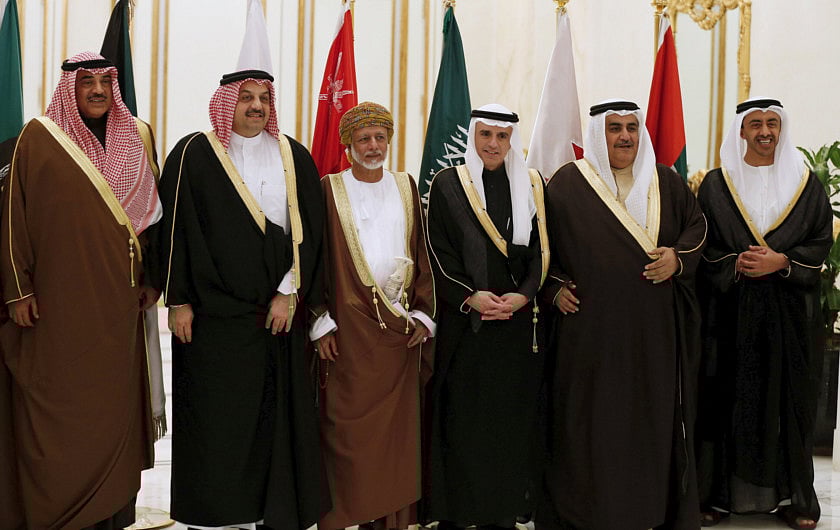
Riyadh: Officials from around the Gulf have arrived in Saudi Arabia to meet on regional security issues.
The two-day summit began Wednesday in the Saudi capital, Riyadh. Saudi state television showed dignitaries from around the Gulf meeting with Saudi King Salman Bin Abdul Aziz after arriving at the capital’s international airport.
Also on hand to meet the Gulf leaders was the king’s son, Deputy Crown Prince Mohammad Bin Salman, who also serves as the kingdom’s defence minister. Interior Minister and Crown Prince Mohammad Bin Nayef, the king’s nephew, also was there.
The summit agenda will tackle a range of pressing issues such as plunging oil revenues, the war in Yemen and pressure for peace in Syria.
The kings and emirs, gathering in Saudi Arabia, are expected to voice support for a bid to unify Syria’s opposition at separate talks due to get under way on the same day in Riyadh.
The Gulf Cooperation Council (GCC) summit also comes days before warring factions from Yemen are to gather in Switzerland in an effort to end a costly war that has drawn in Gulf nations.
GCC leaders will hold two days of talks in the Saudi capital.
But despite the urgency of the challenges facing the six countries, analysts say the Gulf leaders will struggle to find common ground at the gathering.
“This summit comes as the Gulf is witnessing one of its most critical years,” said Farea Al Muslimi, a visiting scholar at the Carnegie Middle East Centre.
He sees “internal disagreement” among the Gulf states as they face complicated economic and security challenges.
These include greater worries about Iran after a July deal that will ease sanctions on it, including its oil sector, in return for restrictions on its nuclear facilities.
Iran and Saudi Arabia are rivals for regional influence in Yemen, Syria and elsewhere.
“The main challenge facing the GCC summit is, as usual, trying to ensure a united front on the major strategic challenges in the region,” said Neil Partrick, author of a forthcoming book on Saudi foreign policy.
For more than eight months, Gulf military forces have been fighting in Yemen to support President Abd Rabbo Mansour Hadi’s government alongside an array of local anti-rebel forces.
The coalition has been trying to push Iran-backed Al Houthi militants and allied troops from territory they occupied in Yemen.
Oman is the only GCC state not part of the coalition but has mediated and provided a neutral venue for talks.
“On Yemen expect very little” from the summit other than support for Hadi’s “legitimacy”, said Partrick.
According to the United Nations envoy to Yemen, another attempt at peace talks will start on December 15, after earlier efforts collapsed.
The GCC was founded to more deeply integrate the Gulf countries but the emphasis over the last few years has been on intelligence and security cooperation.
Low oil prices “should focus the minds of GCC leaders” on economic integration and joint infrastructure development, in line with the wishes of many Gulf citizens, she said.
Crude prices have more than halved since early 2014 and the IMF has projected a $275 billion (Dh1.009 billion) drop in export revenues this year for the resource-dependent Gulf economies.
Sign up for the Daily Briefing
Get the latest news and updates straight to your inbox
Network Links
GN StoreDownload our app
© Al Nisr Publishing LLC 2026. All rights reserved.