This general overhead view shows a section of one of Britain's most famous shopping streets, Oxford Street, as it goes permanently traffic-free for the first time in central London on October 26, 2026.
London’s Oxford Street goes traffic-free in historic move
Mayor Sadiq Khan says transformation to help reverse years of decline in shopping district
Last updated:
3 MIN READ
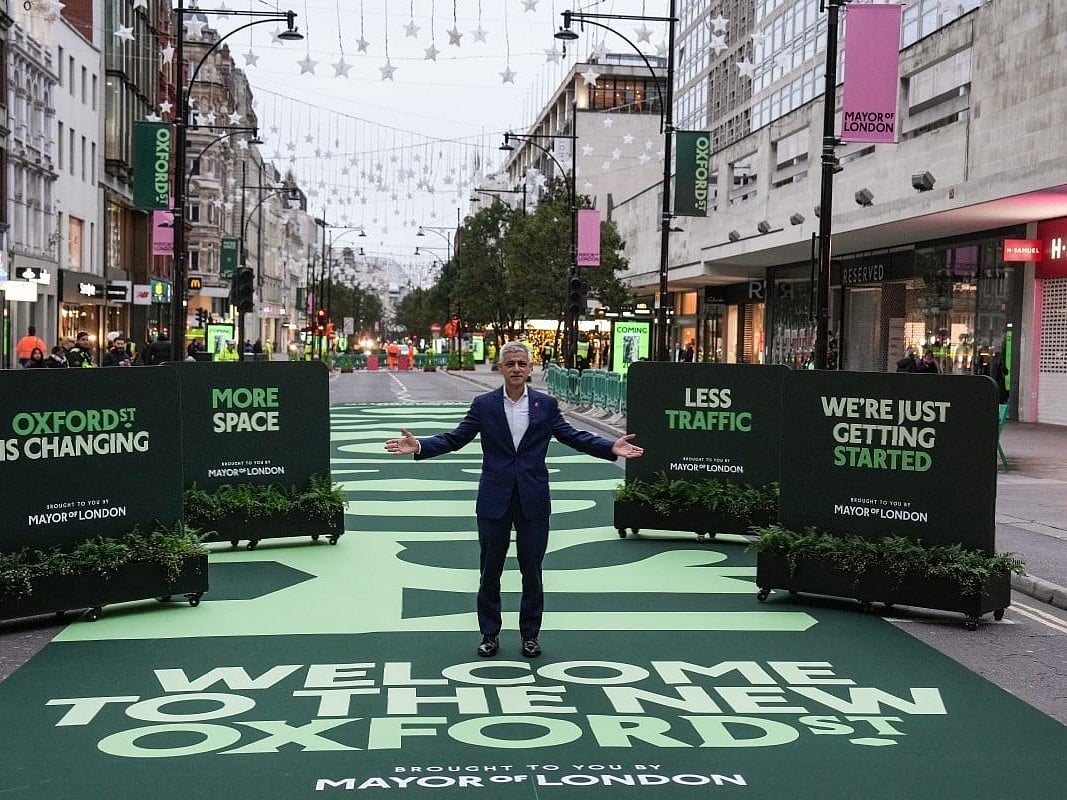
London Mayor Sadiq Khan attends the opening ceremony for a section of one of Britain's most famous shopping streets, Oxford Street, as it goes permanently traffic-free for the first time in central London on October 26, 2026.
AFP
One of the world’s most famous shopping streets entered a new era on Monday as a nearly one-kilometre stretch of London’s Oxford Street became traffic-free, with Mayor Sadiq Khan declaring that the long-awaited transformation could reverse years of decline in the British capital’s premier retail destination.
The move, which comes after decades of proposals, abandoned schemes and political disagreements, bans cars, buses, taxis and bicycles from the stretch between Orchard Street, near Selfridges, and Great Portland Street, just east of Oxford Circus, according to a report by the PA news agency.
Khan hailed the development as a historic moment for London, saying the changes would help restore Oxford Street’s appeal to shoppers, tourists and major international retailers.
“For too long we’ve had years and years of decline,” Khan told the Evening Standard, pointing to the impact of online shopping, out-of-town retail centres and the Covid-19 pandemic.
“It’s really important to recognise that decline is not inevitable, we can reverse it,” he said.
A new chapter for Oxford Street
Oxford Street attracts around 500,000 visitors daily and generates approximately £3.1 billion in annual spending, making it one of the world’s busiest shopping destinations, PA reported.
But the famous thoroughfare has struggled in recent years with vacant retail premises, the departure of established brands and the proliferation of American-style candy stores, souvenir shops and vaping outlets.
Khan said he hoped the transformation would encourage established retailers to return and attract new investment.
“I’m looking forward to good quality shops rather than the dross we’ve had,” he told the Evening Standard, referring to some of the low-quality outlets that have appeared along the street.
The mayor said the pedestrianisation would create opportunities for cultural events, outdoor activities and new shopping experiences, helping Oxford Street compete with destinations such as New York’s Times Square, Paris’s Champs-Élysées and Barcelona’s La Rambla.
What changes for visitors?
Under the new arrangements, buses, taxis, private vehicles, bicycles, scooters and pedicabs are prohibited from entering the pedestrianised section, according to Transport for London (TfL).
Delivery vehicles will be allowed access between midnight and 7am, while emergency vehicles can enter at any time. Mobility scooters will also retain access.
Bus services have been diverted to surrounding roads, with alternative stops generally located around 200 metres from the traffic-free stretch, PA reported.
The changes have been introduced ahead of the busy Christmas shopping season, with construction work deliberately limited to minimise disruption.
By spring 2027, the area is expected to feature more than 50 new trees, over 100 seats, two public squares, improved lighting and additional dining spaces, according to plans outlined by London authorities.
Concerns over traffic congestion
Despite support from major retailers including Selfridges and John Lewis, the project has faced opposition over its potential impact on neighbouring streets.
Westminster City Council has warned that diverting vehicles could increase congestion, pollution and noise in surrounding residential and commercial areas, according to PA.
Council deputy leader Tim Barnes has raised concerns about access, street cleaning and public safety, arguing that preparations have been rushed.
Transport for London said it would closely monitor the changes to assess their impact on businesses, residents and visitors.
Khan, however, insisted the transformation represented an opportunity to revive one of Britain’s best-known commercial landmarks.
“I’m hugely excited to see my bold vision for Oxford Street coming to life from today. It is a truly momentous occasion for the capital,” he said, according to PA.

Alex has been on the frontline of global headlines for nearly 30 years. A Senior Associate Editor, he’s part newsroom veteran and part globe-trotting correspondent. His credentials? He was part of the select group of journalists who covered Pope Francis’ historic visit to the UAE - flying with the pontiff himself. With 27 years on the ground in the Middle East, Alex is one of the most trusted voices in the region when it comes to decoding politics and power plays. He breaks down global affairs into slick, 60-second news - his morning reels are practically a daily ritual for audiences across the UAE. Sharp. Grounded. Fast. Insightful. That’s Alex at his best, bringing a steady editorial hand to every story he tells.
Sign up for the Daily Briefing
Get the latest news and updates straight to your inbox
Network Links
GN StoreAbout Gulf NewsTerms & ConditionsReach by GNSitemapContact usPrivacy PolicyGN FocusHave your sayWork with usAdvertise with usGulf News epaperPrinting Services
Download our app
© Al Nisr Publishing LLC 2026. All rights reserved.