Philippines, China trade accusations after fresh South China Sea confrontation
Manila and Beijing trade blame after water cannon clash near Scarborough Shoal
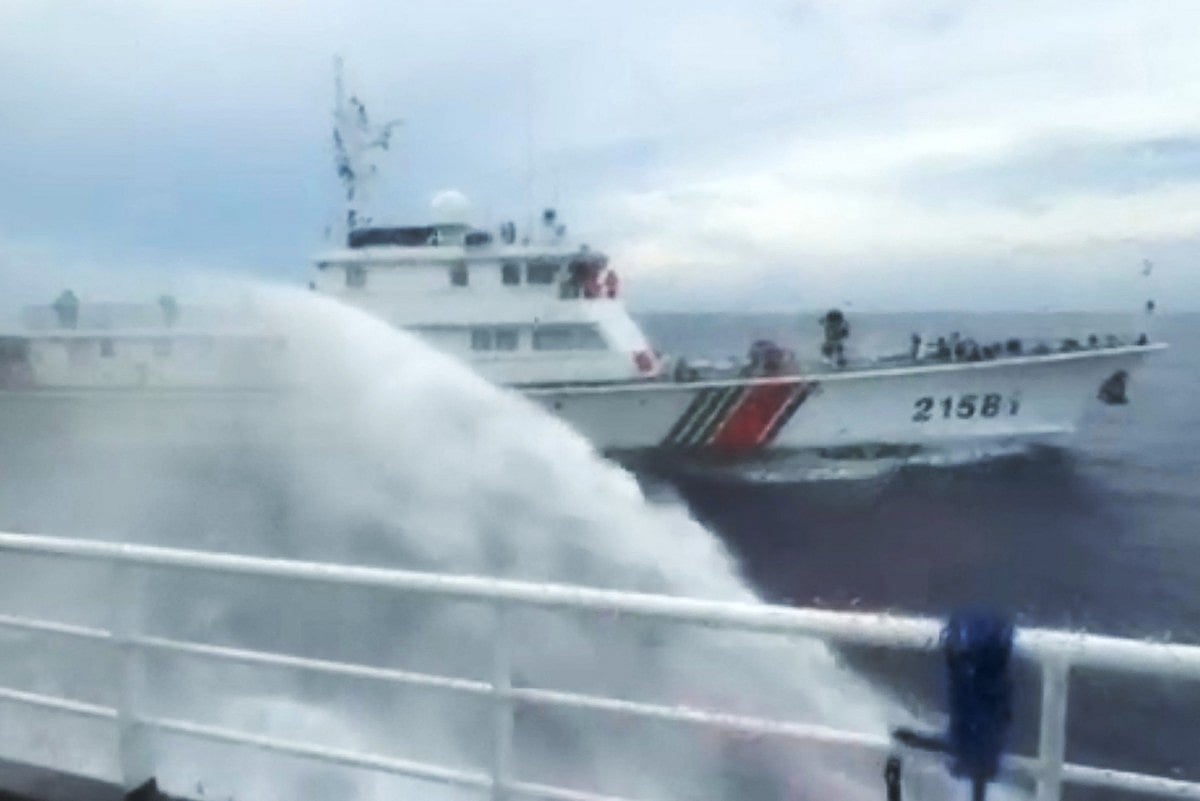
Dubai: A fresh confrontation between the Philippines and China unfolded in the disputed South China Sea on July 24, with both countries accusing each other of provoking the latest maritime incident near Scarborough Shoal.
The Philippine Coast Guard (PCG) has shared that Chinese Coast Guard (CCG) vessels repeatedly fired water cannons at Philippine government ships and carried out dangerous manoeuvres during a mission to deliver fuel subsidies and food supplies to Filipino fishermen.
China has rejected the allegations, saying the Philippine vessels had illegally entered waters it claims and that its coast guard responded “with the utmost restraint.”
The latest encounter comes a day after a similar incident has been reported on July 23, underscoring the continuing tensions in one of the world's most hotly contested waterways.
Get updated faster and for FREE: Download the Gulf News app now - simply click here.
Mission to support fishermen
According to the PCG, the incidents have occurred on the morning of July 24 as it and the Bureau of Fisheries and Aquatic Resources (BFAR) carried out the “Kadiwa ng Bagong Bayaning Mangingisda” programme.
The government initiative provides fuel subsidies and essential supplies to Filipino fishing boats while supporting fishermen operating in what Manila considers their traditional fishing grounds.
“The PCG and the BFAR were subjected to a series of water cannon attacks and dangerous manoeuvres by China Coast Guard vessels,” said rear admiral Jay Tarriela, PCG spokesperson, in a Facebook post.
Water cannon incidents
The PCG has noted that the first incident occurred when CCG vessel 3107 allegedly fired a water cannon at the PCG vessel BRP Cape San Agustin from around 400 metres away.
The Philippine vessel has been conducting a maritime patrol about 15 nautical miles northeast of Bajo de Masinloc, the Philippine name for Scarborough Shoal, when it was allegedly shadowed by at least six CCG vessels and Chinese maritime militia ships.
In another incident, CCG vessel 21581 has allegedly begun firing water cannons at the BFAR vessel BRP Datu Paduhinog, which was on its way to carry out a fisheries monitoring mission.
The PCG has mentioned that the Chinese vessel also came within seven metres of the Philippine ship's port bow, creating what it described as a “serious risk of collision.”
“It is worth noting that the CCG vessel had deliberately switched off its Automatic Identification System, concealing its identity in violation of international regulations on safety of navigation,” said Tarriela.
More encounters at sea
The PCG has bared that BRP Datu Paduhinog was struck directly by water cannon blasts three times during the encounter. The vessel has also temporarily lost its satellite internet connection before communications were later restored.
Moreover, Philippine authorities have revealed that a Chinese maritime militia vessel was seen towing a rope about 100 metres behind another BFAR vessel, BRP Datu Sumakwel, which they claimed to pose a hazard to safe navigation.
Later, CCG vessel 3303 has allegedly fired a water cannon at BRP Datu Cabaylo from about 300 metres behind the vessel.
Despite the incidents, Tarriela has stressed that the Philippine mission continued without injuries.
“All PCG and BFAR personnel are safe, and the vessels sustained their presence in the area in continued support of Filipino fisherfolk exercising their legitimate rights in their traditional fishing ground,” shared Tarriela.
The PCG has highlighted that it monitored 26 vessels in the area during the mission, including three PCG vessels, seven BFAR vessels, 12 CCG vessels, and three Chinese maritime militia vessels.
Manila condemns China's actions
The PCG has condemned what Tarriela regarded as China's “illegal, coercive, aggressive, and deceptive” actions.
He has reiterated Manila's position that Bajo de Masinloc forms part of Philippine territory and that the surrounding waters are within the country's territorial sea and exclusive economic zone.
“The 2016 Arbitral Award has affirmed that Bajo de Masinloc is a traditional fishing ground of Filipino fisherfolk, whose rights cannot be lawfully impeded by any foreign power,” exclaimed Tarriela.
He has emphasised that the coast guard would continue to “protect Filipino fisherfolk, uphold the rule of law, and defend the country's sovereignty, sovereign rights, and jurisdiction in the West Philippine Sea, without escalating tensions and in accordance with international law.”
Beijing rejects Philippine claims
On the other hand, the Chinese Embassy in Manila has rejected the Philippine account and accused Tarriela of distorting the facts.
“Jay Tarriela is once again turning the facts upside down and misleading the public,” stated the embassy in a Facebook post.
It has pointed out that Philippine vessels had “illegally intruded into the waters of Huangyan Dao in two consecutive days” and ignored repeated warnings from the CCG.
Chinese authorities have then taken “necessary law enforcement measures” to warn the Philippine vessels and regulate their movements.
“The operation was lawful, justified, professional, well-regulated, and conducted with the utmost restraint.”
Additionally, the embassy has accused Tarriela of misrepresenting the incident.
“Jay Tarriela removes the context, exaggerates the response, labels every law enforcement measure as an ‘attack,’ and rushes to social media to push a false narrative.”
It added, “It was the Philippine vessels that created the incident, and the CCG responded with the utmost restraint.”
Why the shoal matters
The confrontation has taken place near Scarborough Shoal, known in the Philippines as Bajo de Masinloc and in China as Huangyan Dao.
Located in the South China Sea, the shoal lies within the Philippines’ exclusive economic zone under international maritime law. However, it has long been under China's effective control, with both countries claiming sovereignty over it.
Beijing has also claimed sovereignty over nearly the entire South China Sea, including waters that overlap with the exclusive economic zones of Brunei, Indonesia, Malaysia, Vietnam, and the Philippines.
In 2016, an international arbitration tribunal ruled largely in favour of the Philippines, finding that China’s maritime claims had no legal basis under international law and that its blockade of Scarborough Shoal violated the rights of Filipino fishermen. China has consistently rejected the ruling and does not recognise it.
Meanwhile, the latest maritime tensions have come days after Southeast Asian foreign ministers concluded regional meetings in Manila attended by Chinese foreign minister Wang Yi and US secretary of state Marco Rubio.
During the meetings, Rubio has reaffirmed Washington's support for the Philippines, a US treaty ally.
Network Links
GN StoreDownload our app
© Al Nisr Publishing LLC 2026. All rights reserved.