Philippines lodges protest over China Daily's 'racist' AI video depicting Filipinos as monkey character
Manila has called for the immediate removal of a China Daily video, editorial cartoons
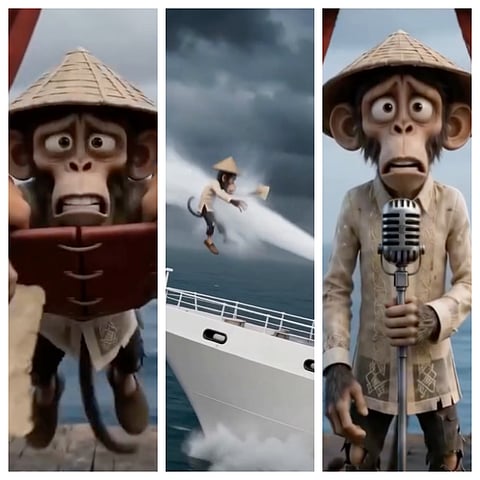
Dubai: The Philippines has formally lodged a diplomatic protest against China's state-owned newspaper China Daily over an AI-generated video and editorial cartoons that Manila says contain “demeaning, dehumanising, and racist depictions of Filipinos.”
The protest has come amid a video published on China Daily's Facebook page on July 10, days before the anniversary of the 2016 South China Sea arbitral ruling commemorated every year on July 12.
According to the Philippine Department of Foreign Affairs (DFA), the content has crossed the line from political commentary into discriminatory and offensive rhetoric.
As of writing, the video has remained available on China Daily's Facebook page.
Get updated faster and for FREE: Download the Gulf News app now - simply click here.
Philippines raises issue with Chinese ambassador
The Philippine government has first raised its concerns on July 16, when Foreign Affairs undersecretary Leo Herrera-Lim met Chinese ambassador Jing Quan.
During the meeting, Lim has strongly objected to the video and related editorial cartoons, calling for their immediate removal.
“Such content is inconsistent with the mutual respect expected between states and does no favours to the sound and stable management of bilateral relations,” said DFA in a statement.
The agency has later issued a formal diplomatic protest, saying China Daily had gone beyond legitimate political debate by resorting to “racist” depictions of Filipinos.
“The Philippines has consistently rejected false narratives and distortions regarding the Arbitral Award and its lawful positions in the South China Sea, disagreement over legal and political issues does not justify resorting to imagery that has no place in the public discourse of responsible states.”
Moreover, the DFA has warned that the content “only widens distrust between the two countries” and urged China to “uphold dignity, respect, and truth in its public discourse.”
Monkey character
In the AI-generated video, a monkey character has been featured dressed in a traditional Philippine barong, an embroidered formal shirt widely regarded as the country's national attire.
In one scene, the monkey character has been struck by a powerful water cannon.
The Philippine government has noted that the imagery was racist and particularly offensive because it echoed long-standing stereotypes while appearing to reference real-life confrontations between Philippine and Chinese vessels in the disputed South China Sea.
For its part, the Philippine Embassy in Beijing has also sent a formal letter to the editor-in-chief of China Daily, reiterating the demand for the immediate removal of the video and related cartoons.
“The department remains committed to dialogue and diplomacy in its engagement with China, but will not hesitate to call out discriminatory and offensive rhetoric wherever it appears,” stated the DFA.
Tensions remain high
The diplomatic protest has added to the continuing tensions between the Philippines and China over disputed areas of the South China Sea.
In recent years, the Chinese Coast Guard has repeatedly used high-pressure water cannons against Philippine vessels operating near contested shoals. Several incidents have damaged Philippine boats and injured crew members.
The AI video's water cannon scene has appeared to reference those maritime confrontations.
Background to the maritime dispute
The dispute has centred on the landmark 2016 ruling by an arbitral tribunal under the Permanent Court of Arbitration, which found that China's “nine-dash line” claims over the South China Sea had no legal basis under international law.
The tribunal has ruled in favour of the Philippines and affirmed its sovereign rights within its exclusive economic zone, where it has exclusive rights to explore and use marine resources.
China has rejected the ruling and continues to assert its claims over much of the strategic waterway.