In a press briefing held by the Department of Public Works and Highways (DPWH) on December 18, 2025, Secretary Vince Dizon confirmed that ₱150 million were surrendered by a number of individuals involved in the flood control scam. The amount includes ₱110 million returned by ex-DPWH District Engineer Henry Alcantara to the Department of Justice (DOJ) on Nobyembre 28, 2025 and the ₱40 million surrendered by former DPWH Regional Director Gerard Opulencia on December 16, 2025. Dizon said they are expecting more individuals to do the same, while also expecting both Alcantara and Opulencia to surrender bigger amounts.
Why Philippine politics keeps producing scammers : 3 Senators, 1 system, more to face arrest?
3 senators in detention: Real prison is the system we keep funding, pols we keep voting
Last updated:
6 MIN READ
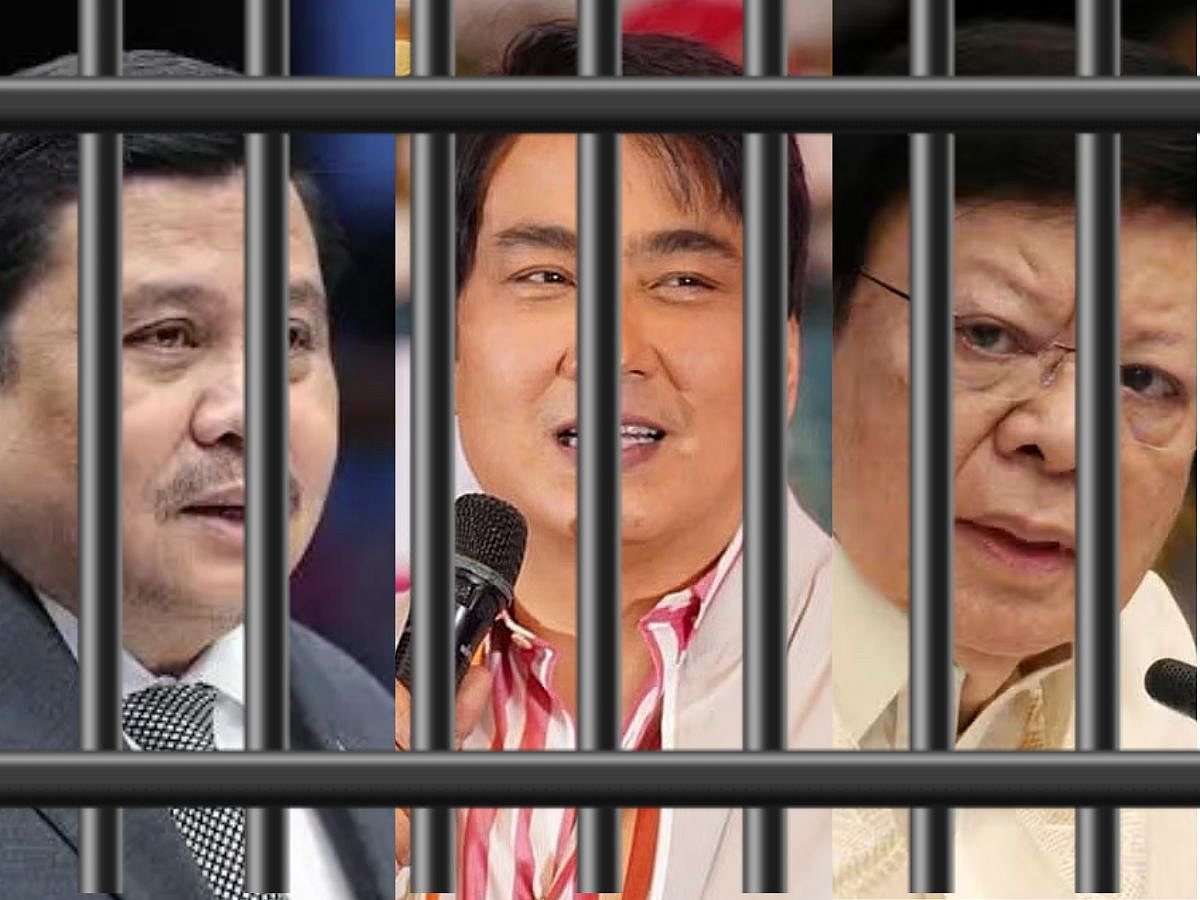
Three Philippine Senators detained for alleged corruption, plunder (from left) Jinggoy Estrada, Bong Revilla (ex-senator), and Rodante Marcoleta.
Gulf News
Manila: The arrest of Sen. Rodante Marcoleta on Monday (July 6) on plunder charges, the detention of Sen. Jinggoy Estrada over alleged flood-control kickbacks, and the earlier imprisonment of former senator Bong Revilla Jr. over the same “tongpats” scheme (and earlier, in the Priority Development Assistance Fund (PDAF) scam) are not isolated stories.
They are chapters in the same book.
The names change.
The allegations evolve — from ghost NGOs to flood-control projects, confidential funds, campaign donations, or procurement anomalies.
Familiar refrain
Yet the script remains painfully familiar.
Lawmakers become associated with public works, and public contracts, then find themselves answering criminal charges.
The question Filipinos should ask is NOT why another senator has been arrested.
The question is this: why does the Philippine's system keeps creating the conditions for these scandals.
In Marcoleta's face, he's facing a non-bailable plunder charge before the Sandiganbayan over the alleged nondisclosure of ₱75 million (about $1.2 million) in campaign donations received during the 2025 senatorial elections.
On Monday (July 6, 2026), the Sandiganbayan found "probable cause", denied his motions to dismiss the case, and issued a warrant for his arrest.
According to the Ombudsman, Marcoleta allegedly received ₱75 million in campaign "donations" from three individuals, then failed to disclose the amount in his Statement of Contributions and Expenditures (SOCE) filed with the Commission on Elections.
He also failed to declare the funds in his Statement of Assets, Liabilities and Net Worth (SALN). Marcoleta also allegedly retained or concealed the unused campaign funds instead of reporting them as required by law.
Under Philippine law, the Ombudsman argues that the alleged concealment of the money constitutes, because the amount involved exceeds the ₱50 million threshold under the Republic Act #7080.
Breeding ground for scams
The Constitution was never designed for legislators to become builders of roads, distributors of farm equipment, financiers of local projects, de facto public works secretaries.
Election laws mandate campaign contributions to be properly reported.
Article VI of the post-dictator 1987 Constitution vests Senators and Congressmen with legislative power.
The principal role of these two chambers (bicameral system) is to enact laws, appropriate funds through the national budget, and oversee the Executive — not to choose which bridge gets built, which drainage canal is repaired, or which municipality receives a sports complex (or a mental institution that's never used).
The Executive, under Article VII, is tasked with implementing the budget.
That separation is not a technicality.
It is a constitutional safeguard against exactly the kind of political patronage that has repeatedly engulfed Congress.
It's not enough to call lawmakers 'buwaya' (crocs)
Yet over decades, that line blurred.
The most notorious example was the Priority Development Assistance Fund (PDAF), better known as the "pork barrel".
It's not enough for Filipino taxpayes to call Congressmen who thrive on government kickbacks as "buwaya". It's an insult to the reptiles; at least their skin can be turned into designer bags.
Not so with the scammers.
Under PDAF, senators and representatives effectively nominated projects and beneficiaries for hundreds of millions of pesos each year.
Why is this foul?
This arrangement gives lawmakers extraordinary influence over spending, while allowing executive agencies to release the funds.
In 2013, the Supreme Court of the Philippines declared PDAF unconstitutional in the landmark Belgica v. Executive Secretary ruling.
Separation of powers
The Court held that lawmakers could not participate in identifying projects after the General Appropriations Act (GAA) had been enacted. The reason: doing so violated the Constitutional separation of powers.
Many celebrated the decision as the death of the pork barrel. It was not.
The system adapted.
Today, the labels are different: "budget insertions", congressional allocations, locally funded projects, assistance-to-local-government programmes.
Different name, same scam
What disappeared was the official name. What survived was the political culture.
Infrastructure became particularly attractive because concrete is difficult to audit.
A school can be inaugurated three times.
A flood-control project can be funded repeatedly.
A road can be widened, reblocked every election cycle.
Costs can be inflated through variations, change orders, or procurement arrangements hidden from ordinary taxpayers.
Unlike education or healthcare outcomes — which can be measured by learning metrics or survival rates — many infrastructure projects are judged by ribbon-cuttings rather than long-term public value.
That is why public works have repeatedly surfaced in corruption investigations.
The Commission on Audit (COA) has, year after year, flagged unfinished projects, idle infrastructure, poor planning, unsupported disbursements, and billions of pesos in audit observations across national agencies and local governments.
The problem is not that infrastructure is inherently corrupt.
The problem is that infrastructure offers enormous discretion over contracts involving enormous sums of money.
That discretion becomes politically valuable when lawmakers influence where projects go.
How other countries did it
Other democracies have confronted similar temptations.
The United States once embraced congressional "earmarks," allowing legislators to direct spending toward projects in their districts.
After widespread criticism over waste and favouritism, Congress imposed a moratorium in 2011.
While a limited and far more transparent form of earmarking later returned, key tweaks were made to improve transparency:
Requests must now be publicly disclosed
Lawmakers must certify they have no financial interest, and
The projects are subject to detailed scrutiny.
In the UK, Members of Parliament do not receive discretionary infrastructure funds to distribute.
Public investment decisions are largely driven by government departments, local authorities, and independent appraisal processes rather than legislators choosing individual projects.
South Korea dramatically strengthened its anti-corruption framework after a series of political scandals by empowering independent prosecutors, digitizing procurement, and expanding transparency through electronic government procurement systems that reduce opportunities for political intervention.
Singapore took an even stricter path.
Ministers and legislators face some of the world's toughest corruption enforcement under the Corrupt Practices Investigation Bureau, while procurement rules sharply limit political discretion over public contracts.
None of these countries eliminated corruption. They reduced opportunities for it.
That distinction matters.
Put out the fire before it burns the house
Philippine anti-corruption policy has often focused on catching offenders after billions have already disappeared.
Far less attention has been devoted to redesigning institutions so that fewer opportunities arise in the first place.
The legal framework is already substantial.
The Constitution declares that public office is a public trust.
Republic Act No. 3019 criminalises corrupt practices by public officials.
Republic Act No. 7080 defines plunder and punishes the accumulation of ill-gotten wealth amounting to at least ₱50 million.
Republic Act No. 6713 requires asset disclosure and ethical conduct ("Code of Conduct and Ethical Standards for Public Officials and Employees").
Republic Act No. 9184 established competitive bidding rules intended to cut favouritism.
Why scandals continue
Yet scandals continue.
Here's why: Laws cannot overcome the culture of incentives that reward political control over spending.
For taxpayers, the consequences extend beyond stolen money.
Every peso diverted to an overpriced flood-control project is a peso unavailable for classrooms, hospitals, disaster preparedness, or lowering the national debt.
Here's the real, though hidden, cost of corruption:
Contractors anticipating kickbacks inflate bids.
Delays increase financing costs.
Poor-quality projects require repeated repairs.
Investors perceive higher political risk (and go elsewhere, i.e. to neighbouring countries).
Jobs go away
Citizens pay more (via overpriced projects) — and receive less (via lemons).
The burden ultimately falls not on politicians but on ordinary Filipinos who finance government through taxes, inflation, and public borrowing.
Real reform requires more than arrests.
What the Philippines needs
The detention of another senator may satisfy the public's desire for accountability.
While it's a step in the right direction, accountability after the money is gone is not enough.
The Philippines does not merely have a corruption problem.
It has an incentive problem.
It has a whistleblower problem.
More to it, the country's laws are painfully lacking in terms of legal protections for insiders who boldly call out wrongdoing).
Whistleblower protection, which the Philippines currently lacks, is considered a fundamental standard in developed countries.
If we badly want bad infrastructure and stay in the poverty rut, while our neighbours see better days, then that's all we're going to get.
All we must do is ignore whatever the Senators and Congressmen are doing the people's money, and hope -- one day -- they will be enlightened enough to do the right thing.
Forgive when scammers are caught red-handed? And join those who ask: What about scammers?
Yes, indeed, what about them? But that doesn't mean we ignore those who are already caught red-handed, or worse, vote them back to office come next election season.
Until our people have a change of heart and mind, until lawmakers stop controlling the flow of public money — and voters stop rewarding them for doing so — the next corruption scandal is not a matter of if.
It is a matter of when.
And flow of Filipinos to greener pastures away from home will simply continue.
Network Links
GN StoreAbout Gulf NewsTerms & ConditionsReach by GNSitemapContact usPrivacy PolicyGN FocusHave your sayWork with usAdvertise with usGulf News epaperPrinting Services
Download our app
© Al Nisr Publishing LLC 2026. All rights reserved.