Property developer Filinvest said the 6,000 sqm land handed over to the Department of Transportation (DOTr) will facilitate construction of the Bicutan Station, a critical interchange linking the 147-kilometer North-South Commuter Railway (NSCR) and the upcoming Manila Subway, potentially bumping up property values in the area.
Video: Tunnel breakthrough marks engineering feat in $7-billion Manila Subway project
Manila Subway tunnel borer smashes through wall at Q. Avenue Station in engineering first
Last updated:
4 MIN READ
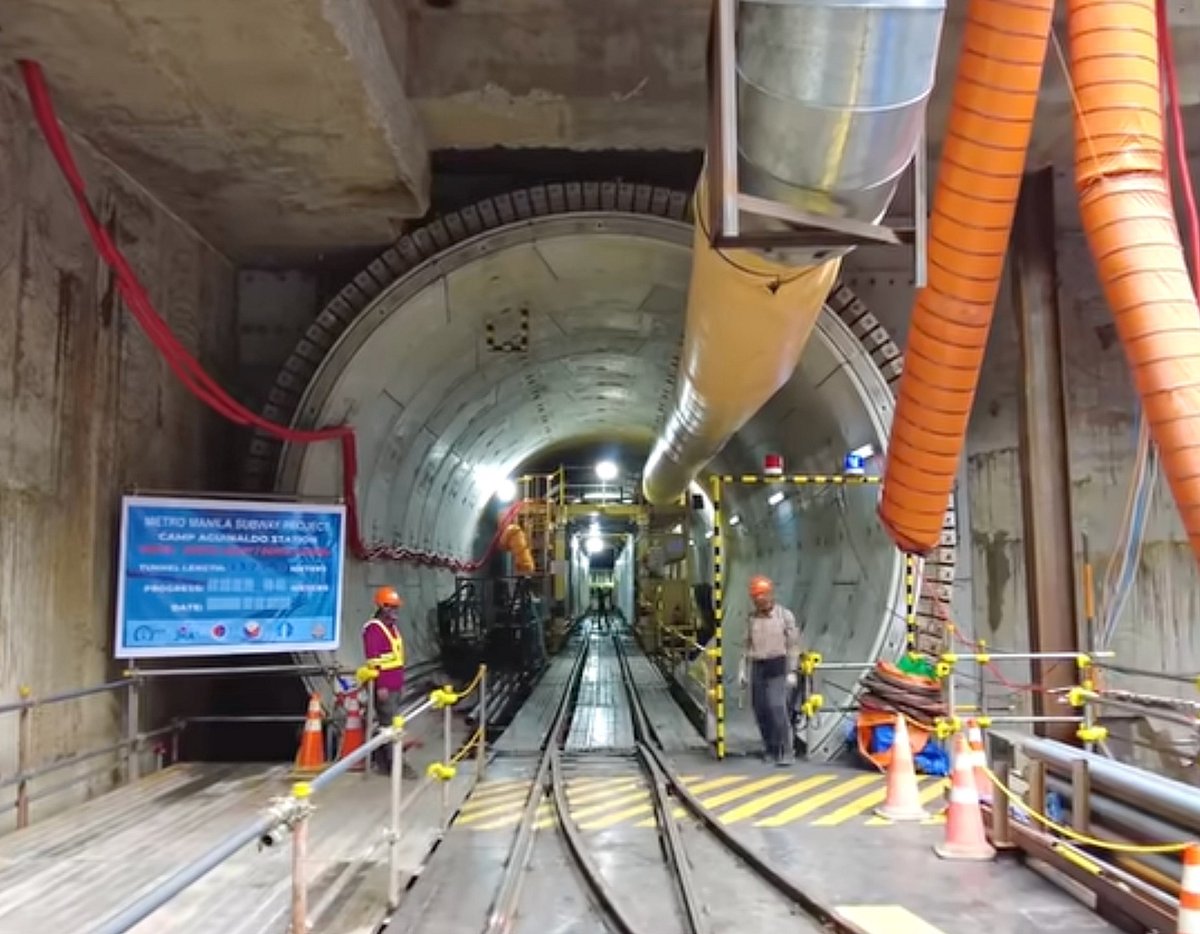
Work in progress: A Manila Subway tunnel leading to the Camp Aguinaldo Station. After years of delays, land disputes and pandemic setbacks, the Metro Manila Subway is beginning to resemble the backbone of a new transportation network. But the country's most ambitious rail project still faces a race against time.
Sumitomo Corp | DoTr
Manila: The $7-billion Manila Subway Project has hit a new milestone dubbed an engineering first in the country when a giant tunnel boring machine (TBM) broke through a concrete "diaphragm wall".
The move marks the completion of a southbound tunnel segment from North Avenue Station in Quezon City, under the project's "Contract Package 102".
It marks a new phase during the construction of the 36-km line, the Philippines' first "tube" system, slated to have 17 stations.
Get it: Fast, verified news for FREE ... download the Gulf News app — simply click here
The wall was built with fiberglass rebar instead of conventional metal rebar, allowing the TBM’s cutterhead to pass through cleanly without unnecessary damage, an engineering decision that has drawn attention online.
The breakthrough
The TBM, part of the Nishimatsu-DMCI Joint Venture (NDJV), broke through the diaphragm wall at Quezon Avenue Station, a key node in the underground rail line that will run from Quezon City to Taguig via Ninoy Aquino International Airport (NAIA).
The 1.12-km tunnel segment is one of several being constructed under Contract Package 102, which runs the North Avenue to Quezon Avenue stretch.
Fiberglass rebar
Glass Fiber Reinforced Polymer (GFRP), widely known as "fiberglass rebar", is being heavily utilised in the subway project.
It serves as a modern, high-performance alternative to traditional steel bars in critical underground segments.
The use of fiberglass rebar is an engineering innovation: it is used in the tube's "diaphragm wall", and is a notable technical choice.
Conventional metal rebar (or reinforcing steel bar, RSB) would have required the TBM to cut through steel, risking damage to the cutterhead and slowing progress.
Fiberglass, being non-metallic, allowed the TBM to bore through the wall cleanly, reducing wear and maintenance costs while maintaining structural integrity during construction.
Why fibreglass rebar is used in the Manila Subway
In the Metro Manila Subway infrastructure (such as in Contract Packages like CP102 and CP103), fiberglass rebar is specifically integrated into the concrete diaphragm walls ("D-walls") of station boxes and connecting tunnel segments.
By reinforcing the exact breakthrough zones of diaphragm walls with fibreglass rebar (often called a "soft-eye"), the massive TBMs can chew directly and cleanly through the wall without damaging the machine's expensive cutting tools.
This was demonstrated during the TBM breakthrough at the Quezon Avenue Station.
Interconnecting interoperability zones
It is being laid in critical connecting nodes, such as the ₱23.9-billion Contract Package S-03B connecting the underground Food Terminal Inc. (FTI) Station and the subway lines.
The project is partly funded by a $2.5 billion loan from the Japan International Cooperation Agency (JICA).
President Ferdinand Marcos Jr. visited the Quezon Avenue Station on 25 September 2026 to witness the event
Funding
The Metro Manila Subway Project, funded largely by a $2.5-billion loan (official development assistance, or ODA) from the Japan International Cooperation Agency (JICA), alongside counter-funding from the Philippine government.
In March 2026, the Philippines secured an additional ¥220 billion Japanese yen (₱84 billion) — the fourth tranche — from JICA to fund civil works, electromechanical systems, and rolling stock.
President Marcos Jr. has also ordered the release of ₱44.17 billion from unprogrammed appropriations to expedite the subway and the North-South Commuter Railway (NSCR).
In the 2027 budget, the proposed National Expenditure Program allocates ₱67.44 billion specifically for Phase 1 of the MMSP to fast-track its construction timeline.
The line will have 17 stations, with travel time from Quezon Avenue to FTI in Taguig and extending to Ninoy Aquino International Airport. It is the Philippines’ first underground rail system.
Manila Subway Project Cost: Estimated at approximately ₱488.48 billion. JICA finances roughly 75.9% of the project cost through multi-tranche time-sliced ODA loans while Philippine government share covers the remaining 24.1%.
President Ferdinand Marcos Jr recently toured the breakthrough site alongside leaders of Nishimatsu Construction Co., Ltd. (NCC) and D.M. Consunji, Inc. (DMCI), the partners under NDJV.
The visit underscored the government’s push to accelerate infrastructure delivery under the “Build Better More” programme, with the subway seen as a flagship project to decongest Metro Manila’s roads and improve connectivity.
What’s next
With the southbound tunnel from North Avenue to Quezon Avenue complete, work will continue on the northbound tunnel and subsequent segments toward the project’s target completion in 2029 for the first phase (North Avenue to BGC).
Full completion of the line to NAIA Terminal 3 and FTI is expected by 2031.
Bicutan becomes a mega hub
One of the project's biggest developments came recently when property developer Filinvest Land Inc. turned over a 6,000-square-metre parcel in Bicutan to the Department of Transportation (DOTr), removing a key right-of-way (ROW) obstacle for what is expected to become one of Metro Manila's busiest railway interchanges.
The station is designed to connect the Metro Manila Subway with the North-South Commuter Railway (NSCR), allowing passengers from Bulacan and Central Luzon to transfer directly onto the subway toward Bonifacio Global City, Ortigas, Quezon City and other major destinations.
Filinvest also plans to build an elevated pedestrian link connecting the future station to its adjacent commercial property, illustrating how developers are beginning to redesign projects around future rail access.
Network Links
GN StoreAbout Gulf NewsTerms & ConditionsReach by GNSitemapContact usPrivacy PolicyGN FocusHave your sayWork with usAdvertise with usGulf News epaperPrinting Services
Download our app
© Al Nisr Publishing LLC 2026. All rights reserved.