Protesters take part in a rally as they demonstrate against corruption following the revelations over bogus flood control projects, one of the country's biggest corruption scandals in decades, at the People Power Monument in Quezon City, Metro Manila on September 21, 2025.
Romualdez, Marcos' cousin, faces ₱7.4b plunder case: Why the filing puts one of Philippines’ most powerful politicians under unprecedented legal pressure
Plunder case thrusts Marcos cousin into a high-stakes test of Philippine justice
Last updated:
7 MIN READ
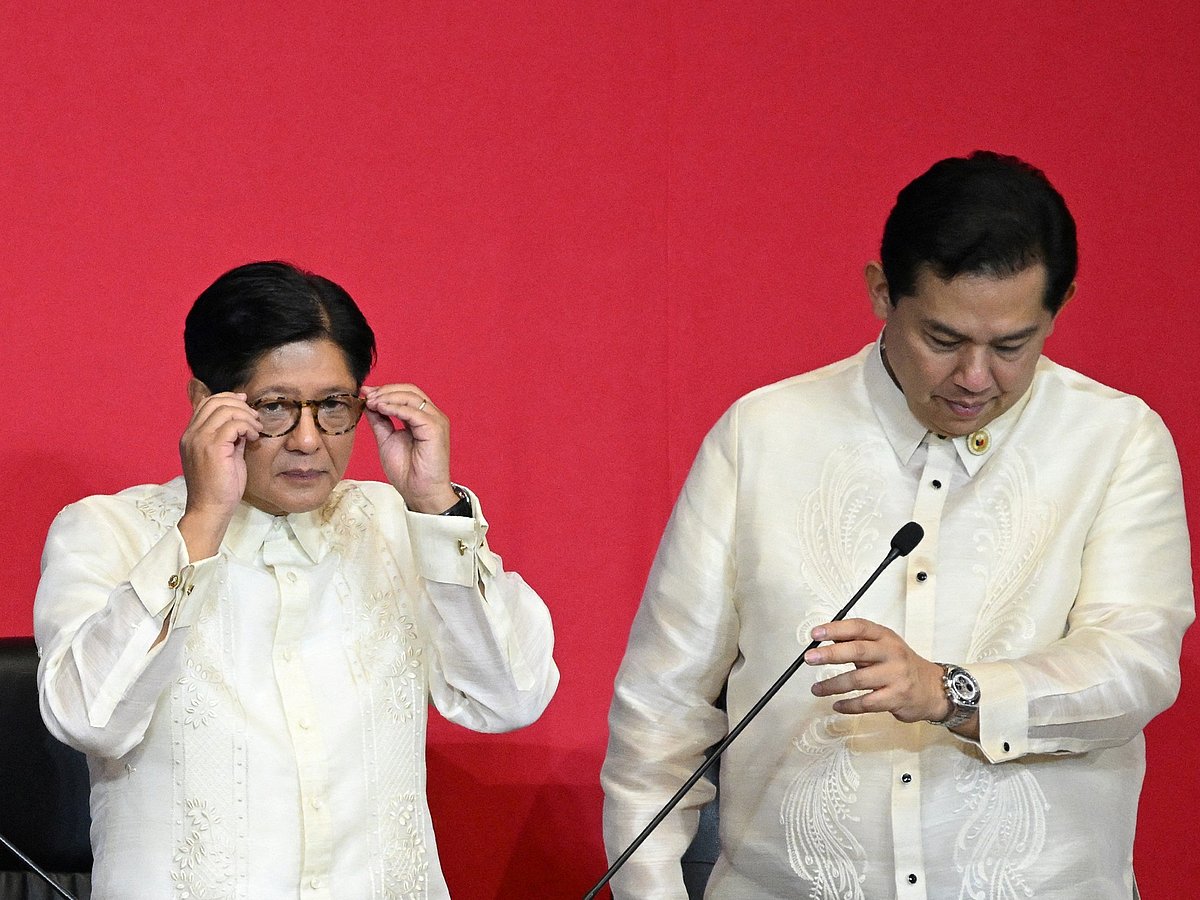
File photo: Philippine President Ferdinand Marcos (left) and former Speaker of the House Martin Romualdez, the president's cousin, in the upper rostrum after delivering his speech during the State of the Nation Address at the House of Representatives on July 28, 2025.
AFP
MANILA: The Philippine Ombudsman has filed a ₱7.4 billion ($117.9 million) plunder case against former House Speaker and incumbent Leyte Rep. Ferdinand Martin Romualdez.
It's an exceptionally serious charge.
It escalates a sprawling corruption investigation into flood defences that has already shaken the country's political establishment.
The case was filed Monday before the Sandiganbayan, the Philippines' anti-graft court, against Romualdez, former Ako Bicol party-list lawmaker Elizaldy Co and two other respondents.
The court has since raffled the case to its Third Division, which will determine whether there is probable cause to issue arrest warrants. No arrest warrant had been issued against Romualdez as of Monday.
Get it: Fast, verified news for FREE ... download the Gulf News app — simply click here
Ombudsman officials said the ₱7.4 billion figure covers alleged bribes, anomalous budget insertions and project allocations.
The broader investigation has alleged that Romualdez and Co participated in a scheme that could have generated roughly ₱56 billion in ill-gotten wealth from infrastructure projects between 2022 and 2025.
Romualdez has repeatedly denied wrongdoing, saying he had no role in demanding or receiving kickbacks.
His lawyers have questioned the credibility of witnesses and have argued that allegations against him have been politically motivated.
Major escalation
The filing is nevertheless a major escalation.
It moves the Romualdez investigation from an executive-branch inquiry into the judicial process, placing one of the country's most powerful political figures in a courtroom proceeding where prosecutors must establish probable cause and, eventually, prove their allegations beyond reasonable doubt.
Who is Martin Romualdez?
Romualdez, 62, is not simply another member of Congress.
He is the first cousin of President Ferdinand Marcos Jr. and comes from one of the Philippines' most politically and commercially powerful families.
He represented Leyte's 1st District and served as Speaker of the House of Representatives from July 2022 until September 2025, when he stepped down amid mounting scrutiny over the flood-control controversy.
He remains a congressman.
His political influence is closely intertwined with the country's economic elite.
Romualdez is the son of the late Benjamin "Kokoy" Romualdez, the powerful Leyte politician, businessman and brother of former first lady Imelda Romualdez Marcos.
That family connection makes Martin Romualdez both a member of the Marcos political dynasty and heir to the broader Romualdez business network that developed during and after the Marcos era.
Romualdez's background is not exclusively political.
Protesters take part in a rally as they demonstrate against corruption following the revelations over bogus flood control projects, one of the country's biggest corruption scandals in decades, at the People Power Monument in Quezon City, Metro Manila on September 21, 2025.
From lawyer and banker to politician
Before becoming a major political figure, Romualdez worked as a lawyer and banker.
His corporate interests have historically included banking, mining, real estate and other investments.
A 2008 House disclosure reported that Romualdez had investments worth about ₱378.9 million in 14 corporations, with holdings spanning banking and mining companies as well as real estate and food businesses.
His declared net worth at the time was about ₱477.2 million.
He also became deeply involved in the affairs of Equitable PCI Bank, where he served as chairman during the 2000s.
That connection became controversial because the bank held shares that had been the subject of a long-running government "sequestration" dispute involving the Romualdez family.
Government investigators alleged that some of the disputed assets were beneficially owned by Benjamin "Kokoy" Romualdez, although ownership questions were litigated for years.
That history is important because it illustrates how the Romualdez family's political influence and corporate interests have overlapped for decades.
The Benguet Corp. connection
One of the most consequential corporate links is Benguet Corporation, the country's oldest mining company.
Founded in 1903, Benguet began as the Benguet Consolidated Mining Company and became one of the Philippines' most important gold and mining enterprises. It eventually expanded into gold, chromite, copper, nickel and other mineral interests.
Its history became intertwined with the Marcos-Romualdez family during "Martial Law".
Before the Marcos era, Benguet had substantial American ownership.
But the restructuring of foreign-ownership rules under Marcos — including limits on foreign participation in natural-resource industries — changed the company's ownership structure.
Historical accounts say Benjamin "Kokoy" Romualdez, Imelda Marcos' brother, emerged as the dominant Filipino figure in Benguet, with the Romualdez family's stake eventually reaching a majority
The Philippine Supreme Court later dealt with government efforts to recover shares allegedly beneficially owned by Benjamin Romualdez.
In one major case, the Presidential Commission on Good Government, or PCGG, had sequestered 16.2 million Benguet shares registered to Palm Avenue Realty Development Corp. and Palm Avenue Holding Co.
The government alleged that the companies were controlled by Benjamin Romualdez.
The Sandiganbayan subsequently upheld the sequestration of a separate block of Benguet shares associated with the Romualdez family.
Benguet Corp was not merely a company in which the Romualdezes invested. It became one of the central corporate assets around which the family's economic power was built.
A flood-hit community in the Philippines following heavy rains dumped by a storm. Ghost flood-control projects, overpricing and kickbacks in government projects had been exposed by on-going investigations, in an elaborate scam involving lawmakers, government engineers, private contractors and state auditors working like a syndicate.
Where Martin fits into Benguet
Martin Romualdez himself was a significant Benguet shareholder for years.
Global Witness, citing his financial disclosures, says Romualdez was a significant shareholder in Benguet from 1991 through at least 2008, while his brothers also held senior positions in the company.
The family's relationship with Benguet has continued across generations.
Benguet's corporate leadership included members of the Romualdez family, including Benjamin Philip Romualdez and Daniel Andrew Romualdez.
The Philippine Stock Exchange notes that the Romualdez family took over the company's helm in the 1980s and that Martin Romualdez attended the company's 75th anniversary event in 2024.
Current ownership disclosures show a more complicated structure involving the Romualdez family, RYM Business Management Corp. and other shareholders.
Why Benguet matters to the Romualdez story
The Benguet history provides an important window into the family's evolution from a political clan into a political-business dynasty.
The family's corporate interests have historically intersected with:
Mining, particularly Benguet and other mineral companies;
Banking and finance, including the Equitable PCI Bank controversy;
Media, including the family's Journal Group interests;
Real estate and investment companies;
More recently, mining and natural-resource ventures connected to certain companies.
Global Witness, in an investigative report titled "Power, corruption and reprisals in Philippine nickel mining", released in December 2025 has reported corporate links between RYM Business Management Corp., Benguet and Marcventures-related companies, while also noting that Martin Romualdez was a significant Benguet shareholder for many years.
The flood-control scandal changes the stakes
The current investigation occurrs against the backdrop of an unusually powerful political-business network.
In February, 18 men identifying themselves as former security personnel, claimed they delivered cash from allegedly anomalous flood-control projects to personalities including Romualdez, President Marcos and Zaldy Co.
The allegations were explosive, but they were allegations — and several of the men later recanted their statements.
The Ombudsman has nevertheless said it has additional evidence and witnesses.
By July, Ombudsman Jesus Crispin Remulla said the case against Romualdez was "very close" to filing and said investigators believed they had evidence sufficient to proceed.
On Monday, the government finally crossed that threshold.
Why Monday's court filing is significant
The biggest significance is institutional.
For months, the Romualdez controversy existed primarily as an investigation, political battle and public war of competing allegations.
The filing changes that.
#1. The case is now before an independent judicial forum
The Ombudsman has filed the case with the Sandiganbayan. The court, not the Ombudsman, now controls the judicial proceedings.
The case has been assigned to the Sandiganbayan Third Division, which must determine whether "probable cause" exists for arrest warrants.
That does not mean Romualdez has been found guilty.
It means prosecutors have formally accused him and must now persuade the court that the case should proceed.
#2. It tests the government's "no sacred cows" claim
Remulla explicitly said the case demonstrates that prosecutors are not selecting whom to investigate based on political power.
That is particularly important because Romualdez is the president's cousin and, until last year, was one of the most powerful figures in Congress.
If the case proceeds, it will be a major test of President Marcos' repeated promise that the flood-control scandal would be pursued regardless of political connections.
#3. It puts the Marcos-Romualdez political alliance under pressure
Romualdez was arguably the administration's most important congressional power broker.
His fall from the speakership in 2025 following convulsions on Manila streets filled with anti-corruption protesters, was already politically significant.
A criminal prosecution takes the issue much further.
It raises questions about whether the administration can simultaneously maintain political stability, defend the president's family relationship with Romualdez and demonstrate that its anti-corruption campaign is genuinely independent.
#4. It brings the political-business nexus under a brighter spotlight
The case will inevitably revive scrutiny of the Romualdez family's long corporate history — including the family's relationship with Benguet, banking interests and mining investments.
Iit explains why scrutiny of Romualdez extends beyond his years in Congress: he represents a political family whose influence has historically extended deep into Philippine corporate life going back to the Martial Law years.
5. Plunder is an exceptionally serious charge
Under Philippine law, plunder involves the accumulation of ill-gotten wealth of at least ₱75 million through a combination or series of criminal acts and carries a potential penalty of life imprisonment.
The charge is therefore qualitatively different from an ordinary graft complaint.
If the Sandiganbayan finds "probable cause", Romualdez could face an arrest warrant and the case could move toward trial.
But a criminal charge is not a conviction. The prosecution still has to prove its case in court.
Also In This Package
Philippines: Sen. Estrada surrenders amid plunder case
Philippines: Cayetano bro offers info on ghost projects
Philippines: Court orders arrest of lawyer Baligod
Philippines: Why was Senator Marcoleta arrested
Philippines: 3 Senators detained — more arrests soon?
Philippines: Ombudsman charges Marcoleta with plunder
The bigger picture
The flood-control scandal has already become one of the most consequential corruption investigations of the Marcos administration.
The government has said that thousands of projects worth hundreds of billions of pesos are under scrutiny, amid allegations that some projects were defective, overpriced, duplicated or never built.
The scandal has already claimed political careers.
Now it has reached Martin Romualdez — a former House speaker, incumbent congressman, Marcos cousin and member of one of the Philippines' most powerful political-business families.
Sign up for the Daily Briefing
Get the latest news and updates straight to your inbox
Network Links
GN StoreAbout Gulf NewsTerms & ConditionsReach by GNSitemapContact usPrivacy PolicyGN FocusHave your sayWork with usAdvertise with usGulf News epaperPrinting Services
Download our app
© Al Nisr Publishing LLC 2026. All rights reserved.