A queue for overseas workers at the Manila Airport Terminal 3.
EXPLAINER
Flying to the Philippines from the UAE? Know the COVID-19 test, quarantine rules
COVID-19 travel guidelines cover testing, quarantine and authority of local government
Last updated:
7 MIN READ
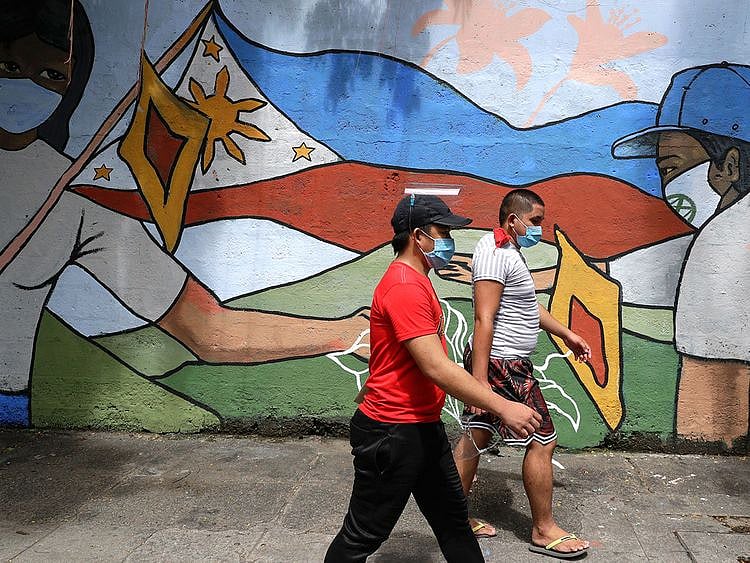
People wearing protective masks to prevent the spread of the coronavirus walk past a mural showing a Philippine flag and Filipinos wearing masks in Manila, Philippines.
AP
Highlights
- Mandatory RT-PCR for new arrivals COVID-19
- Rules on pooled testing include OFWs, means results may come sooner, but this may be offset by spike in volume of travellers due ot Christmas holidays
- Travel guidelines cover citizens, tourists
- Rules on testing, isolation, quarantine and authority of local government units laid down
DUBAI: Strict quarantine measures await Filipinos citizens, including overseas workers (OFWs) and tourists, flying to the Philippines for the Christmas holidays. December is "most wonderful time of the year" when a huge number of Filipinos traditionally make their journey home to be with loved ones. But this Christmas and New Year celebrations will be unlike any other in recent memory, due to COVID-19.
First off, mandatory a RT-PCR test will be done on every person flying into the major airports in the country (Manila, Cebu, Davao, Clark). A negative PCR test result is usually out in two to three days. However, an expected spike in the volume of travellers may affect waiting times, though pooled testing measures in place may make things more efficient.
And since no test is 100% accurate all the time, given the number of testing devices and kits being introduced now in the market, Philippine health authorities remain vigilant, as 2,152 new cases were recorded Saturday (November 7, 2020), bringing the total to 396,000, with 362,000 recoveries and 7,539 deaths.
The Philippine Department of Health (DOH) is updating recommendations on appropriate diagnostic tests for public use. "Knowledge of diagnostic tests for severe acute respiratory syndrome coronavirus 2 (SARS-CoV-2) is still evolving, and a clear understanding of the nature of the tests and interpretation of their findings is important," the department stated in an October 6, 2020 memorandum.
Local government rules for tourists, citizens
People travelling for tourism purposes will be asked to comply with the requirements of each local government unit (LGU). This usually includes testing, registration, and confirmed bookings prior to travel or even in coordination with a travel agency. Costs of quarantine and screening testing for these endeavors shall be borne by international and local tourists.
File photo shows a scene at the Ninoy Aquino International airport. COVID-19 travel guidelines cover testing, quarantine and authority of local government
Pooled testing covers OFWs
Philippine health authorities are currently evaluating and validating pooled-testing measures, based on which the guidelines may change, depending on results from new developments that may ensue from the studies and implementation. OFWs are currently considered among the pooled testing target.
Under current DOH rules, pooled testing may be done among asymptomatic persons belonging to the targeted populations, including:
Overseas Filipino workers (OFW) stranded due to reduced flights await updates on travel arrangements at a temporary shelter set up in a school in Pasay City, Metro Manila, the Philippines, on Monday, June 15, 2020. The Philippines will keep its capital under loose restrictions, allowing most businesses to continue operating even as coronavirus cases rise.
Pooled testing: 5 samples per batch
Use of a pool sample of five (5) is recommended to be used, until an accurate prevalence of cases with the presence of SARS-CoV-2 is identified in the population. Laboratories that will conduct pooled testing are als mandated to develop guidelines and procedures for the purpose of pooled testing in accordance with the recommendations of local studies on pooled testing.
Interim rules
The rules may still change, depending on Philippine authorities as well as local authorities in each province or town. The October 6 memoradum only provides interim guidelines on surveillance, screening, contact tracing, quarantine or isolation, and testing as part of the COVID-19 response. "These guidelines are subject to change as new evidence comes in," the memorandum stated.
Minimum public health standards, which include physical distancing, hand hygiene, cough etiquette, and wearing of masks among others, shall be strictly implemented across all settings, regardless of severity of risk.
Workers wearing personal protective suits disinfect escalators, as part of measures aimed at preventing the spread of the coronavirus, in a mall in Manila on Tuesday. More than 1 million overseas Filipino workers (OFWs) could be out of work by next year as the world economy continues to slump due to the coronavirus disease (COVID-19) pandemic, analysts and officials warned on Tuesday, June 9, 2020.
Contact tracing
Contact tracing shall be initiated after case investigation of every reported probable and — confirmed COVID-19 case. Close contacts shall refer to persons who has experienced any one of the following exposures during the 2 days before and the 14 days after the onset of symptoms of a probable or confirmed case (WHO Public Health Surveillance for COVID-19, 7 Aug 2020):
Clinical assessment is be the basis for quarantine or isolation.
Isolation vs quarantine: What's the difference?
Philippine health authorities have also stresssed on the difference between isolation and quarantine. Isolation refers to the separation of sick people with a contagious disease from people who are not sick. Therefore, isolation intends to treat and monitor suspect, probable, and confirmed cases. On the other hand, quarantine refers to the separation and movement restrictions of people who were exposed to a contagious disease to see if they become sick. Hence, quarantine intends to keep individuals under observation to see if they will develop COVID-19 signs or symptoms orifthey will test positive for COVID-19.
According to the DOH October 6, memorandum, all close contacts of probable and confirmed cases, and travelers shall be placed under quarantine. In the event that they develop symptoms or test positive for COVID-19, they shall be isolated and shall be admitted and treated in the appropriate facility.
Confirmed cases
Moreover, all suspect, probable, and confirmed cases shall be isolated in the proper facility depending on the severity of symptoms. Asymptomatic confirmed and mild cases shall be admitted and isolated in Temporary Treatment and Monitoring Facilities (TTMFs). Moderate cases shall be isolated and managed in Level 1 or Level 2 hospitals. Severe and critical cases shall be isolated and managed in Level 2 or Level 3 hospitals.
Provincial quarantine
In many provinces, home quarantine is still not allowed within 3 days upon arrival in that province. It may be allowed later, but under strict conditions, following a negative RT-PCR test, for example. Every province may have different quarantine rules, so it pays to know these rules before travelling.
Health authorities have invoked police powers in order to safeguard the community from COVID-19 transmission that may overwhelm the healthcare system's ability to repond.
Hotline
Every quarantine facility has a hotline, so a traveller must also know the hotline or point person for clarifications or appropriate action. In general, following are the quarantine rules at provincial quarantine centres.
Warning
Rules on personal items
a. Receiving personal belongings and cooked food from outside will only be accepted from 9am to 10.30am and from 3.30pm to 4.30pm. Any items sent to you outside the aforesaid time will be not be accepted, unless you are new to the facility.
b. Snacks sent to you by family members should be sent in the morning.
c. Items sent to you will be received from 11am to 12 noon, and from 5pm till 6pm.
Toilet rules
Personal belongings
Attitude
Network Links
GN StoreAbout Gulf NewsTerms & ConditionsReach by GNSitemapContact usPrivacy PolicyGN FocusHave your sayWork with usAdvertise with usGulf News epaperPrinting Services
Download our app
© Al Nisr Publishing LLC 2026. All rights reserved.