Manila officials seek to woo global technology giants — including Apple, Nvidia, Taiwan Semiconductor Manufacturing Co. and Qualcomm — to establish advanced manufacturing operations at the planned hub in New Clark City, about 100km north of Manila.
Apple, Nvidia, TSMC on Philippines wish list as New Clark City eyes ‘Silicon Valley’ future
US, South Korean, Singaporean, Taiwanese investors courted for New Clark City
Last updated:
5 MIN READ
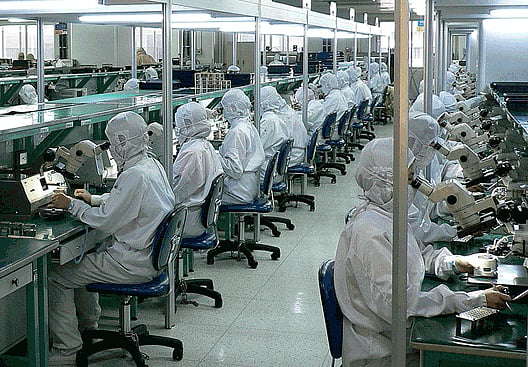
Electronic industry workers in the Philippines. Currently, integrated circuits and microchips account for roughly 73% of the Asian country's electronics manufacturing exports ($50b in 2025), serving major global supply chains for computers, smartphones, and AI infrastructure, according to an industry report.
File
Manila: The Philippines is preparing to court some of the world’s biggest technology companies — including Apple, Nvidia, Taiwan Semiconductor Manufacturing Co. and Qualcomm — to locate advanced manufacturing operations at the planned Pax Silica "hub" in New Clark City (NCC), about 100km north of the capital.
The 1,619-hectare development in Tarlac is being positioned as the foundation of a wider Philippine tech corridor that could link chip design in Metro Manila, critical minerals in Mindanao, artificial-intelligence (AI) data centres in Batangas and digital infrastructure on the Pacific coast.
The Philippines is not new to chips manufacturing.
The Asian nation generates about ~$50 billion/year exporting semiconductor components and devices, particularly electronic integrated circuits and microchips.
This category accounts for roughly 73% of the local electronics manufacturing sector, and serves major global supply chains for computers, smartphones, and AI infrastructure, according to an industry report.
As of late 2026, the US-led Pax Silica alliance consists of 25 signatory nations, including Australia, Japan, South Korea, India, Singapore, Israel, the UAE, and the UK aimed to safeguard advanced technology ecosystems.
Global tech giants targeted
Bases Conversion and Development Authority President and CEO Joshua Bingcang said the government plans to approach major technology firms once the New Clark City ecosystem and its master agreement with US counterparts are in place.
The government’s initial wish list includes:
| Company | Why it matters |
|---|---|
| Apple | One of the world’s largest electronics brands, with extensive global supplier networks |
| Nvidia | Leading designer of AI chips and accelerated-computing platforms |
| TSMC | World’s largest contract chip manufacturer and a central player in advanced semiconductors |
| MediaTek | Major Taiwanese designer of smartphone, connectivity and consumer-electronics chips |
| United Microelectronics Corp. | Taiwanese contract semiconductor manufacturer known as UMC |
| Qualcomm | U.S. designer of wireless, mobile and automotive chips |
| AMD | U.S. designer of CPUs, graphics processors and AI computing chips |
| Broadcom | Major U.S. chip and infrastructure-software company |
“We are going to invite them once the ecosystem is available,” Bingcang said at a forum organized by the Foreign Correspondents Association of the Philippines. “Once the agreement is signed, we’re going to court them together with our private sector partners.”
The strategy is not merely to attract factories. Bingcang said the long-term goal is to move the Philippines beyond being a consumer market or assembly location and toward greater participation in high-value technology production.
“One day, we want to have our own brand,” he said. “The Philippines should have its own brand. We should not just be buyers, but producers of these companies.”
Development could start in 2027
BCDA is negotiating a master agreement with US government counterparts for Pax Silica, which has been presented as part of a broader US-Philippine effort to strengthen secure and diversified technology supply chains.
If the agreement is signed by the target date of November, site development could begin as early as 2027, Bingcang said.
Tech Hub
The facility slated for the Philippines is touted as an AI-native industrial acceleration hub or Economic Security Zone.
Planned across 4,000 acres (1,620 hectares) in Tarlac, within the "Luzon Economic Corridor", the envisioned zone differs from traditional economic or data-hosting parks.
It would operate under a specific design framework tailored for the next generation of supply chain resilience.
It aims to be a purpose-built environment where specific industrial operations are directly shaped by real-time market demand and the collective geopolitical needs of the Pax Silica network.
Rather than serving a single company, it functions as a multi-jurisdictional platform for friendly nations.
The full project is a long-term undertaking.
BCDA has previously said complete development may take up to 30 years, while the first locators could begin arriving within three to five years of the project’s start.
The agency estimates Pax Silica could generate P180 billion in government income and create as many as 190,000 jobs over the project’s lifetime.
Pax Silica is an ambitious tech, manufacturing and critical minerals hub set to be located next to Clark International Airport about 100km north of Manila. The Philippines is a major producer of natural but critical minerals like nickel, most of it is exported to China where it's processed and re-exported as finished products (EV batteries, stainless steel).
Why other countries are interested
While Pax Silica is central to Washington’s technology and supply-chain push, the BCDA said it does not intend to limit New Clark City to US investment.
Bingcang said the agency is in preliminary discussions with at least three other countries about industrial developments in the area.
South Korea is planning to lease at least 250 hectares in New Clark City.
Singapore is targeting a larger 300-hectare site.
Taiwan is also considering a land lease in the area.
Other countries: Developments led by other countries may be smaller than Pax Silica but could still support the broader advanced-manufacturing ecosystem.
“We want to assure that we’re not just limiting the option to one country,” Bingcang said. “There are other opportunities.”
New Clark City was master-planned for industrial and advanced-manufacturing uses, giving the government a large development footprint at a time when countries are competing for semiconductor, electronics, AI and clean-technology investments.
Location map of Lima Estate, as it intersects the Luzon Economic Corridor (LEC), which represents the Philippines’ largest economic "engine", accounting for approximately 50% of GDP. The LEC offers a compelling platform for economic growth, supported by targeted fiscal and non-fiscal incentives, a skilled, English-proficient workforce, and opportunities to integrate into regional and global supply chains.
The Philippine technology corridor
Pax Silica is designed as the first link in a larger national industrial plan.
| Location | Proposed role |
|---|---|
| New Clark City | Pax Silica advanced-manufacturing and technology hub |
| Metro Manila | Integrated-circuit design hub, with Muntinlupa identified as a possible location |
| Mindanao | Minerals corridor supplying inputs for advanced manufacturing |
| Batangas | AI-compute data centers, cloud services and digital infrastructure |
| Casiguran, Aurora | “Pax Pacifica” hub for subsea cables, digital trade, edge infrastructure and logistics |
Trade Undersecretary Ceferino Rodolfo has said Muntinlupa is being considered for the integrated-circuit design hub because of its access to academic institutions and technology-industry talent.
Mindanao, meanwhile, would be expected to support the corridor with minerals and materials essential to electronics, batteries and advanced manufacturing.
Batangas is being positioned for energy-intensive AI-compute data centers and cloud infrastructure, while Casiguran could serve as a Pacific-facing digital gateway under the proposed Pax Pacifica initiative.
The proposed Pax Silica industrial and tech hub in the Philippines covers an area of 4,000 acres, which is equal to about 1,619 to 1,620 hectaresl. It is planned within New Clark City in Tarlac, 1 hr by car north of Manila, as part of the Luzon Economic. The hub is designed as an AI, semiconductor, critical minerals and advanced manufacturing economic security zone.
The real challenge
The Philippines’ ambition faces serious execution tests.
Winning commitments from companies such as TSMC, Nvidia or Apple’s suppliers will depend on more than available land.
Investors will assess reliable and competitively priced electricity, water supply, ports, airports, fiber connectivity, skilled engineers, regulatory certainty, customs efficiency, environmental permitting and the ability to protect sensitive technology.
Network Links
GN StoreAbout Gulf NewsTerms & ConditionsReach by GNSitemapContact usPrivacy PolicyGN FocusHave your sayWork with usAdvertise with usGulf News epaperPrinting Services
Download our app
© Al Nisr Publishing LLC 2026. All rights reserved.