Thatta, Pakistan: Pakistani troops and workers were on a "war footing" on Sunday as they battled to save the deserted southern city of Thatta after most of the population of 300,000 fled the advancing flood waters.
Torrential monsoon rains have triggered massive floods that have moved steadily from north to south over the past month, engulfing a fifth of the volatile country and affecting 17 million of its 167 million people.
Southern Sindh is the worst-affected province, with 19 of its 23 districts ravaged as flood waters swell the raging Indus river to 40 times its usual volume.
A million people have been displaced over the past few days and hundreds of thousands have already fled Thatta alone ahead of the approaching torrents as soldiers work frantically to repair breached levees on the river.
"The water is still two kilometres away from Thatta where the armed forces and the local administrative workers are working on war footing to save the city," senior city official Hadi Bakhsh Kalhoro told AFP on Sunday.
"The army brought a maximum of resources to try to fill up the breach. Almost all the people have left Thatta to safer places, all shops and schools are closed," he said.
Water levels were still rising in the district, but "We are hopeful that we can save at least Thatta city in two days," he said.
The Pakistani government has been overwhelmed by the magnitude of the disaster, the worst in the country's history, with millions in need of tents and food.
But Sindh home minister Zulfiqar Mirza said people were reluctant to go to relief camps because they feared there would not be enough supplies.
"People are not going to relief camps because they're afraid of the lack of food and medicine there," he told reporters on Saturday.
"In Karachi we've set up a camp for 40,000 people, but so far not a single (displaced person) has turned up there," he said.
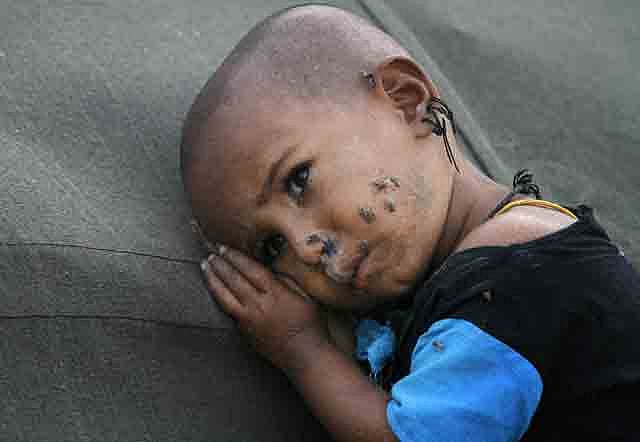
Aid agencies are worried about the growing danger of malnutrition and water-borne disease, with children especially vulnerable.
Oxfam warning
Oxfam warned Sunday that reconstruction efforts must begin immediately to prevent the disaster from becoming a long-term catastrophe.
The British-based international charity said billions of dollars would be needed to start rebuilding schools, roads, bridges and hospitals immediately, adding that the aid effort was struggling to respond.
"One month into a crisis we would expected the situation to have stabilised and the long-term planning to have begun," Neva Khan, Oxfam's country director in Pakistan, said in a statement.
"But we are still in phase one of an increasing catastrophe, evacuating people, providing them with shelter, trying to get clean water and sanitation to those people who need it.
"Pakistan doesn't have the luxury of waiting for the emergency phase to be over before starting the reconstruction."
At the massive Kotri barrage embankment which protects the southern city of Hyderabad, engineer Qadir Palijo said Sunday that water levels were falling.
"The water is slowly receding in Kotri but still increasing down in the south (towards Thatta). The process of recession of the water is slow but we hope the pace will increase in a couple of days," he told AFP.
Pakistan's worst humanitarian disaster has left eight million dependent on aid for their survival and has washed away huge swathes of the rich farmland on which the country's struggling economy depends.
The government has confirmed 1,600 people dead and 2,366 injured, but officials warn that millions are at risk from food shortages and disease.
The United Nations has warned that 800,000 people in desperate need of aid had been cut off by the deluge across the country, and has appealed for more helicopters to deliver supplies to those reachable only by air.
Sign up for the Daily Briefing
Get the latest news and updates straight to your inbox
Network Links
GN StoreDownload our app
© Al Nisr Publishing LLC 2026. All rights reserved.