People visit a market to buy kites to celebrate upcoming three-day kite flying festival in Lahore.
Punjab set to celebrate Basant after 18 years: Kites fly again, rooftops booked for millions
Families reunite on decorated rooftops as the festival returns under tight safety curbs.
Last updated:
3 MIN READ
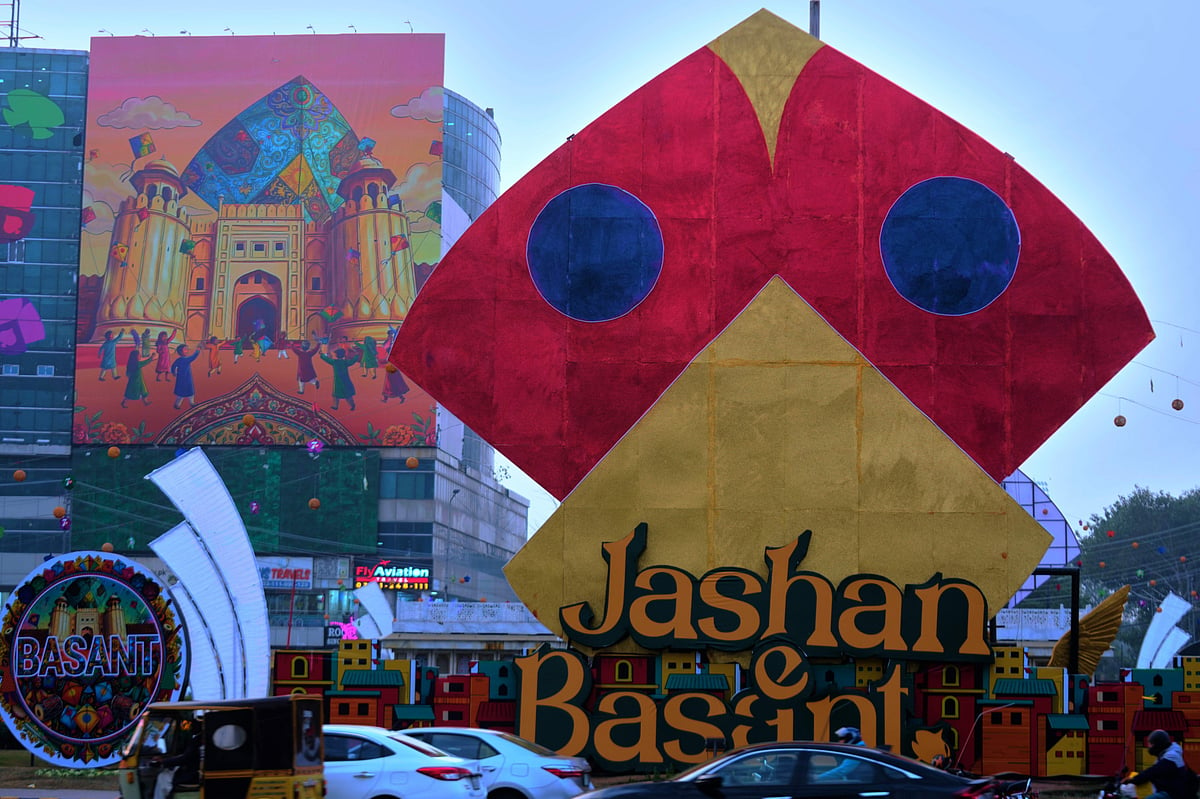
A giant kite model placed by local administration to celebrate upcoming three-day kite flying festival in Lahore.
AP
Dubai: After nearly two decades of silence in the skies, the colourful whirl of kites is set to return to Punjab, bringing with it excitement, nostalgia and a festive buzz many residents feared they might never witness again.
Basant will be celebrated in Lahore from February 6 to 8 under tight restrictions after the Punjab government lifted the long-standing ban on the festival, according to Dawn. While celebrations remain limited to the provincial capital, authorities have allowed the manufacture of permissible kite-flying material in four additional districts — Faisalabad, Kasur, Multan and Sheikhupura — to meet soaring demand ahead of the much-anticipated comeback.
Strict safety rules are in place, allowing only cotton string while banning metallic thread and oversized kites. Manufacturers have been asked to register through deputy commissioners and the provincial e-Biz digital portal to ensure compliance.
Across Lahore, preparations have taken on a life of their own.
Rooftops booked for Basant — at a price
Prime rooftops in central Lahore rented for Rs2.1 million to Rs5.5 million for three days
Popular areas include Mochi Gate and Rang Mahal
Only spacious, structurally safe rooftops approved
Many rooftops fully decorated with lights, colours, food arrangements and searchlights for night kite flying
Historic neighbourhoods such as Mochi Gate and Rang Mahal are once again bursting with colour, crowded markets and rooftop celebrations, according to The Express Tribune. Walls are being painted yellow, lights and searchlights installed for night-time kite flying, and rooftops transformed into festive gathering spots.
Families are turning the occasion into reunions, inviting relatives and friends after years apart. Elder residents are teaching children how to control kites — many youngsters experiencing Basant for the first time in their lives after growing up during the ban years.
Traditional kite makers, whose livelihoods nearly vanished during the long hiatus, say the festival’s return has brought renewed hope and income. Small food vendors across inner Lahore are also seeing a surge in business, selling sweets, snacks and cold drinks late into the night.
Pakistanis hold kites on their way to celebrate the festival Basant in Lahore.
Households are preparing elaborate menus featuring barbecue, malai boti, sweets such as ladoos and gajrela, treating the three-day celebration almost like a wedding feast.
Despite soaring prices — with premium kite thread selling for as much as Rs15,000 — enthusiasm remains undimmed. Some families are pooling money together to afford supplies, saying Basant’s return after 18 years is worth every rupee.
Authorities insist safety will remain the priority. Dilapidated rooftops have been barred, loud music and fireworks prohibited, and kite flying restricted near sensitive areas including airports. Law enforcement agencies have been directed to act swiftly against violations, while some neighbourhoods have even organised volunteers to monitor rooftop safety.
For many Lahoris, the return of Basant is about far more than flying kites.
It is about reclaiming a cultural memory, reviving traditions lost for nearly two decades, and bringing colour, laughter and community spirit back into everyday life.

A Senior Associate Editor with more than 30 years in the media, Stephen N.R. curates, edits and publishes impactful stories for Gulf News — both in print and online — focusing on Middle East politics, student issues and explainers on global topics. Stephen has spent most of his career in journalism, working behind the scenes — shaping headlines, editing copy and putting together newspaper pages with precision. For the past many years, he has brought that same dedication to the Gulf News digital team, where he curates stories, crafts explainers and helps keep both the web and print editions sharp and engaging.
Sign up for the Daily Briefing
Get the latest news and updates straight to your inbox
Network Links
GN StoreAbout Gulf NewsTerms & ConditionsReach by GNSitemapContact usPrivacy PolicyGN FocusHave your sayWork with usAdvertise with usGulf News epaperPrinting Services
Download our app
© Al Nisr Publishing LLC 2026. All rights reserved.